Australian GP 2019: Hamilton Pole, Ferrari 0.7s Off the Pace
Lewis Hamilton edged Valtteri Bottas by a tenth for pole at Albert Park, but the real story of Saturday was how far Ferrari fell and how far a teenager in a McLaren rose.
The lights on the timing tower told a story nobody in the paddock had scripted. Ferrari arrived at Albert Park as the team many expected to trouble Mercedes in 2019, yet when the flag fell on Saturday it was Lewis Hamilton and Valtteri Bottas locking out the front row and Sebastian Vettel staring at a gap of over seven tenths. Somewhere further back, a 19-year-old on his first competitive Saturday in Formula 1 was busy stealing the undercard.
This was supposed to be close. It wasn't. Hamilton's pole lap tells only half of it; the shape of the whole session, from the Ferraris' underwhelming pace to Red Bull nearly losing a car in Q1, is the more interesting document.
Qualifying at Albert Park always carries a season-opener's nervous energy, everyone guessing at pecking order from testing times that lie as often as they tell the truth. Track temperatures pushed toward 38 degrees under dry skies, conditions that put a premium on getting tyres into their window without cooking them, and it was that balancing act, more than raw horsepower, that separated the contenders from the pretenders through Q1 and Q2.
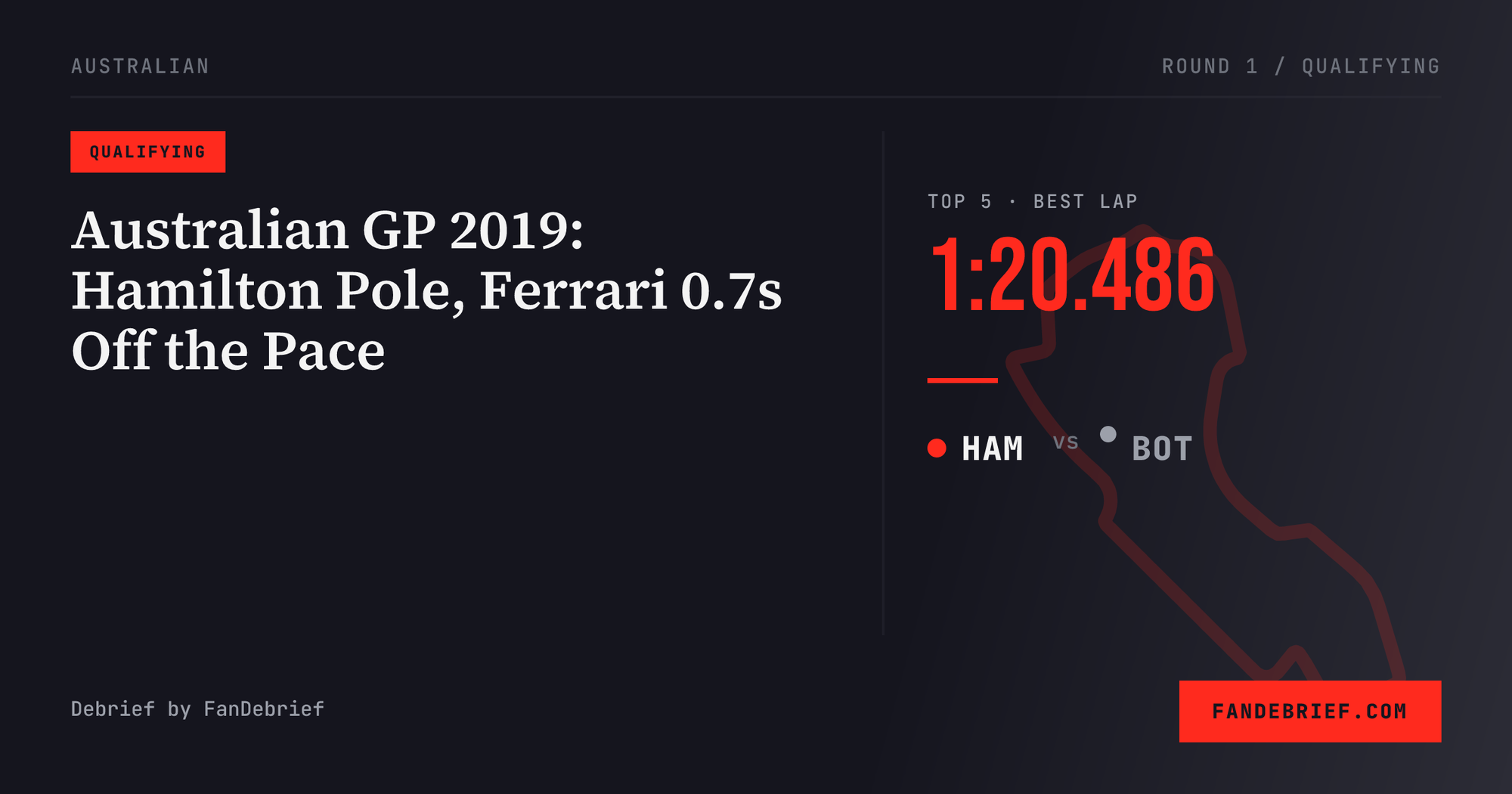
Hamilton's answer to the pressure was a 1:20.486, a new benchmark for the circuit, and it came with him only two hundredths clear of Bottas after the first runs before he found the extra tenth that mattered. The margin over Bottas was a slender 0.112 seconds, close enough to feel like a coin flip, but the gap that really defined the top of the sheet was the one behind it: Vettel's Ferrari was 0.704 seconds adrift in third, comfortably beaten not just by both silver cars but nearly matched by Max Verstappen's Red Bull in fourth, just 0.13s further back. With many having believed that Mercedes and Ferrari were nip-and-tuck going into the session, it was a tough showing for the Scuderia, and Charles Leclerc's fifth place, 0.956s off pole on his Ferrari debut weekend, only reinforced how comprehensively that pre-season narrative got torn up.
What made the gap sting more was where it showed up. Hamilton's advantage over the field was concentrated at the corners that matter most on this lap, the tight opening sector and the fiddly final chicane complex: he set the fastest sector-one time on six of the laps recorded across the session, and the fastest sector-three time on seven, each by a margin sitting around three tenths. Bottas, by contrast, made his money in the middle sector, topping that split five times by an average of over a second when he had it, evidence that both Mercedes cars were finding time in different parts of the lap rather than one simply carrying a blanket advantage. Ferrari, for all their power-unit reputation, could not match either car through the twisty middle sector or the run to the flag.
There's a neat irony sitting in the speed traps: Hamilton's pole lap didn't come from having the fastest car in a straight line. His best trap speed of 319 km/h ranked only eighth quickest of the whole field, behind cars that had long since been eliminated, Alexander Albon, Antonio Giovinazzi and Sergio Perez all clocked 322 km/h at various points in the session. Pole at Albert Park, a circuit built around a mix of medium-speed corners and fast sweeps rather than long straights, was won through cornering efficiency, not top-end pace, and Mercedes' rivals never worked out how to close that gap.
The other half of the story wore a McLaren
While the front of the grid played out along familiar lines, Q1 delivered the session's genuine shock. Red Bull's new signing, Pierre Gasly, was eliminated at the first hurdle, ending up 17th, a staggering 1.700 seconds off his own teammate Verstappen's fastest lap despite driving the same car. Red Bull chose to only make one run in the first segment of Melbourne qualifying, and going into the final minutes it sat comfortably inside the cut, but improvements from most of the rest of the field pushed them down the order. Verstappen, who took a second run, survived to fight on and eventually split the Ferraris for fourth; Gasly, on a single flying lap, did not, and Red Bull's Saturday split into a best-of-times, worst-of-times story inside one garage.
Lando Norris supplied the other genuine plot twist. The rookie had barely troubled the top ten across practice, yet he strung together enough of a lap to reach Q3 on his first Formula 1 Saturday, eventually classifying eighth, quicker than the Alfa Romeo of Kimi Raikkonen and the Racing Point of Sergio Perez. He finished up P8 in his debut qualifying performance, a moment the 19-year-old planned to treasure, after surprising even himself with his display in Melbourne. The gap between Norris and pole tells its own story about where the last of that lap was lost: Hamilton's final sector alone was 0.815 seconds faster than Norris's best, the fast chicane complex proving exactly where a rookie loses time that a six-time Melbourne polesitter does not. His teammate Carlos Sainz, by contrast, didn't make it out of Q1 at all, eliminated 18th, a reminder that McLaren's Saturday was built on one exceptional lap rather than a genuinely quick car.
Behind the top ten, Haas topped the midfield fight, Romain Grosjean's P6 sitting just over a tenth clear of teammate Kevin Magnussen, while Nico Hulkenberg edged Daniel Ricciardo in an early skirmish between the Renault pair that neither converted into a Q3 place. Robert Kubica's return to the grid ended where it began the weekend, at the very back, over five seconds off pole, the kind of gap that says everything about where Williams stood on this particular Saturday.
The forward look here writes itself from the season's own history at this circuit. In each of the last three years staged at Albert Park, Hamilton has taken pole, yet the race win went elsewhere twice, to Vettel in both 2017 and 2018, and to a Mercedes teammate in 2016. Pole here has never been a guarantee of Sunday's silverware, and with Vettel starting from the exact spot on the grid that delivered him victory twelve months ago, and Verstappen sitting close enough behind the Ferraris to pounce, Sunday's race looks a good deal less settled than Saturday's timesheet suggests.
The data behind qualifying
Timing and telemetry from every car on track.


