Leclerc Beats Vettel and Both Mercedes to Bahrain 2019 Pole
Charles Leclerc beat a four-time champion team-mate and both Mercedes to his first pole, and the lap sheet says he did it in the last five corners, not the long straights.
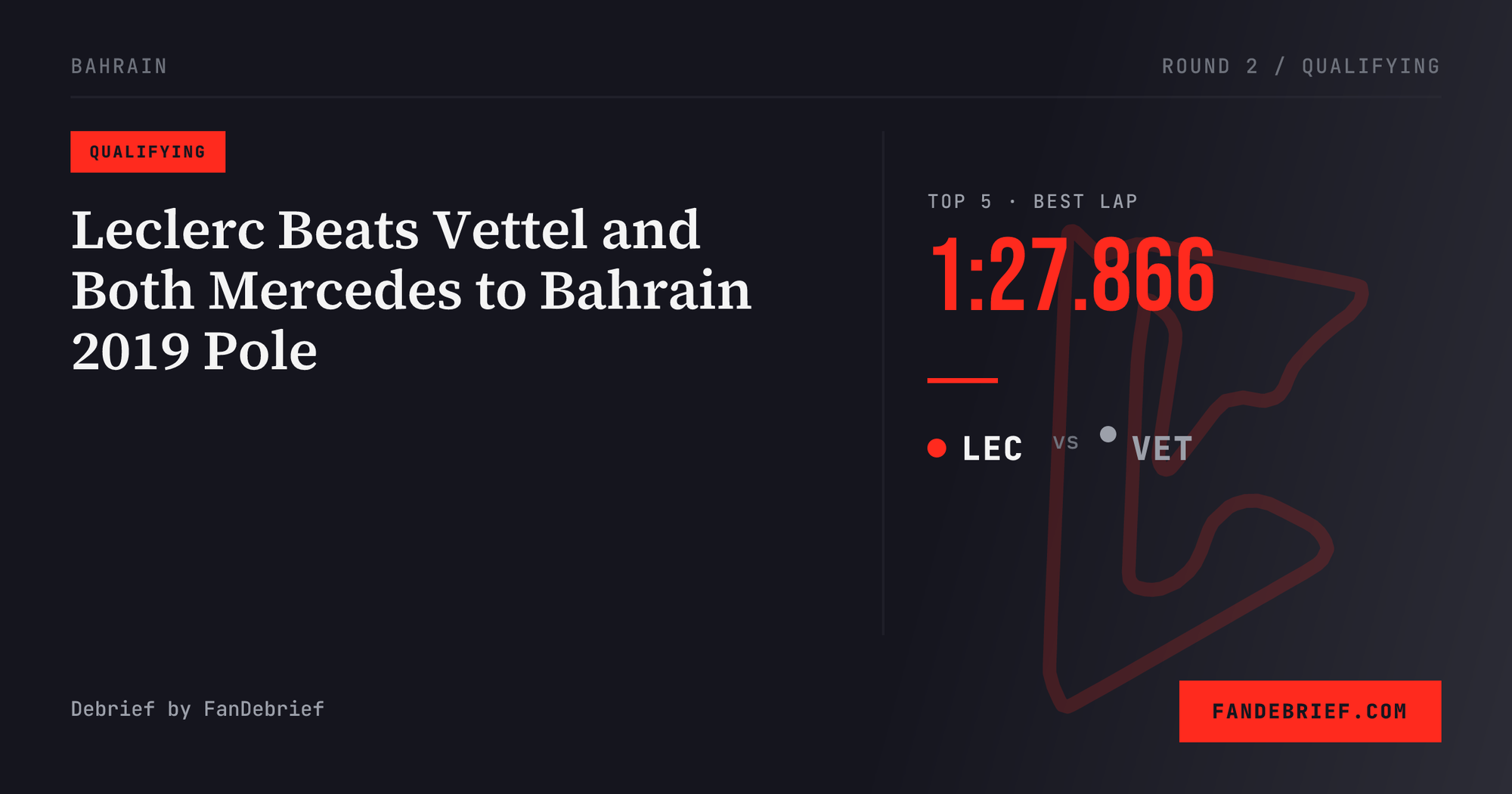
The sun had gone down and the floodlights were fully up by the time Charles Leclerc crossed the line at the end of Q3, and Ferrari's underdog status in 2019 went down with it. He had just taken the first pole of his career, in only his second start for the team, ahead of a team-mate who already had four world titles on his shelf.
The story of this session isn't that Ferrari was fastest. Everyone watching the timing screens through Q1 and Q2 could see that coming. The story is where Leclerc found the time, because it wasn't on the straights that define this circuit.
Mercedes arrived in Sakhir still processing a season-opening sweep at Albert Park, Bottas leading the championship on the back of that win with Hamilton second and pole there, and both Mercedes on the podium. Ferrari, by contrast, sat fifth and fourth in the standings with Vettel and Leclerc chasing. Practice had suggested a gap to close, and depending which account you believed, Ferrari held a real advantage through the sessions. Qualifying settled the argument. Two red cars locked out row one, with Mercedes closing but not nearly enough.
A front row won in the braking zones, not the straights
Leclerc's pole lap beat Vettel by 0.294 seconds, Hamilton by 0.324 and Bottas by 0.390, a top four covered by under four-tenths of a second, tight enough that a driver's confidence into the final corner mattered as much as anything the engine was doing. And that's exactly where the gap opened.
Charles Leclerc took his maiden pole position in only his second race for Ferrari, with his teammate Sebastian Vettel joining him on the front row, ahead of Lewis Hamilton. But look at the speed trap and a contradiction appears: Leclerc secured pole position in his Ferrari, setting a new track record with a qualifying time of 1:27.866, yet his own top speed for the session was only ninth-best on the grid. Vettel and Ricciardo shared the fastest reading of the weekend at 327 km/h; Leclerc never got near it. Ferrari's pole didn't come from raw pace down the straights that define this 5.412km layout, with its heavy braking zones and long full-throttle sections.
It came from sector three, the tight final stretch through Turns 11 to 15. Across the fastest laps logged in the session, Leclerc set the benchmark there five separate times, with an average margin over the rest of the field of more than six tenths of a second, by far the largest sector advantage anyone built anywhere on the lap. Sector one, the heavy braking into Turn 1 and the tight Turn 4 hairpin, actually belonged to Carlos Sainz more often than anyone, the McLaren driver topping that segment five times too. Leclerc's advantage was concentrated exactly where a driver's touch under braking counts for more than horsepower. That's the story behind the record lap: not a Ferrari engine advantage on a power circuit, but a driver extracting time from the corners everyone else thought were a wash.
Vettel's own history at this track made the order sting a little more. He won here from pole in 2018 and took pole again the year before that, so Sakhir has been kind to him. This time his own team-mate simply had more in the final sector than he did, and 0.294 seconds isn't a lot to find back before Sunday.
The data behind qualifying
Timing and telemetry from every car on track.


The midfield fight nobody saw coming
While the front of the grid absorbed the attention, the real drama was buried in the middle of the timesheet. Kevin Magnussen's Haas missed out on matching Verstappen's Red Bull by just five thousandths of a second, the two separated by 1:28.752 to 1:28.757, a gap smaller than a car length at racing speed. Behind them, Sainz, Grosjean and Raikkonen were split by barely two-hundredths across three positions, and Norris rounded out the top ten less than a quarter-second off Magnussen.
Q1's tightest call was more brutal still. Antonio Giovinazzi's Alfa Romeo squeezed through by eight thousandths of a second over Nico Hulkenberg's Renault, a margin too small to see with the naked eye and one that ended Hulkenberg's session before it properly began. It was his own team-mate, Ricciardo, who set the pace that pushed him out, Ricciardo himself then missing Q3 by 0.445 seconds to Norris in tenth.
At Red Bull, the intra-team story ran the other way. Verstappen made Q3 comfortably in fifth, but Pierre Gasly was eliminated in Q2, 0.774 seconds off his team-mate's pace on identical machinery, a gap that's hard to explain away as a scruffy lap. On a track where Red Bull will need every tenth on Sunday, that's the kind of number that gets studied in the debrief.
Ferrari goes into Sunday's race with the two fastest cars on the grid and the confidence of a front-row lockout behind it, but Mercedes closed to within three-tenths having looked further back through practice, and that's not nothing over a full race distance. The bigger question the sector data raises is whether Ferrari's pace is genuinely there everywhere, or whether it's a final-sector trick that a longer run, degrading tyres and traffic will blunt by Sunday evening. Round three in China will tell us plenty about which version of Ferrari just showed up in Bahrain.