Hamilton Wins Bahrain 2019 After Passing Leclerc on Lap 48
Charles Leclerc set the fastest lap of the entire race and led for most of the distance from a maiden pole, yet it was Lewis Hamilton standing on the top step after a lead change on lap 48 turned the result on its head.
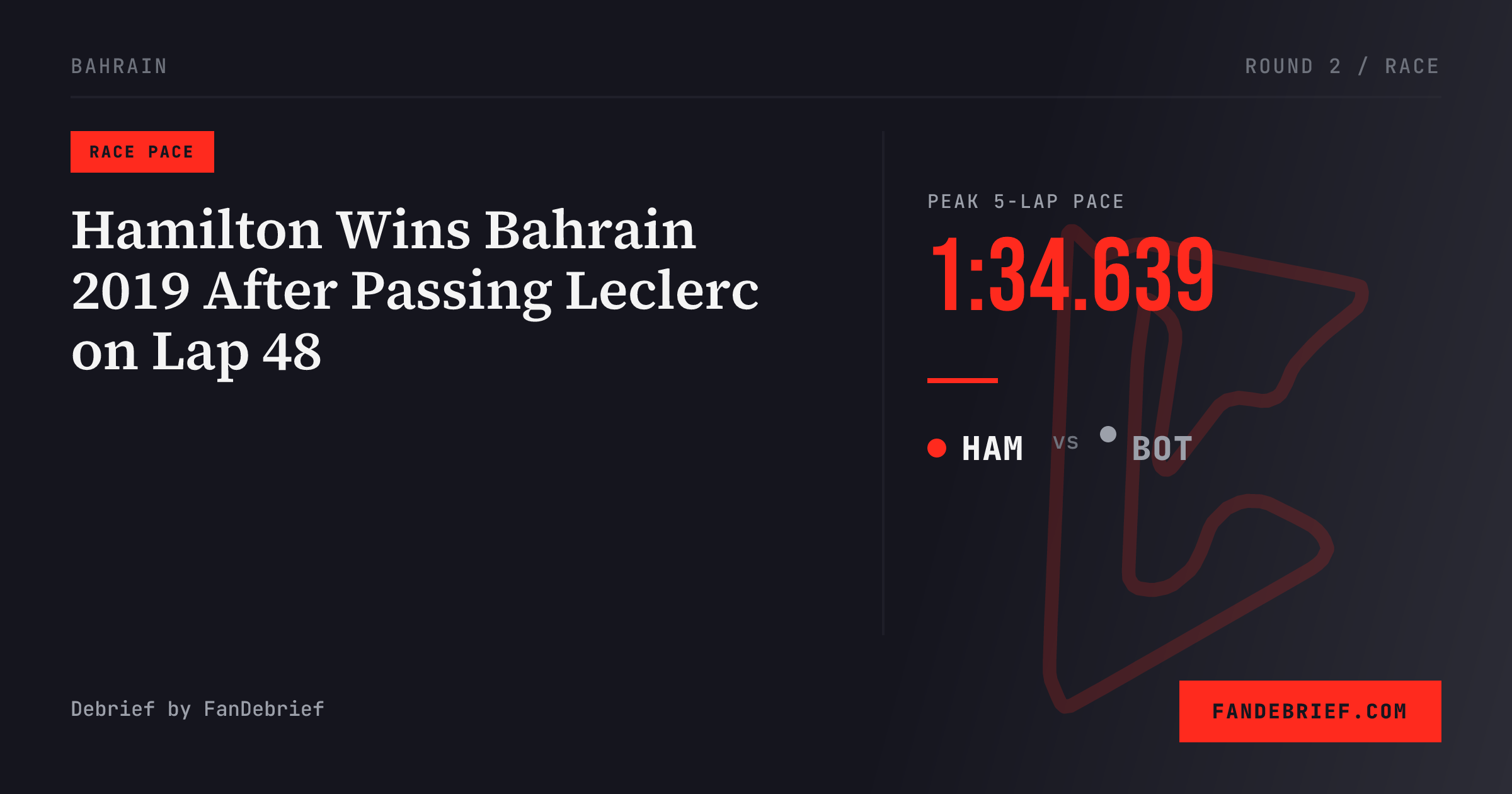
Charles Leclerc spent the best part of an hour and a half doing everything a driver on his maiden pole is supposed to do. He converted a front-row lockout into the race lead inside six laps, controlled the middle sector better than anyone else on the grid all afternoon, and set the outright fastest lap of the entire race. Then, on lap 48, with the chequered flag closer than the start, the lead went to Lewis Hamilton on track, and it never came back.
This is a race about the gap between deserving a result and getting one. Leclerc's pace across the weekend, from a pole time nearly three-tenths clear of his own teammate to a fastest lap that beat Hamilton's best by over a tenth, was the standout number of the session. But Formula 1 doesn't hand out points for who led longest or who lapped quickest once; it hands them out for who's ahead at the flag, and on that measure it was Hamilton's afternoon.
Qualifying had been a Ferrari benefit. Leclerc's 1:27.866 was good enough for his first pole, with Sebastian Vettel three-tenths back in second to complete the lockout. Hamilton and Valtteri Bottas filled row two, three- and four-tenths off the pace respectively, with Max Verstappen's Red Bull over eight-tenths back in fifth. Coming into the weekend, Bottas held the early championship lead on 26 points to Hamilton's 18 after winning the season-opener at Albert Park, where Hamilton had started on pole and finished runner-up in that same podium order behind Verstappen. Bahrain's recent history had leaned Ferrari's way too, with Vettel winning here in both 2017 and 2018, so a red front row felt less like an aberration and more like a continuation.
The pass that decided it
The race itself opened with more churn than the grid suggested was coming. Vettel jumped his own teammate off the line and led before Leclerc reclaimed the position on track by lap 6, the first of four lead changes across the afternoon. Two more followed in the space of a single lap, 14 and 15, as the two Ferraris swapped the position purely through the sequencing of their first pit stops rather than anything happening on the circuit. None of that mattered in the end. What mattered was lap 48, when the lead changed hands for the final time, on track, from Leclerc to Hamilton.
By that stage Leclerc had led for the overwhelming majority of the distance and had banked the fastest sector-2 average of the race, quickest through that section on 19 of the 57 laps with a margin over half a tenth clear of the field on average. He'd also gone on to set the outright fastest lap of the entire grand prix, a 1:33.411 on lap 38, quicker than Hamilton's own best by over a tenth. None of it survived contact with lap 48. Hamilton, who had spent the whole race quietly present rather than visibly dominant, was simply there when the door opened, and Leclerc crossed the line third having led for most of a race he didn't win.
The closing laps added their own twist. Hamilton's advantage over Bottas had swelled past 30 seconds by lap 45, effectively a canter to the flag. Then the retirements of both Renaults on the same lap brought the safety car out on lap 55, bunching the entire field for the run to the chequered flag. What had been a routine one-two turned into a photo finish on paper if nothing else: Hamilton crossed the line just under three seconds clear of his teammate, a gap that had been ten times that size only a few laps earlier. It wasn't Bottas finding pace late; it was the field being squeezed back together by circumstance, and Hamilton having just enough in hand to survive the restart.
Sebastian Vettel's race unravelled in a way the timing sheets only half explain. He started second, needed three pit stops where every other frontrunner needed two, and fell three places to finish fifth. And yet his weighted average race pace across the whole distance was the second-best of anyone on the grid, quicker than Bottas, quicker than Verstappen, quicker than his own teammate who beat him by two positions. Whatever cost Vettel those places, it wasn't a lack of speed in the car; it was time lost somewhere the lap charts don't fully capture, and an extra visit to the pit lane he didn't plan for.
The data behind the race
Timing and telemetry from every car on track.


Norris, the midfield gainers, and a rough night for Renault
Away from the podium fight, Lando Norris produced the tidiest midfield drive of the day. He qualified ninth, executed the fastest pit stop of the entire field on lap 10 at 24.10 seconds, and worked his way up to sixth by the flag, a gain of three places in only his second grand prix start. Pierre Gasly matched that kind of progress from further back, climbing five places from P13 to finish eighth, while Antonio Giovinazzi did the same in the sister Alfa Romeo, up five from sixteenth to eleventh. Sergio Perez and Alexander Albon both profited from the long Bahrain straights too, gaining four and three places respectively to round out the points and just ahead of the top ten.
Not everyone had that kind of day. Daniil Kvyat picked up a five-second penalty for speeding in the pit lane on lap 18 and still salvaged a net gain of three places by the finish, which tells you how much movement there was through the pack. Kevin Magnussen had no such consolation, sliding seven places from sixth on the grid to finish thirteenth, while his Haas teammate Romain Grosjean never got that far, retiring after just 16 laps. Renault's Sunday was the bleakest of the lot: Nico Hulkenberg and Daniel Ricciardo both failed to make the finish, the only team on the grid where neither car saw the chequered flag, and it was their双 retirement on the same lap that triggered the late safety car. Carlos Sainz's McLaren, meanwhile, dropped twelve places to nineteenth after collision damage forced him through four separate pit stops just to get home.
What Bahrain leaves for Shanghai is a straightforward puzzle for Ferrari to solve and a straightforward pattern for Mercedes to protect. Between them, Bottas and Hamilton have now won the first two races of the season, and Ferrari has led both of them at some stage without converting either into victory. Leclerc's raw pace at Sakhir, a pole lap nearly three-tenths clear of his own four-time champion teammate and the outright fastest lap of the grand prix itself, says the car is there. The next question, heading to China, is whether a lead can actually be held to the flag.