Bahrain GP 2018: Vettel Holds Off Bottas by 0.75 Seconds
Sebastian Vettel led every lap that mattered and still had to defend Sakhir's front straight with the lights out, while Lewis Hamilton's climb from ninth quietly out-paced everyone in front of him.
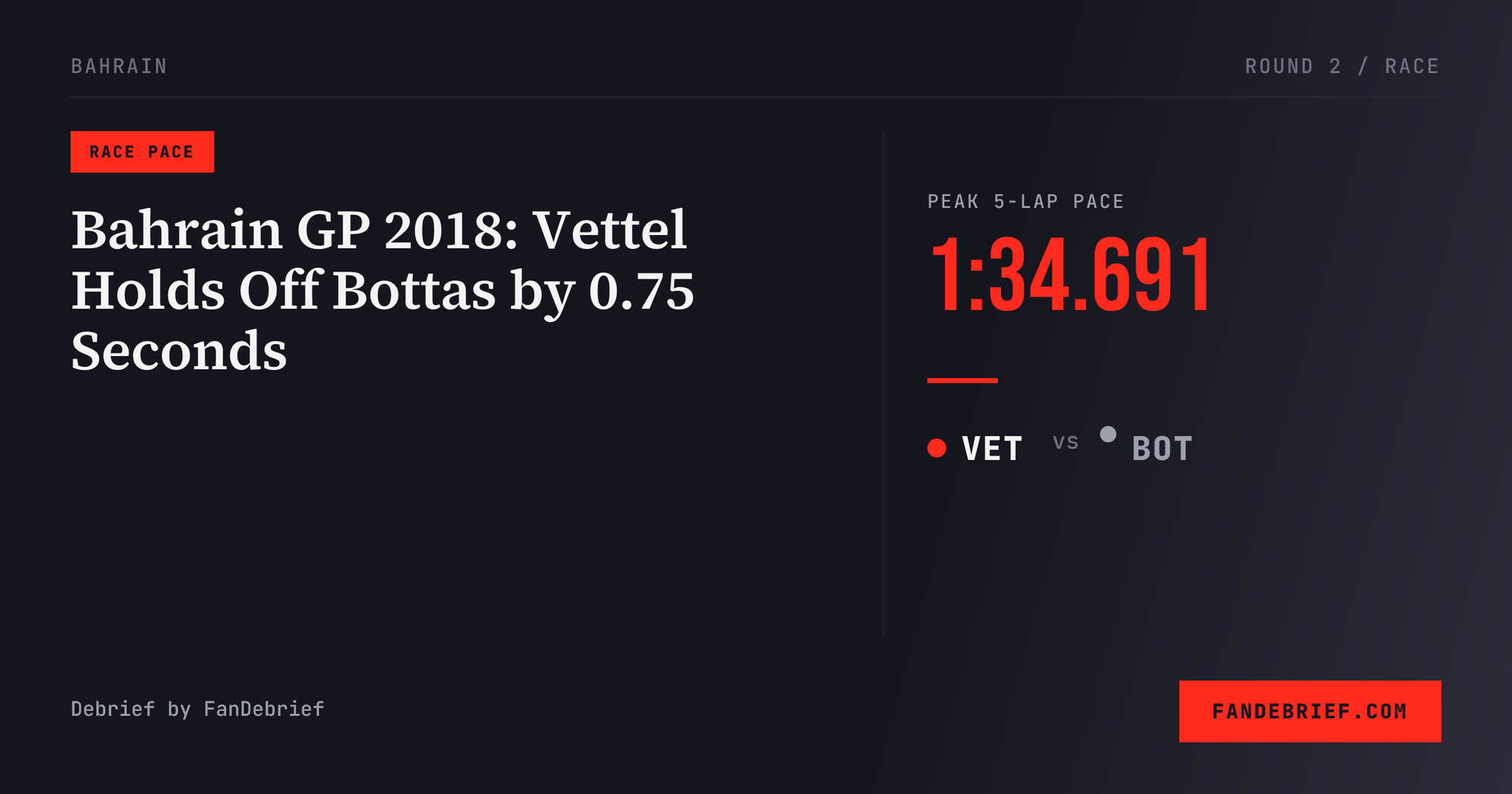
Sebastian Vettel crossed the line at Sakhir with Valtteri Bottas close enough to see in his mirrors without needing to look twice. Three quarters of a second, at the end of 57 laps, is nothing. It's the width of a driver's hesitation on the brakes into Turn 1. And it's exactly the margin that separated a comfortable Ferrari one-two on paper from a genuinely nervy final ten laps that could have gone either way.
This was a race won on lap 17, in the pit lane, and almost lost again on lap 57, on merit. Vettel's strategy call to switch to the soft tyre built him a lead of nearly eight seconds by lap 20. Then it started evaporating, lap by lap, until Bottas was practically alongside him at the flag. The story of this Bahrain Grand Prix is that gap: how it grew, and why it very nearly disappeared entirely.
Vettel had taken pole by a tenth and a half over teammate Kimi Räikkönen, with Bottas third and Hamilton fourth on raw pace. But Hamilton's timesheet position never made it to the grid; a five-place gearbox penalty dropped him from a strong qualifying effort to a day of damage limitation that got progressively worse as the Ferraris looked seriously quick, and he lined up ninth instead of fourth. That single number, P9, would define the shape of everyone's afternoon.
Two Laps, Two Red Bulls, One Disaster
The race barely had time to breathe before it turned. Verstappen, starting fifteenth after his own qualifying trouble, went for a gap into Turn 1 that Hamilton wasn't going to concede, and the contact saw the Red Bull launch up the inside and give Hamilton the squeeze, the two making contact and Verstappen picking up a puncture. He crawled back to the pits, rejoined, and lasted four laps before he was parked. Daniel Ricciardo never got that far; an electrical problem ended his afternoon after just two laps and triggered the Virtual Safety Car that briefly neutralised the field. It was, by any measure, a wretched sequence for Red Bull, their first double retirement since the 2010 Korean Grand Prix, and it meant the front-running story became a straight Ferrari-versus-Mercedes fight rather than the four-way scrap qualifying had promised.
Hamilton, for his part, walked away from the Verstappen contact undamaged and simply got on with the job. Starting on the soft tyre while most of the field around him ran the faster-degrading supersoft, he sliced through the midfield with a plan that looked, in hindsight, close to perfect: stay out, stay patient, let strategy do the passing. By the time he made his own single stop on lap 25, he had inherited the lead through the pit cycle, a lead that lasted precisely long enough for Vettel to catch and repass him.
Because Vettel had gone again already. Ferrari sent him in on lap 17 for a fresh set of softs, the earliest of the three front-runners to change tyres, and the on-track gap tells the story of what that bought him. He was 2.8 seconds up on Bottas at the moment he pitted; twenty laps later, on fresher rubber and in clean air, that had stretched to 7.8 seconds. That single stint, laps 20 to 40, was the race.
The data behind the race
Timing and telemetry from every car on track.


Three Quarters of a Second
But a 40-lap stint on one set of tyres always has a sting in the tail, and this is where it got tense. Ferrari's gamble was to run Vettel long on the soft compound rather than switch to the medium; Mercedes did the opposite with Bottas, banking on a tyre that would hold its pace all the way to the flag rather than degrading late. The numbers back up why Bottas was closing: across the race he was the fastest car through the middle sector by nearly four tenths on his best lap, a margin most drivers would take to the bank without a second thought. Vettel's advantage, by contrast, was concentrated in the second sector too, but by fewer laps and by a smaller average margin, and by the closing stages his tyres simply had less left to give.
The gap chart tells you everything you need to know about how the final ten laps actually felt in the grandstands. Seven and a half seconds on lap 40. Five and three quarters by lap 45. Under four by lap 50. By lap 55, Vettel's cushion was down to eight tenths, and it barely grew again before the chequered flag. Bottas simply ran out of road. Two or three more laps and this would have been a different headline entirely; instead it becomes the story of a Ferrari that had done enough, just, and a Mercedes that arrived one lap too late to matter.
Räikkönen never got the chance to make it a three-way argument for the lead. Running third and looking capable of applying real pressure, his second pit stop on lap 34 turned into the low point of Ferrari's afternoon for reasons that had nothing to do with strategy. He was released from his pit box before the left-rear change had been completed, and the tyre, which had not been changed, struck a mechanic's leg and fractured his tibia and fibula as the car pulled away. Räikkönen's race ended there and then, a wheel problem in the literal sense, and the mood on the Ferrari podium afterwards carried the weight of it even as Vettel celebrated his win.
The Midfield Made Its Own Argument
While the headline fight played out at the front, the tyre-strategy story repeated itself lower down the order, and it's worth pausing on. Fernando Alonso ran an extra pit stop compared with Vettel and still posted quicker average race pace, yet finished seventh, six places behind the winner. Kevin Magnussen did the same trick, an extra stop, faster underlying pace, and still only fifth. Neither result is a mystery once you remember that Bahrain doesn't reward raw pace with position the way some circuits do; both were fighting traffic and track position all afternoon rather than a clean, empty road. It's a reminder that a driver who is objectively quicker in the car can still lose the argument to whoever pitted first.
Hamilton's recovery drive deserves its own line in the ledger. Starting ninth, he finished third, a gain of six places, and his average racing lap across the weekend was actually the fastest of anyone in the field, quicker even than Vettel's. That he still finished 30 seconds or more back tells you how much of Sunday was decided before the lights went out, by a gearbox penalty rather than a driving mistake.
Further back, Pierre Gasly brought Toro Rosso home fourth, the best result of his young career at that point, while Nico Hülkenberg's Renault crew produced the fastest pit stop of the race, just over 23 seconds stationary, on their way to sixth. Marcus Ericsson climbed eight places from seventeenth to ninth for Sauber, and Charles Leclerc, starting nineteenth, worked his way up seven positions before the chequered flag. Brendon Hartley took a ten-second time penalty for causing a collision and slipped from eleventh on the grid to seventeenth at the flag, the one driver in the field to carry a points-costing penalty into the final classification.
Everything, in other words, that could go wrong for Red Bull on lap 1 and 2 went wrong, and everything that could go right for a patient Mercedes strategy on Hamilton's car went right, right up until Ferrari's own patience on tyres nearly cost them the lead they'd built through the pit cycle rather than on the racetrack. Three lead changes all weekend, and not one of them happened with a car actually passing another on track. On a circuit built for long straights and heavy braking zones, that's a detail worth sitting with.
Vettel now has the opening two rounds of the season in his pocket, having won at Albert Park and again in the desert, and Ferrari's early advantage over Mercedes in both championships looks less like a fluke and more like a pattern forming. But the pace numbers from Sakhir suggest the gap is thinner than the results imply; Hamilton's recovery, and Bottas's late charge, both point at a Mercedes package that isn't far off at all. China in two weeks will tell us whether Ferrari's tyre management edge travels, or whether Sakhir's near-miss becomes Shanghai's correction.