Australian GP 2026: Russell Wins on a Lap 12 VSC Pit Call
George Russell beat a faster-closing Kimi Antonelli to open the new regulation era, but the race was really decided by who blinked first under the Virtual Safety Car.
George Russell crossed the line at Albert Park less than three seconds clear of his own teammate, and somehow that gap felt like the tightest part of the whole afternoon. Isack Hadjar had qualified third on his Red Bull debut and was out of the race by lap eleven. Max Verstappen started from the back of the top twenty and finished with the fastest lap anyone set all day. Russell won it, but the story of round one was about who got their pit strategy right under pressure, and who didn't.
This was not a lights-to-flag procession. It was a race where the front two swapped the lead twice inside the opening three laps, where a Virtual Safety Car turned one team's pit call into a decisive advantage, and where the driver with the better underlying pace still finished second because the gap had already been banked before he could close it.
The setup: a new era, and a grid gone sideways
Russell had taken pole by three tenths over Antonelli, with Hadjar an eye-catching third on his first weekend in Red Bull colours, an eyelash ahead of Leclerc's Ferrari. It was the first qualifying and race of a season built around a wave of new technical regulations, and the paddock had spent the winter wondering how much the pecking order would move. After weeks and months of anticipation, a new era of Formula 1 was about to officially get underway with the 2026 Australian Grand Prix, the first race of a season in which a wave of new technical regulations have come into effect.
The grid took a hit before the race had even started. Oscar Piastri never made it to his grid slot, and the timing sheets simply mark him as a non-starter; the home crowd's own driver was gone before lap one. Verstappen, meanwhile, had gone off in qualifying and lined up nineteen places behind his own teammate, a gulf that would define the shape of his afternoon.
Conditions were dry throughout, with track temperatures pushing past 36 degrees, the kind of afternoon that punishes anyone who gets their tyre call wrong.
The data behind the race
Timing and telemetry from every car on track.


The narrative: Ferrari's gamble, and the stop that decided it
Leclerc got the better start from fourth and took the lead early, with Russell fighting back to reclaim it before Leclerc snatched it straight back by lap three. That early scrap set the tone: this was a Mercedes-Ferrari fight at the front, not a Mercedes procession.
The pivotal moment arrived on lap 12. A Virtual Safety Car came out, and Russell and Antonelli both dived for hard tyres while Leclerc, running at the front, chose to stay out. Leclerc fought hard with Russell and was leading when the VSC was called for Hadjar's stricken Red Bull, and feeling it was too early for a one-stop strategy to work, Ferrari opted to leave both drivers out. It meant Ferrari briefly ran one-two on the road, a lead that looked commanding but was really a loan against tyres that would eventually have to be repaid at full price, in green-flag conditions, with nobody covering their pit lane time.
That bill came due on lap 25, when Leclerc finally pitted and Hamilton, who hadn't yet stopped, inherited the lead for three laps until his own stop on lap 28 handed it straight back to Russell. From that point, Russell never lost it again. The gap between the Mercedes cars, which had already swollen past six seconds by lap 20, kept growing through the mid-race before Antonelli started eating into it in the final stint, first sensing the pace advantage Mercedes had built into the hard tyre, then converting it lap after lap.
The decisive moment: a race Antonelli was faster in, and still lost
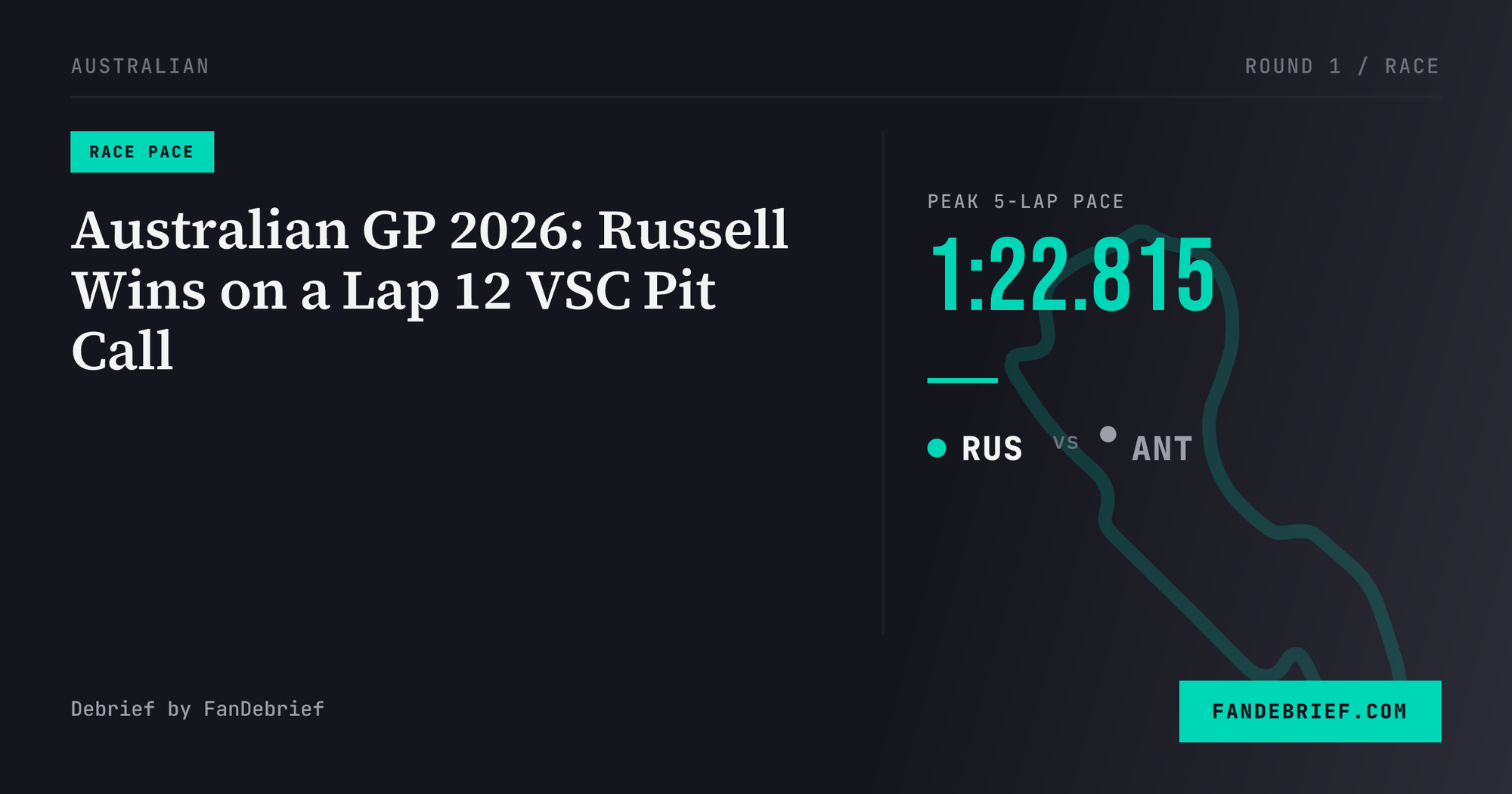
Here is the number that should worry Russell more than any other from this weekend: across the full race, Antonelli's weighted average lap was quicker than Russell's, by roughly seven hundredths of a second. It's a margin so fine it barely registers lap to lap, but strung across fifty-eight laps it's the difference between a driver who was, on raw pace, the fastest man in the field, and one who still finished runner-up.
The explanation sits in the sector times. Russell owned the opening two sectors most of the afternoon, fastest through the first twenty-two laps' worth of sector one and eighteen laps of sector two, while Antonelli was the man to beat through the technical final sector, quickest there on twenty-four separate laps. It meant Antonelli was always chasing a deficit built into the lap rather than a driver he was actually losing ground to in real time. By lap 55 the gap was down to four and a half seconds; by the chequered flag it had shrunk to just under three. Given more laps, or a cleaner run through traffic, this might have been a different story on Sunday. It wasn't, and Russell's early stop under that VSC is the reason why.
The other stories: Verstappen's statement, and a scrambled midfield
If the podium fight was about strategy, the story further back was about pure recovery. Verstappen went from twentieth to sixth, and set the outright fastest lap of the race in the process, quicker than Russell's own best lap by more than half a second. He did it on a two-stop strategy, running hard tyres first before switching to mediums and back to hards again, a plan built for a driver with nothing to lose and a whole grid in front of him to pick off. Set against that, his own teammate's weekend could not have gone more differently: Hadjar had out-qualified half the championship-winning teams on his Red Bull debut, only to retire eleven laps in. Red Bull's tally from the day was one car finished, one retired, and the gulf between the two speaks for itself: Verstappen's fastest lap was three seconds quicker than the best Hadjar managed before his car stopped.
Norris ran the same shape of strategy as Verstappen, two stops instead of the one used by the podium finishers, and it delivered the fastest pit stop of the race, a 17.7-second stationary time on lap 34, timed to land inside another Virtual Safety Car window. It got him to fifth, but not past Verstappen, who briefly threatened to make it a four-way scrap for the podium places before the tyre wear that comes with an aggressive middle stint pulled him back.
Further down, Haas's Oliver Bearman and Racing Bulls rookie Arvid Lindblad both took points on debut weekends worth remembering, seventh and eighth respectively, while Bortoleto brought Audi home ninth and Gasly claimed the final point for Alpine. Sainz and Stroll both gambled on strategies nobody else tried, three stops and four stops respectively, and neither was rewarded for the extra time in the pits; both finished well down, a lap behind the leaders. It's the clearest evidence from the day that, on a circuit rated only moderate for overtaking, the one-stop was the strategy to beat, and the further a team strayed from it without a compelling reason, the more ground they lost.
What it means going forward
Mercedes leave Melbourne with a one-two finish and a genuine internal contest already brewing: Antonelli's underlying pace matched or beat his teammate's on merit, and only lost the day to timing. That is a dynamic Russell will need to manage all season, not just survive once. Ferrari's Melbourne gamble, staying out when the VSC offered a free pit window, cost them the win but not the podium, and it's the kind of call a team only gets away with occasionally. And Verstappen's fastest lap from twentieth on the grid is the header before the real story: if Red Bull's reliability holds up better than it did for Hadjar, a driver who can win the race pace battle from the back of the field is not a footnote heading into round two in China, he's a warning.