Australian GP 2026: Russell Leads a Mercedes Front-Row Lockout
George Russell put nearly three tenths between himself and his own teammate, and the rest of the grid never got a look at either of them.
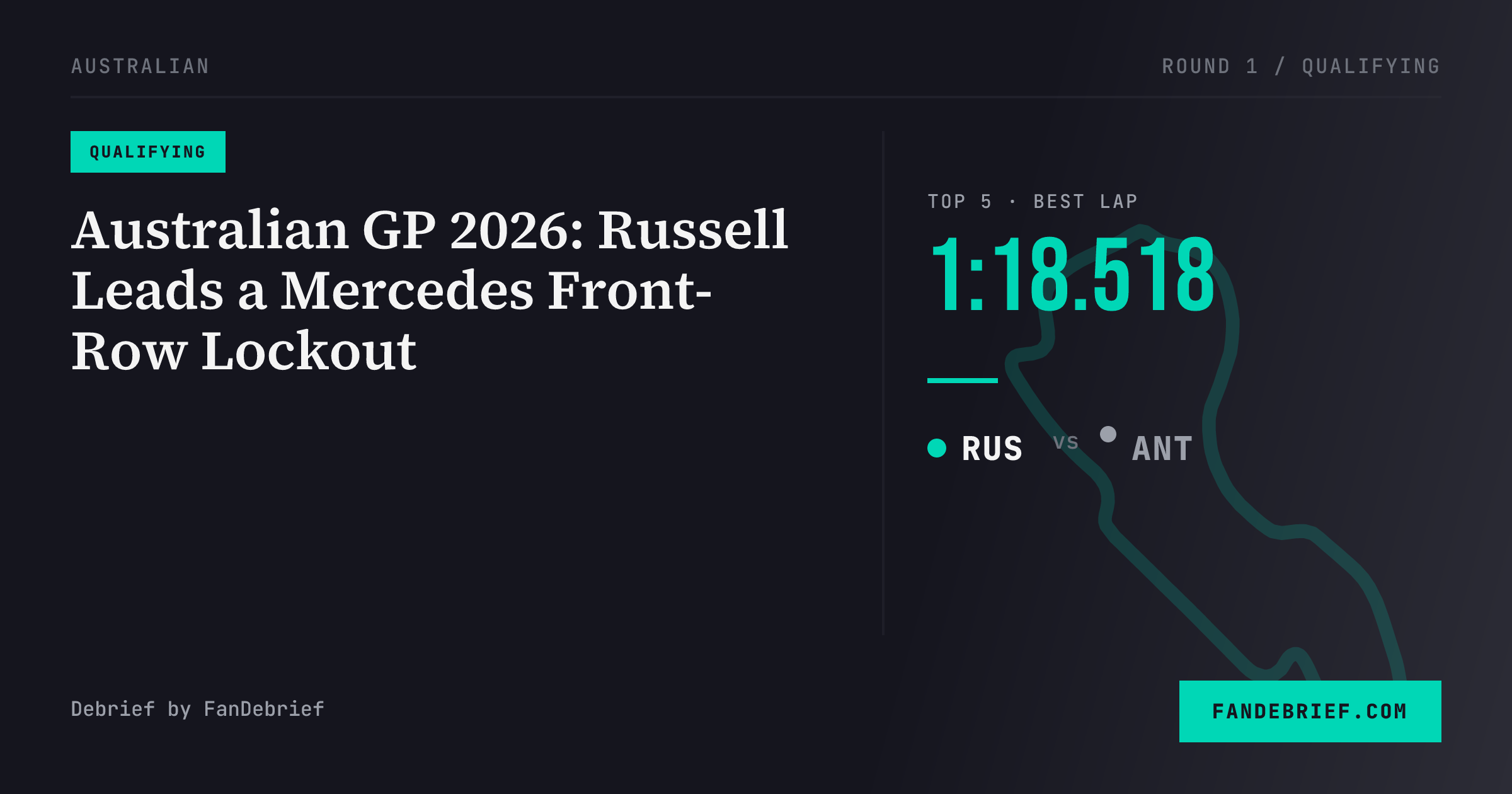
George Russell didn't need to look at a timing screen to know he'd nailed it. He crossed the line at Albert Park with a 1:18.518 that nobody else came within three tenths of, and by the time Qualifying wrapped up, the only car sharing his front row was the other silver one.
This was never really a one-lap story. Mercedes had the fastest car in every segment on Saturday, and the margin they built at the sharp end of the lap simply couldn't be clawed back anywhere else on the circuit.
Russell's pole came by 0.293 seconds over teammate Kimi Antonelli, a gap that sounds tight until you see what it did to the rest of the field. Isack Hadjar put together an eye-catching third for Red Bull, but he was over three-quarters of a second adrift of the pole. Charles Leclerc split the McLarens in fourth, with Oscar Piastri fifth and Lando Norris sixth, then Lewis Hamilton seventh. Squeeze all of that together and the top eight, right down to Liam Lawson in eighth, were covered by under a second and a half. It's the kind of number that tells you the midfield is bunched, and the kind that tells you Mercedes are not currently part of that conversation.
Qualifying itself had to survive two red flags before that picture settled, and the session chewed through a string of deleted laps for track limits along the way, Franco Colapinto, Lawson, Hamilton twice, Alex Albon and even Russell himself all had times wiped during the afternoon. None of it touched the final order at the front. Once the laps that counted went on the board, Russell's advantage was never seriously threatened.
Russell owned the start and the finish, Lindblad owned the middle
Dig into where that pole lap was actually won and a pattern emerges. Russell was the fastest car through the opening sector on six of the session's laps, and fastest again through the final sector on six more, bookending the lap with a genuine speed advantage at both ends. What's odd is who had the answer in between: Arvid Lindblad was the fastest car through the middle sector five times over the session, quicker there than anyone including the pole-sitter.
It didn't translate into a result. Lindblad's own lap time landed him in ninth, over two and a half seconds off pole, a reminder that owning one sector means nothing if the other two don't come with it. He did, however, set the outright fastest speed-trap reading of the entire field, touching 315 km/h, quicker even than Hamilton's Ferrari and comfortably clear of the Red Bulls. Whatever Racing Bulls have found for the straights, it isn't showing up in the lap time yet.
The sector split between Russell and the midfield tells its own story too. Russell's fastest sector one alone was over seven tenths quicker than Lawson could manage in the same sector, on a lap that put Lawson eighth rather than fighting for the front row. That's not a knock on Lawson, whose lap was good enough to reach the top eight comfortably. It's a measure of how far clear Mercedes currently are that a driver's whole session can be built on a sector deficit that size and it barely dents his grid slot, because everyone around him is losing similar amounts to the same two cars.
The data behind qualifying
Timing and telemetry from every car on track.


The midfield squeeze and the missing man
Behind the top eight, Q2 turned into its own scrap. Gabriel Bortoleto's Audi headed that group in tenth, ahead of teammate Nico Hulkenberg, then the Haas pair of Oliver Bearman and Esteban Ocon, Pierre Gasly's Alpine, Albon's Williams and Colapinto rounding out the second Alpine. Fernando Alonso, Sergio Perez and rookie teammate Valtteri Bottas didn't make it out of Q1, with Bottas propping up the classified order in nineteenth.
The name missing from that list matters more than any of the names on it. Max Verstappen simply isn't in the final classification at all. His session ended after just two laps, the shortest running total of anyone in the field, and his fastest recorded speed of the day came on that second lap rather than anything set later. Whatever happened to end his afternoon that early, the practical result is a Red Bull driver with no qualifying time and a grid slot that will make Sunday an uphill climb regardless of how the top eight sort themselves out.
Ferrari's approach was worth watching too. Both Leclerc and Hamilton started their sessions on mediums before switching to softs, a strategy Mercedes and McLaren didn't bother with, running softs from the first lap to the last. It's a small tell about how each team read the surface at Albert Park, and it's the kind of detail that tends to matter more once a race weekend, rather than a qualifying hour, is asking the tyre the harder question.
This circuit handed Lando Norris pole and the win twelve months ago. That version of Albert Park is not the one anybody saw on Saturday. Mercedes have arrived at round one with what looks like a genuine step, not just a Russell masterclass, and the question for Sunday isn't whether Russell can convert a comfortable pole into a comfortable lead. It's whether Antonelli, starting alongside him with the identical car and an even bigger buffer over third, turns this into the kind of afternoon where Mercedes control both ends of the race as completely as they controlled both ends of the lap.