Norris Beats Verstappen to Australian GP 2025 Win in the Pits
Norris took the opening win of 2025 not by being the fastest car on track, but by winning three separate strategic gambles in a race that flipped from wet to dry and back again.
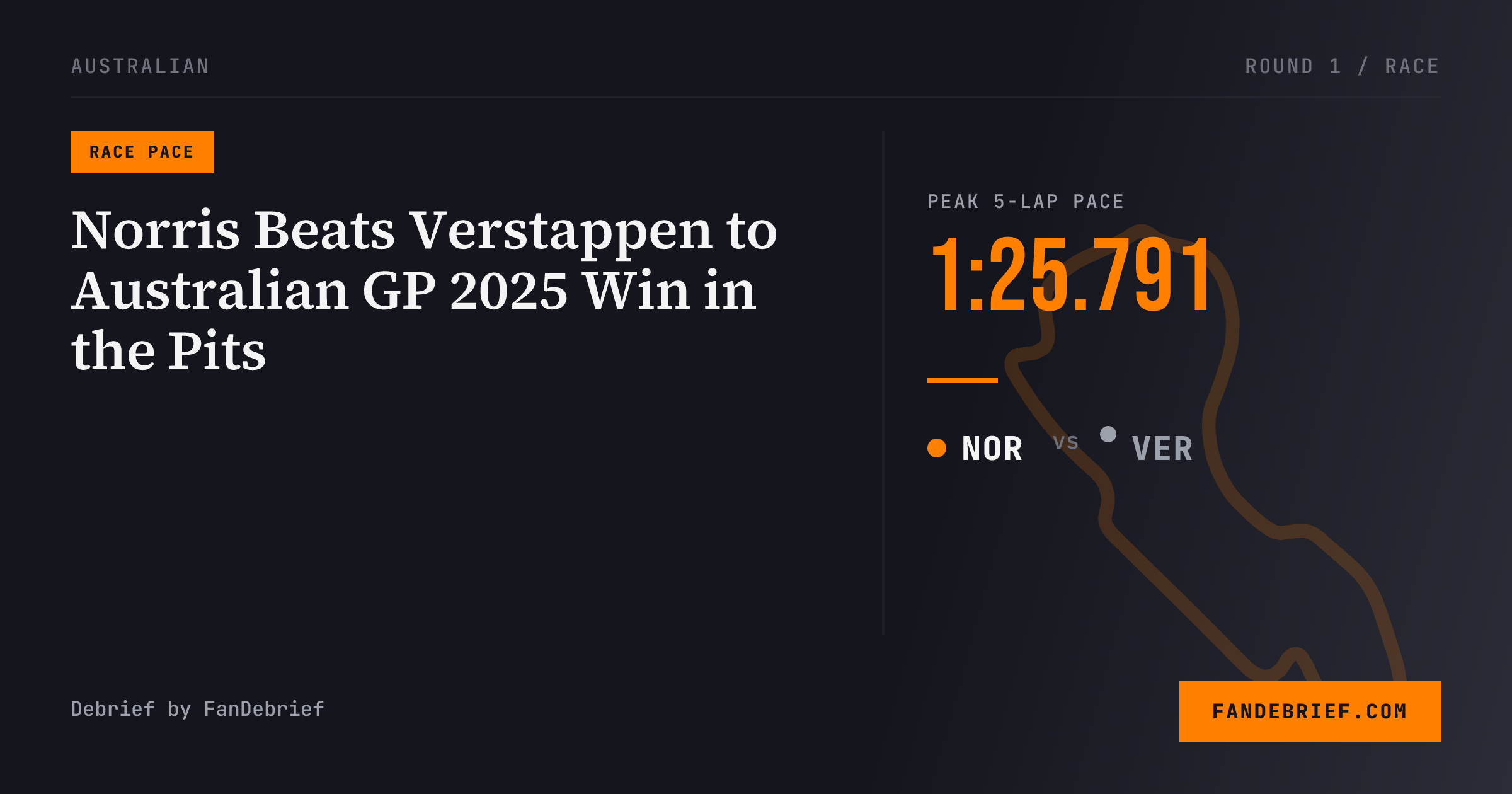
Three separate pit-stop windows swapped the race lead three times in the space of three laps, and not one of those changes happened on the racetrack.
The verdict
Lando Norris won the opening round of 2025 from pole, but he didn't win it by being the fastest car on Sunday. That distinction belonged to Max Verstappen. Norris won it by picking the right moment to change tyres in a race that flipped from wet to dry to wet again, three times over, and by keeping his nerve through three separate safety car restarts while cars were crashing out around him from the first lap onward.
The data behind the race
Timing and telemetry from every car on track.


How Melbourne set the trap
Qualifying had been tight at the front, Norris's pole lap of 1:15.096 only just holding off teammate Oscar Piastri by eight hundredths of a second, with Verstappen a further three tenths back in third. That form looked set to carry into Sunday, McLaren locking out the front row. But Albert Park on race day was wet, with rain arriving and clearing in waves badly enough that the timing sheet lists seventeen separate transitions between rain starting and stopping across the afternoon. Nobody was going to win this one on a single tyre strategy; the only question was who read each window correctly.
They found out immediately. Race control was working overtime before the field had even completed the opening lap: double yellows flashed through sector after sector, a safety car was deployed before lap one had finished, and three cars, Carlos Sainz, Jack Doohan and Isack Hadjar, were already done for the day, each classified with just a single lap completed. The safety car stayed out until lap seven. It was, in the truest sense, a season opener that arrived swinging.
Three pit windows, three leaders, no overtakes
Here's the number that tells you everything about how this race was actually won: the lead changed hands three times, and all three were pit-cycle swaps. Zero on-track passes for the lead all afternoon.
That's because the front-runners didn't all blink at the same moment. As the second bout of rain arrived and the field ditched intermediates for slicks, Norris, Verstappen, Russell, Antonelli, Stroll, Albon and Piastri all made their moves around lap 33-34. But Verstappen chose mediums over the hard that most of that group ran, and pitted back to inters two laps later than them, on lap 46. Hamilton and Leclerc gambled longest of all, staying out on hard tyres until lap 47 as the rain kept threatening to return.
That staggered decision-making produced exactly the chaos the lead-change column shows. Norris handed the lead to Verstappen on lap 44 when the Dutchman's later stop briefly put him ahead on strategy. Two laps later Verstappen handed it to Hamilton, who'd stayed out even longer still on his ageing hards. And a lap after that, Hamilton's own stop finally arrived and Norris inherited it back for good on lap 47. Hamilton leading a grand prix, even for a single lap, on Ferrari's return to the grid was one of the stranger sights of the day, and however brief, it was real: the timing sheet has him at the front of the queue before his own pit call dropped him away again.
The on-track gap chart tells the same story in numbers. Norris had built what looked like a comfortable buffer, over 25 seconds ahead of Verstappen by lap 35, before the pit cycle swallowed it whole; by lap 40 that lead was down to three seconds, and by lap 45, with Verstappen still to stop, Verstappen was actually 18.6 seconds up the road. Norris hauled it back to under a second by lap 50 and never let it grow much beyond that again, crossing the line less than a second clear at the flag. Only 14 of the 20 cars finished in the treacherous conditions in Sunday's race.
It's worth saying plainly: on raw pace, this wasn't even close to Norris's race to win outright. Verstappen's weighted average racing lap of 1:29.969 was the fastest of anyone in the field, quicker than Norris's own 1:30.298. Piastri, before his afternoon unraveled, was third-quickest at 1:30.840. Norris won this one on tyre-window judgment and composure through the restarts, not outright speed, and that's a different kind of statement to make in round one.
Antonelli's arrival, Piastri's collapse
If the front of the field was decided by strategy, the story further back was about who could read those same rain windows from a worse starting position. Nobody read it better than Kimi Antonelli. The Mercedes rookie started sixteenth and finished fourth, a gain of twelve places in his very first grand prix, carrying a five-second penalty for an unsafe release into the bargain and still holding position. That's as good a first impression as a rookie can make in Formula 1, doing it in conditions that were catching out experienced drivers all afternoon.
Nico Hulkenberg told a similar story from further back, up ten places from P17 to finish seventh, and Lance Stroll climbed seven spots from P13 to sixth. These weren't cars with outright pace advantages; Hulkenberg and Stroll both spent the race outside the top ten in the weighted race-pace ranking. They were drivers who kept their cars pointed the right way while others didn't.
Which brings us to the flip side of the McLaren story. Piastri had the second-fastest lap of the pole shootout and the third-best race pace all afternoon, plus the single fastest sector 1 and sector 2 tally of anyone in the field, quickest through those opening two sectors thirteen and fourteen times respectively across the race. And yet he finished ninth, down seven places from where he started. Whatever happened to cost Piastri seven positions wasn't a pace problem; it was a conditions problem, and it's the kind of gap between what a car can do and what a result says that will sting a driver walking away from his home race. Norris, by contrast, owned sector three more than anyone else on the grid, fastest through that final chicane complex on 32 of the 57 laps, and in a race decided by composure through the trickiest, wettest corners on the lap, that's precisely the sector you'd want to be winning.
Ferrari's Sunday was a story of a gamble that came agonizingly close to paying off and didn't quite. Hamilton's brief race lead on lap 46 was proof the long-stint-on-slicks call very nearly worked; he ended up tenth, still scoring on his very first outing in red. Leclerc, running the identical tyre plan, finished eighth. Both Ferraris were still running at the flag, but they'd swapped their fastest ticket on the grid, seventh and eighth on the timesheet, for exactly those same two positions at the flag, having briefly held far better.
Aston Martin's afternoon split down the middle, in a season opener where the two cars in that garage could not have had more different days. Stroll worked his way from thirteenth to sixth, one of the bigger climbs of the race, while teammate Fernando Alonso was out of the running by lap 33, retired with three stops on the board and nothing more to show for it than a name on the DNF list. Six cars didn't see the finish at all: Lawson, Bortoleto, Alonso, Sainz, Doohan and Hadjar. Hadjar, Doohan and Sainz never even got past the opening lap, victims of a start that had race control throwing yellow and double-yellow flags through half the sector boards on the circuit before the field had settled into any kind of rhythm.
What Melbourne tells us heading to China
Norris leaves round one with a maximum-points afternoon and, more importantly, proof he can manage a genuinely difficult strategic puzzle under pressure, three separate safety car restarts and a car behind that was, lap for lap, slightly quicker than his own. That's a mature way to open a title year. But Verstappen's pace, both on Saturday and in the race-pace numbers on Sunday, is the number Red Bull will point to heading into round two in China: they didn't have the fastest car, no, but they had the fastest driver on the day, and a rain-hit race is not a controlled experiment in which the sport usually gets shown its real pecking order. The Chinese Grand Prix, on a drier and more conventional circuit, should start answering the question Melbourne could only pose.