Vettel Wins 2018 British GP; Hamilton Recovers to Second
Vettel led off the start, lost the race to a Mercedes strategy gamble on lap one of the safety cars, and won it back with a bold dive at Brooklands that Hamilton's frantic recovery from the back of the grid couldn't quite catch.
Lewis Hamilton took pole in front of his own crowd and was running last inside three corners. That single fact tells you almost everything about how strange this Silverstone afternoon turned, and yet it doesn't tell you how Sebastian Vettel actually won it, because the race that decided this Grand Prix happened forty-four laps later, at Brooklands, with two Mercedes drivers still very much in the picture.
This was a race with two separate stories running in parallel: Vettel building and defending a lead that kept getting scrambled by strategy and safety cars, and Hamilton conducting one of the more remarkable recovery drives of his career from a spin he didn't cause. Both stories were true. Only one of them decided who stood on the top step.
Hamilton had taken pole by four hundredths of a second over Vettel, with Raikkonen a tenth back in third and Bottas fourth, the kind of front-row squeeze that promised a genuine fight rather than a coronation. Coming into the weekend Vettel held the narrowest of championship edges over Hamilton, and Silverstone itself had been Mercedes territory for three straight years, pole and win both times. None of that survived the first three corners.
The lap one collision that rewrote the afternoon
Vettel got the better getaway and had the lead cleanly by Turn 1. Behind him, Hamilton was fighting to hold third from Raikkonen into the Village complex when the Ferrari locked a front tyre, clipped the back of the Mercedes and sent Hamilton spinning. The stewards had no trouble assigning blame: Raikkonen picked up a 10-second penalty for causing the collision, which he served at his first pit stop on lap 13. For Hamilton, the damage was instant and total: from third on the road to the back of the field in the space of one corner.
What followed was Vettel doing exactly what a driver in clean air is supposed to do. By lap 10 his lead over Hamilton, who was now working his way back through traffic rather than racing for position, had stretched past 27 seconds. That gap was never a fair reflection of the two cars' pace; it was simply what happens when one driver is unimpeded and the other is picking off backmarkers one at a time. By lap 25, with Hamilton climbing hard, the margin had been cut all the way back to eight and a half seconds, a startling swing that said as much about Hamilton's pace through the field as it did about anything Vettel was doing up front.
The pit cycle then did what pit cycles do at a track with only two DRS zones and a moderate overtaking difficulty rating: it scrambled the order without anyone doing anything wrong. Vettel's first stop on lap 20 dropped him behind Bottas, who inherited the lead through the sequence; Vettel reclaimed it a lap later when Bottas made his own stop. That swap happened twice more before the race was through, each one a function of tyres and timing rather than a pass on track. It's worth pausing on that: of four lead changes across the 52 laps, three were pit-cycle inheritance and only one, the one that actually settled the race, happened with a car alongside a car.
The two safety cars, one for Marcus Ericsson's accident and a second, close behind it, for the collision between Romain Grosjean and Carlos Sainz at Copse, bunched the field back up just as Vettel's advantage looked like it might finally stretch clear. By lap 35 the gap between Vettel and Hamilton, who by then had fought back into podium contention, had been squeezed to under a second. Whatever cushion Vettel had built in the first phase of the race had been erased by circumstance rather than pace.
The data behind the race
Timing and telemetry from every car on track.


The pass at Brooklands
This is where the race was actually won. Vettel emerged from the second safety car period behind Bottas, who was running on the older compound and defending with everything he had. For several laps neither driver could find daylight; the gap between them oscillated around a second, the sort of margin where one driver is clearly quicker but can't quite make the move stick. On lap 47, running the fresher rubber, Vettel finally got the run he needed into Brooklands and went through on the inside. It was the only on-track lead change of the day, and it was the one that mattered: from that point Vettel controlled the finish, crossing the line 2.25 seconds clear.
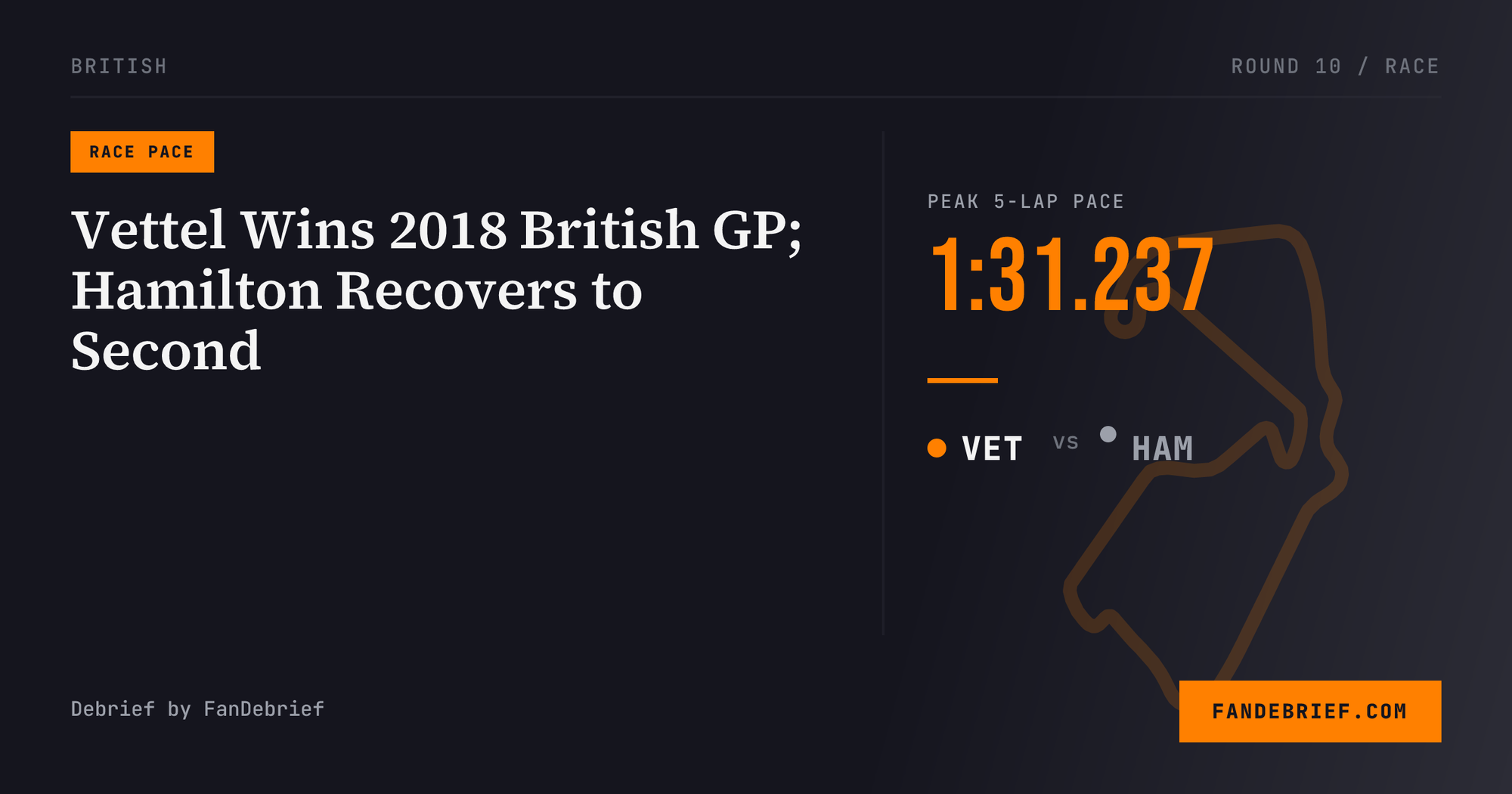
The fastest-lap numbers back up why that pass, rather than the start, was the real contest. Vettel's best lap of the race was the quickest in the field, and he was fastest through the Maggotts-Becketts-Chapel sequence more often than anyone else, eighteen times across the fifty-two laps. That sector, the one this circuit is built around, is where Ferrari's advantage showed up most clearly; Vettel's best time through it was over a full second quicker than Alonso's best, a gap that says less about Alonso's afternoon than about how much sector three separated the front of the field from the midfield all day. Weighted for stint length, Vettel's average racing lap was also the quickest of anyone, with Raikkonen and Hamilton close behind and Bottas and Ricciardo not far off that.
Hamilton's recovery, and the rest of a chaotic field
Hamilton's drive from last to second, on a two-stop that had him running the medium from lap 26 to the flag, deserves its own paragraph regardless of who won. Sector two was his best across the race, fastest twelve times, and that late medium stint clearly had more life in it than Bottas's older tyres did in the closing laps. He finished one place and 2.25 seconds behind the win, which, given where his afternoon started, is as good an advertisement for a recovery drive as this sport produces.
Raikkonen's own race is a study in contrasts: a 10-second penalty served early, then a drive good enough to finish third anyway, ahead of his own teammate at the flag. Bottas, who had led three separate times through the pit-cycle swaps, faded to fourth as his tyres gave up in the final laps, unable to hold off either Vettel or, eventually, Raikkonen.
Further back, the retirements told their own story. Verstappen, running as high as third for long stretches, lost ten places and pulled into the garage with a braking issue after 47 of the 52 laps, a cruel way to lose what had been a strong afternoon. Leclerc's race fell apart even earlier: from ninth on the grid he was out after just 18 laps with a tyre issue, having never got the chance to show what his single-stint pace suggested he had. Grosjean and Sainz collided at Copse and both retired, while Ericsson's accident brought out the first safety car and ended his day at Sauber, who saw both cars fail to finish. Hartley's race never really started, a single lap before a power unit problem parked the Toro Rosso.
The midfield had its own drama in Renault colours. Hulkenberg gained five places to finish sixth, over a second a lap quicker across the race than teammate Sainz, who was out of the points and then out of the race entirely after the Grosjean clash. Alonso, too, gained five places to finish eighth on a two-stop that mirrored the front-runners' strategy, while Perez picked up two places on his way to tenth. Magnussen, by contrast, lost two spots to finish ninth, the shape of a driver who started well but couldn't hold what he had.
Silverstone's outcome breaks the pattern this circuit had settled into for the previous three seasons, and it does it in a way that says more about a start and a single overtake than about a wholesale shift in competitive order. Vettel's win came from getting the jump at the lights and finding the right moment at Brooklands when it mattered; Hamilton's recovery says the pace gap wasn't as wide as the early laps suggested. With the German Grand Prix next up, the question worth watching is whether Ferrari's edge here, visible mostly in that Maggotts-Becketts-Chapel sector and in Vettel's ability to make a decisive move stick under pressure, travels to a different kind of circuit, or whether Silverstone was simply the day Vettel's start and one clean pass were enough.