Antonelli Takes British GP 2026 Pole, Verstappen Only P7
Kimi Antonelli found four tenths of a second no one else could, but the story of Silverstone qualifying is how far Red Bull and McLaren fell behind that fight.
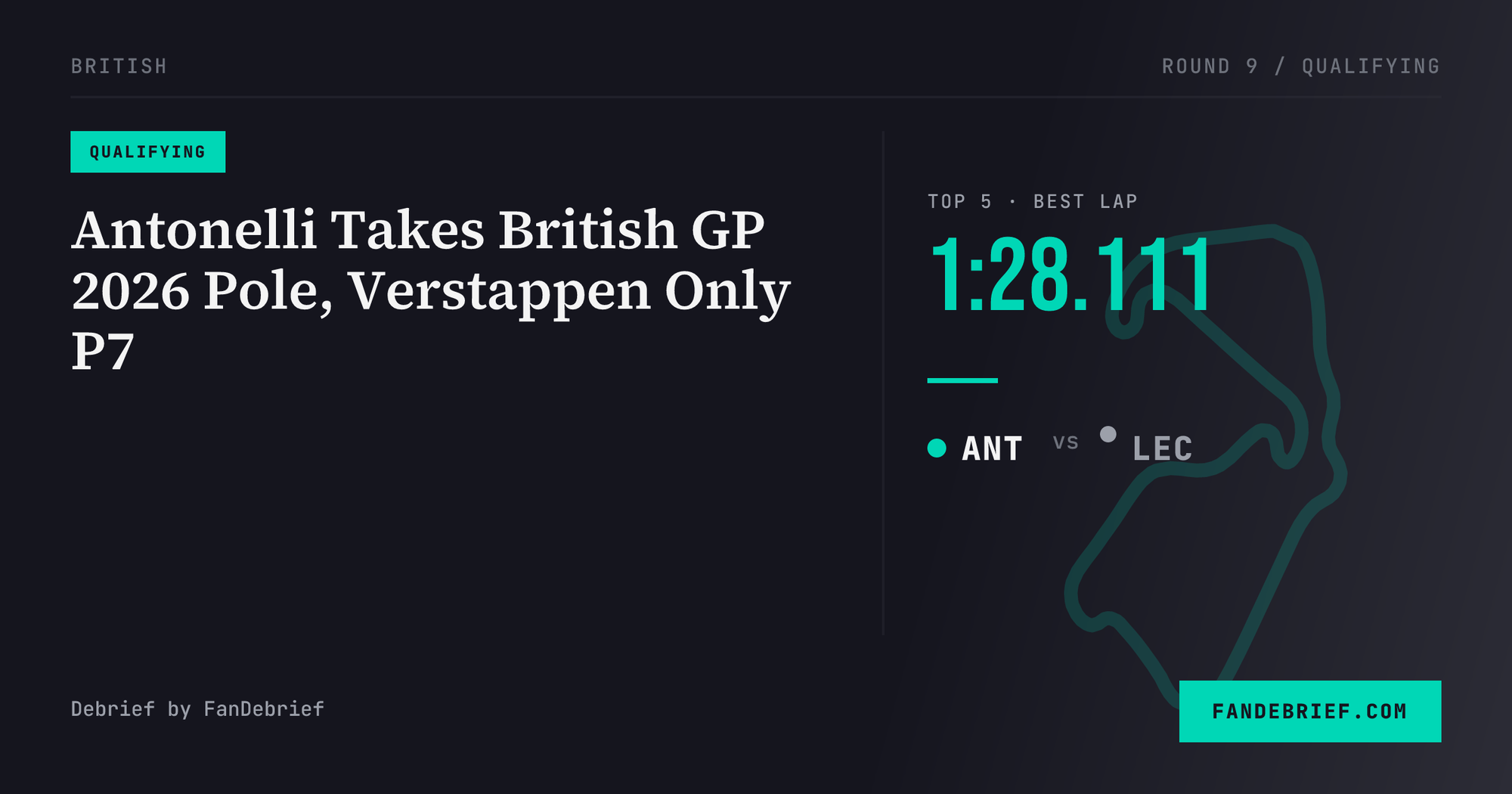
Kimi Antonelli's final lap at Silverstone wasn't just quick, it was the kind of lap that shuts a session down. He crossed the line, glanced at the board, and Q3 was effectively over before Charles Leclerc had even started his own last attempt. That's the picture from the top of this grid: a pole fight decided by fractions, sitting on top of a session where two title-adjacent teams quietly had their worst Saturday of the year.
This was a qualifying hour with two completely different stories running in parallel. At the front, four cars from two teams were separated by well under four tenths of a second, a genuine shootout through Maggotts, Becketts and Chapel. Further down, Max Verstappen and Lando Norris, both men who've led championships in recent seasons, ended up staring at a gap to pole that had nothing to do with fine margins.
Conditions were dry all session, with track temperature hovering around 41 degrees and air a shade over 25, the kind of Silverstone Saturday that rewards a car that can carry speed through the middle sector without giving anything away over the kerbs. That's exactly where this session was won.
A front four covered by four tenths
Antonelli's final lap of 1:28.111 beat Leclerc by 0.175 seconds to take pole, but the deeper story is how tightly the whole top four were bunched. Leclerc's 1:28.286 put him second, Hamilton split the sister Ferrari and the sister Mercedes with a 1:28.458, and Russell rounded out the group at 1:28.481. Four cars, two teams, three tenths and seventy thousandths of a second between top and fourth. That is about as close as a front-row fight gets at a circuit this fast.
The sector breakdown explains why nobody could shake anybody else. Antonelli's pole lap was built in the middle sector, through Aintree, Wellington, Brooklands and Luffield, where he set the fastest time of the session on five different laps. Leclerc's answer was at the other end of the lap: he owned the Maggotts-Becketts-Chapel complex, the sequence that defines Silverstone, topping sector three five times across the session, and doing it by an average margin measured in hundredths, not tenths. Antonelli won the argument in the middle of the lap; Leclerc nearly won it back in the sequence that matters most to the eye. That's why 0.175 seconds decided pole instead of half a second.
Russell's session tells its own smaller story. A Q1 moment running wide, with a deleted lap for exceeding track limits at Turn 7 already on the board before the real drama started, meant he never quite had the rhythm of his teammate, and a fourth-place lap that was still within four tenths of pole reads as a recovery as much as a shortfall.
The data behind qualifying
Timing and telemetry from every car on track.


Red Bull and McLaren's afternoon to forget
Six places back from pole sat two cars that have no business being that far off the front row on pure competitive history. Isack Hadjar was the best of the rest in fifth, 0.635 seconds down, doing more with his Red Bull than his more decorated teammate managed all session. Norris followed in sixth at 0.766 seconds, and Verstappen was seventh at 0.782, with Piastri completing a McLaren-Red Bull sandwich in eighth.
That is a genuinely strange picture. Two cars that spent long stretches of recent seasons fighting for poles and wins were, on this Saturday, closer to the second Red Bull and second McLaren than to the front-row fight. Nothing in this session points to a mechanical explanation for either driver; both completed normal Q3 runs on soft tyres and simply didn't find the pace. Whatever conversation Red Bull and McLaren are having heading into Sunday, it starts with the fact that four tenths separated their cars from a genuine podium fight, and closer to eight tenths separated them from pole.
Behind the top eight, Racing Bulls quietly had a strong hour. Both Liam Lawson's teammate and Lawson himself made it into Q3, ninth and tenth, ahead of established names like Bortoleto and Gasly who fell in Q2. It's the kind of session that won't make headlines on its own but will matter if either car can convert grid position into points on Sunday.
The biggest gap of the day, though, belonged to Alpine. Pierre Gasly's Q2 exit at 1:30.063 doesn't sound dramatic until you put Franco Colapinto's time next to it: 1:31.321, over 1.2 seconds slower and not even good enough to escape Q1. That's not a car problem, since it's the same chassis; that's a gap that will get asked about in the debrief. Elsewhere, Sainz's Williams and Gasly's Alpine both cracked 307 km/h through the speed trap, evidence that even outside the top ten some of this grid had genuine pace in a straight line, just not enough of it everywhere else on the lap.
Sunday's race at a circuit with only two DRS zones and a moderate overtaking rating is not going to be an easy place for Verstappen or Norris to claw back six places of grid deficit. The Belgian Grand Prix, round ten, is only a fortnight away, and if Silverstone's pattern holds, both teams will arrive at Spa needing answers rather than just a better qualifying lap. For now, the questions belong to Red Bull and McLaren; the front row, on Saturday's evidence, belongs to Mercedes and Ferrari, with less than two-tenths separating the two.