Antonelli Passes Hamilton at Stowe to Win British GP Sprint
Hamilton held Antonelli off for seven laps in front of his own crowd, but once the Mercedes found overtake mode at Stowe, the sprint became a formality.
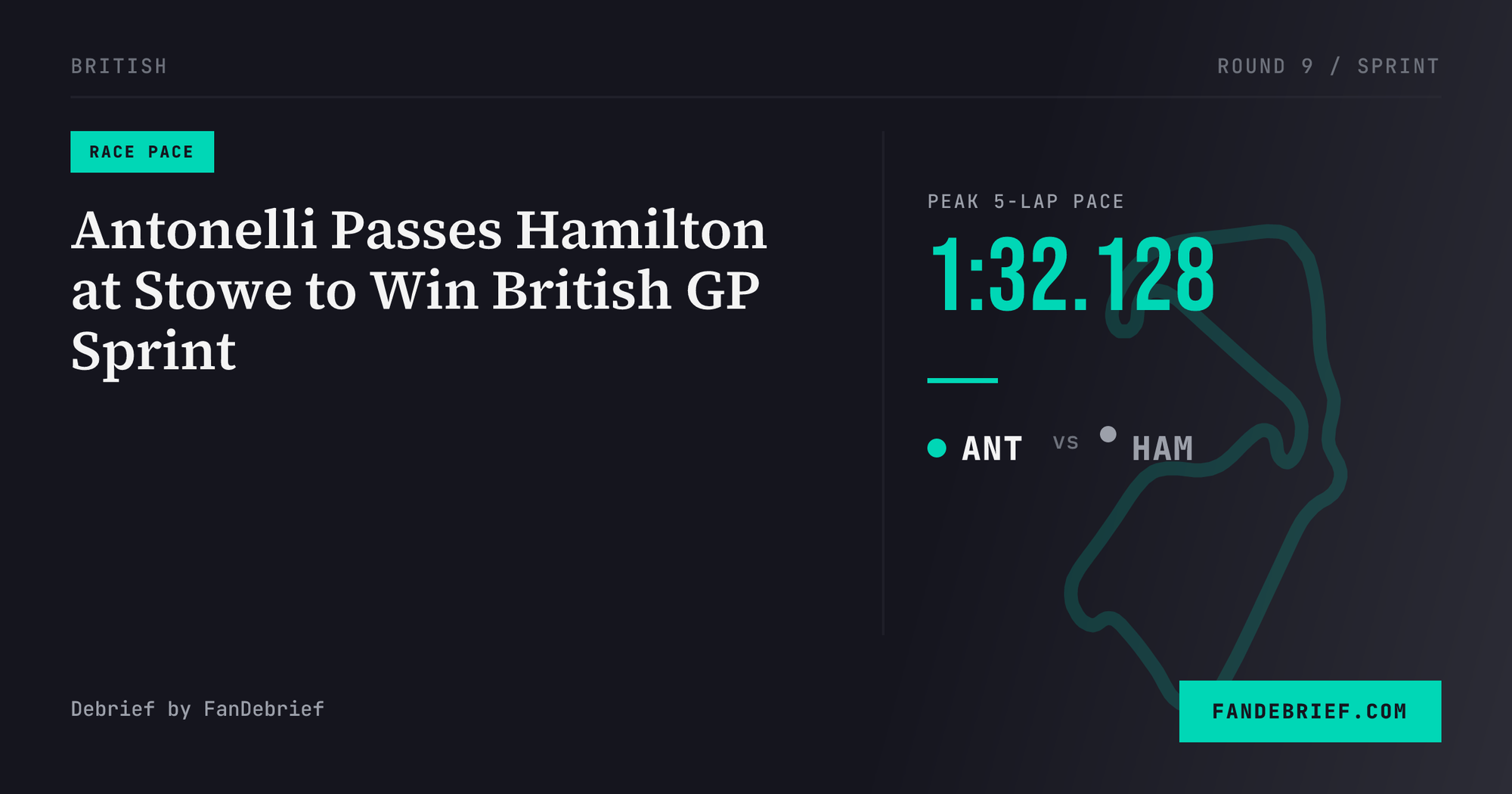
Lewis Hamilton had seven laps to hold off the fastest car in the field, in front of the loudest crowd in the sport, and for seven laps he did it. Then Kimi Antonelli got into overtake mode, and Silverstone's home hero simply had nothing left to fight with.
This sprint was never really about who was faster over one lap. Hamilton had already answered that question by taking pole a tenth clear of the field. It was about who could still be faster once the batteries had been drained by five laps of racing, and on that question there was only one answer.
Hamilton's pole had been a genuine surprise, a tenth clear of Antonelli after Q3, with Verstappen and Leclerc a further three tenths back and Russell only a fraction behind them. Two Racing Bulls cars in the top ten hinted at a midfield that would be tightly bunched all afternoon, and with only an hour of practice on the books, nobody quite knew how the sprint would play out over a genuine race distance. What followed did not disappoint: two breakaway leaders, a five-car scrap for third that refused to settle, and a shape to the result that told you plenty about how this weekend's pecking order actually looks.
Off the line, home advantage counted for something. Hamilton got the better start and the two frontrunners immediately broke clear of the pack, opening a gap that would stretch to over a second by lap five. The gap evolution through the middle of the race told the real story: Hamilton was still 0.94 seconds ahead at lap five, comfortable enough, still defending the sort of lead a home crowd dreams about. Antonelli had other ideas, and by lap ten the picture had flipped entirely, the Mercedes now 0.84 seconds clear.
Stowe, lap eight
The decisive move landed on lap eight, when Antonelli went past Hamilton to take the lead for good, the only change at the front all afternoon. From there the gap only grew, Antonelli 1.96 seconds up by lap fifteen and 2.74 seconds clear at the flag. The sector data explains why: Antonelli set the outright fastest lap of the race on the very last tour, a 1:31.6, and topped sector one on eight of the seventeen laps. Hamilton was the sharper car through the middle and final sectors, fastest in sector two on eight laps and sector three on six, but it didn't matter once Antonelli had track position and the straight-line advantage to go with it. The weighted race-pace numbers back up what the eye saw live: Antonelli's average racing lap was over two tenths faster than Hamilton's across the full run, the difference between a driver who could pass when he chose to and one who was merely defending.
Watching it unfold, you got the sense Hamilton knew what was coming before it happened. He'd built his advantage on a good launch, not raw pace, and Antonelli spent the opening laps sitting patiently in his mirrors rather than throwing early moves away. That patience is what made the eventual pass so decisive; when it came at Stowe, there was no lunge, no half-committed dive, just a car with more in reserve going past a car that had none left to give.
Behind that duel, Silverstone's character did exactly what it always does: separate the cars that can carry speed through Maggotts-Becketts-Chapel from the ones that can't. Norris climbed from P6 to P3, the biggest gain of anyone inside the points, while Leclerc slipped one place from P4 to P5. It's the kind of swing this circuit produces almost every year, rewarding whoever has the confidence to commit through that sequence and punishing anyone who doesn't.
Nobody had a rougher afternoon than Verstappen. He qualified third, a place ahead of teammate Hadjar, and lost three positions to finish sixth, his average racing lap nearly a full second slower than Antonelli's. Hadjar, starting one place further back in P8, finished P9, just one place behind his teammate by the flag despite the wider gap in qualifying. The tightening margin between the two Red Bull drivers, on a track that has historically flattered high-speed downforce, is not the kind of story Milton Keynes wants written about its lead driver a week after his best result of the season.
Further down the order, Sergio Perez's sprint fell apart early. He picked up a ten-second penalty for causing a collision and finished last of the runners, sixteen laps down alongside Stroll, who was also classified as lapped. It was a forgettable afternoon in a season where every point has mattered for both midfield outfits. At the other end of that same story, Alexander Albon quietly made up four places from a P22 start to finish eighteenth, the sort of drive that never makes a headline but keeps a weekend from being a total washout.
Hadjar's top speed of 340 km/h, the fastest reading of the session, is a reminder that Red Bull's straight-line performance isn't the problem; it's what happens in the corners in between that cost them ground all afternoon on a lap defined by Maggotts and Becketts rather than the straights either side of it.
Going into this weekend, Antonelli already led the championship by 40 points over Russell and by 46 over Hamilton, with five grand prix wins already banked this season. A sprint victory doesn't move the title fight in the way a Sunday result does, but it did something else: it showed that even on a weekend where Ferrari found genuine one-lap pace and a home pole, Mercedes could still win the race that mattered when the tyres and batteries were doing the talking. Hamilton will start Sunday knowing he can match Antonelli for one lap. Whether he can match him for seventeen is the question this sprint left hanging over the rest of the weekend.
The data behind the sprint
Timing and telemetry from every car on track.


