Leclerc Wins British GP 2026 as Safety Car Cuts 30s Lead
Charles Leclerc built a lead that stretched past thirty seconds at Silverstone, then watched a late Safety Car strip almost all of it away, while Kimi Antonelli's pole position dissolved into a stops-laden slide to fifteenth.
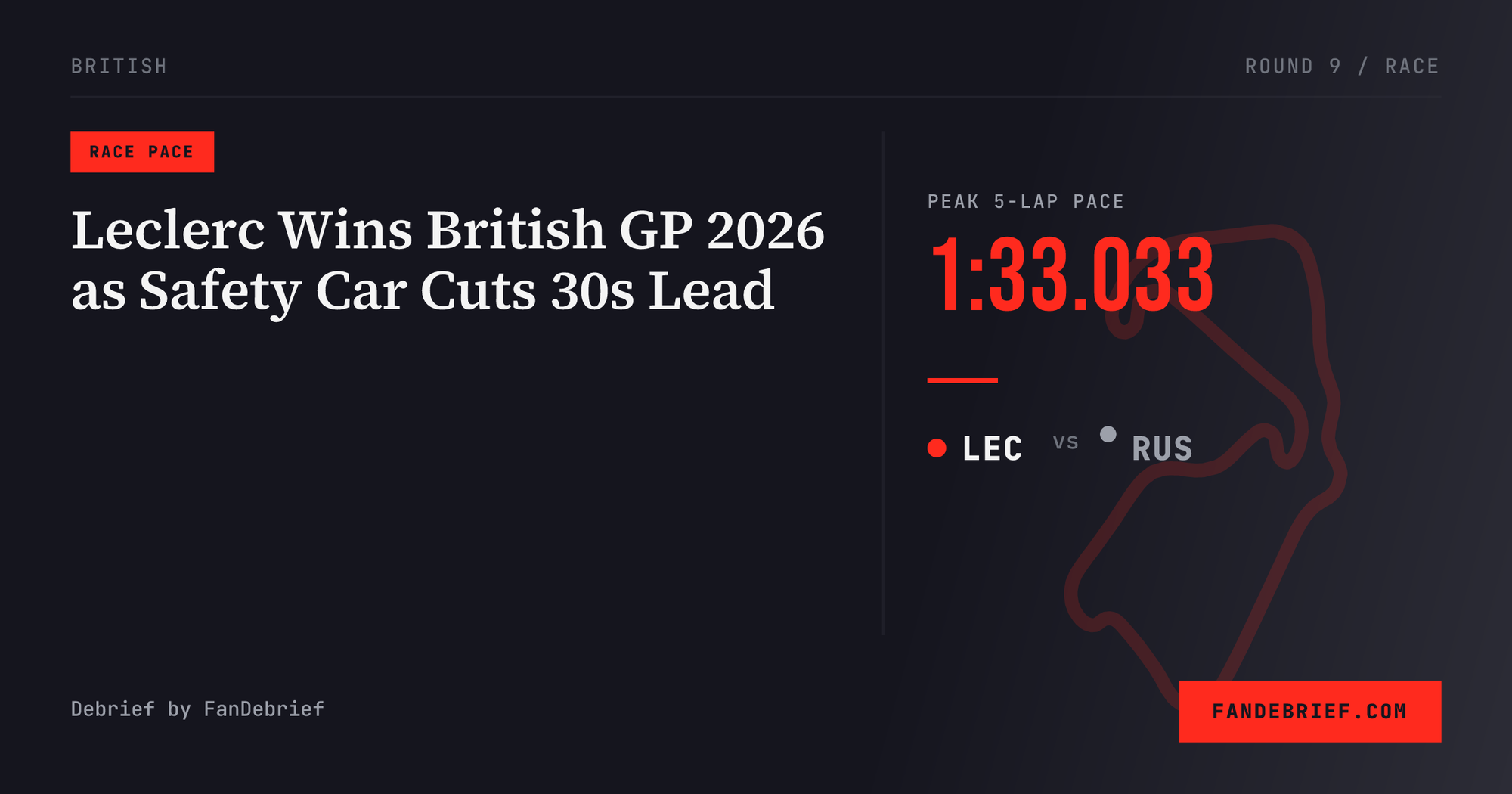
With four laps to go, Charles Leclerc had a lead of over thirty seconds and nothing left to prove. Then Max Verstappen's Red Bull came to rest and the Safety Car boards went up, and by the time the field crossed the line at Silverstone, that thirty-second cushion had shrunk to four tenths. Leclerc still won. He just had to sweat through the last two laps to do it.
This was a race with two stories running in parallel, and they collided in the closing laps. One was Leclerc building and defending a lead through a textbook two-stop. The other was Kimi Antonelli, on pole and briefly leading on merit, coming apart lap by lap until the polesitter was fighting for a single point. Both stories end at the same finish line, but only one of them ends happily.
Setup: a front four separated by blinks
Qualifying had promised a tight one. Antonelli took pole in 1:28.111, with Leclerc splitting the Mercedes pair just under two tenths back in second, Hamilton a further tenth and a half adrift in third, and Russell fourth. Hadjar, Norris, Verstappen and Piastri rounded out the top eight inside a second of the pole time. Antonelli arrived at Silverstone leading the championship on 171 points with five wins already banked this year, Russell second on 131 with two wins of his own, and Hamilton third on 125 having won at Barcelona two rounds earlier. Ferrari had one win between its two drivers all season; Leclerc, sixth in the standings, had none.
The narrative: a lead built, lent out, and won back
Leclerc converted pole pressure into control. He led from the start and pitted first, on lap 25, onto hards. Antonelli didn't follow immediately. He stretched his opening set of mediums for another ten laps, and when Leclerc's stop handed the effective lead to the Mercedes on lap 26, the picture briefly looked like it might belong to Antonelli. The on-track gap between Leclerc and the field had ballooned past thirty seconds by lap 25 as the pit cycle played out, then Antonelli's own stop on lap 36 handed the position straight back: the lead swapped hands twice in this race, and both swaps were pit-cycle inheritance, not a single wheel-to-wheel pass for the position.
The tyre numbers explain why Leclerc never really looked under threat once the sequences settled. His hard stint, laps 26 to 48, actually got quicker as it went, degrading at minus 0.004 seconds a lap, essentially free pace from a cooling track and a fuel-light car. Russell's route to second was different and arguably braver: after his own hard stint, he went back onto mediums for the final eighteen laps rather than reach for softs, and that stint was still fast enough to make his weighted average race lap the third-quickest of anyone in the field, 1:33.851 against Leclerc's session-best 1:33.777. Hamilton's pace matched his teammate's rhythm almost lap for lap, his own average landing at 1:34.055, close enough that a raw fight might have gone either way, but a five-second false-start penalty picked up on lap 7 and served during his lap-25 stop meant Hamilton was always racing with a ten-second handicap that no amount of matching Leclerc's pace could erase.
Antonelli's afternoon tells a different story entirely. He was genuinely the fastest car in the opening exchanges, topping the first-sector charts more often than anyone else in the field. But his final stint reads like nothing else on the timesheet: a stop on lap 41, then another on lap 43 with no tyre compound even settled in the data, the kind of scrambled, repeated-visit pattern that points to a team firefighting a problem rather than executing a plan. Track-limits infringements piled up around Turns 6, 9 and 15 in the same window, and a five-second penalty for one of them was the final indignity. He crossed the line having lost fourteen positions from where he started, the steepest fall of anyone who actually finished the race.
The decisive moment: Stowe changes everything
Leclerc's afternoon had been comfortable enough that the gap to Russell touched 37 seconds as late as lap 35. Then Verstappen, running seventh on the grid and fighting to salvage a weekend that had never quite come together, retired on lap 47. The Safety Car that followed on lap 48 swallowed every second of the cushion Leclerc had built. By lap 50 the gap was down to 1.78 seconds; by the chequered flag, with the race finishing under caution, it was 0.40. Leclerc had done the hard work over 45 racing laps and then had to hold his breath for the final two behind the Safety Car lights, the kind of finish that looks routine on the result sheet and was anything but live.
The other stories: a comeback, a collapse, and a quiet good day for the queue behind
No drive stood out more than Franco Colapinto's. He started nineteenth and finished ninth, a ten-position gain that was the single biggest climb of anyone in the race, built on a strong start and a knack for being in the right place as retirements and safety cars reshuffled the order ahead of him. Pierre Gasly's own race, fifteenth to tenth, gave Alpine a double points finish even if he lost position to his teammate along the way. Liam Lawson (tenth to sixth) and Arvid Lindblad (ninth to seventh) both worked their way forward for Racing Bulls, while Gabriel Bortoleto took Audi's points finish in eighth, the lone bright spot for a team that also saw Nico Hulkenberg retire from twelfth after 37 laps.
Norris had the messiest strategy of anyone near the front, three stops rotating through medium, hard, medium and soft, and still turned it into a two-place gain to fourth. His teammate Piastri had the opposite day: an early, almost reactive stop on lap 2 signalled trouble from the start, and he slid from eighth to eleventh despite also running three stops. Further back, Verstappen's retirement was the headline mechanical story of the day, Alexander Albon's race ended in the garage after a twenty-second penalty and six separate pit visits, and Lance Stroll spent the second half of the race collecting track-limits penalties that eventually totalled thirty seconds, dropping him to nineteenth and a lap down.
Forward look
This was the first race all season that didn't go to a Mercedes driver or to Hamilton, and it was Leclerc's first win of the year after Ferrari's only other victory belonged to his teammate at Barcelona. Silverstone hadn't seen a Ferrari winner in the last three runnings listed in the record books here, and it took a Safety Car at the death to make sure this one counted. Antonelli still leads the championship, but a car that looked like the class of the field for three-quarters of a lap chart and finished fifteenth is the kind of result that puts a target on Mercedes' execution rather than their pace heading to Spa. Whether Leclerc's Silverstone form travels to a very different kind of circuit at the Belgian Grand Prix is the question this result leaves hanging.
The data behind the race
Timing and telemetry from every car on track.


