German GP 2018: Vettel Takes Record Pole, Hamilton 14th
Sebastian Vettel tore up his own history at Hockenheim with a track-record pole in front of a flag-waving home crowd, but the number that will actually shape Sunday is the P14 next to his title rival's name.
There is a moment in every home qualifying session where the crowd noise tells you what the timing screen hasn't confirmed yet. At Hockenheim, that moment belonged to Sebastian Vettel, and it arrived with the German flags already rising before his final sector had finished flashing purple.
This session, though, is really two stories running in parallel: a Ferrari driver delivering the lap of his weekend at home, and a Mercedes driver watching his championship rival do it from the garage after his own car gave up on him in Q1. Both things happened inside the same hour. Only one of them will matter more by Sunday night.
The setup
Vettel arrived at his home race eight points clear of Hamilton at the top of the standings, a gap forged over ten rounds that had already produced four wins apiece for Ferrari and Mercedes' two lead drivers between them. Silverstone the round before had gone Vettel's way from Hamilton's pole, a reminder that grid position and race result don't always agree. Dry, warm conditions at Hockenheim, with track temperatures nudging 38 degrees, gave everyone a clean baseline to find the limit on.
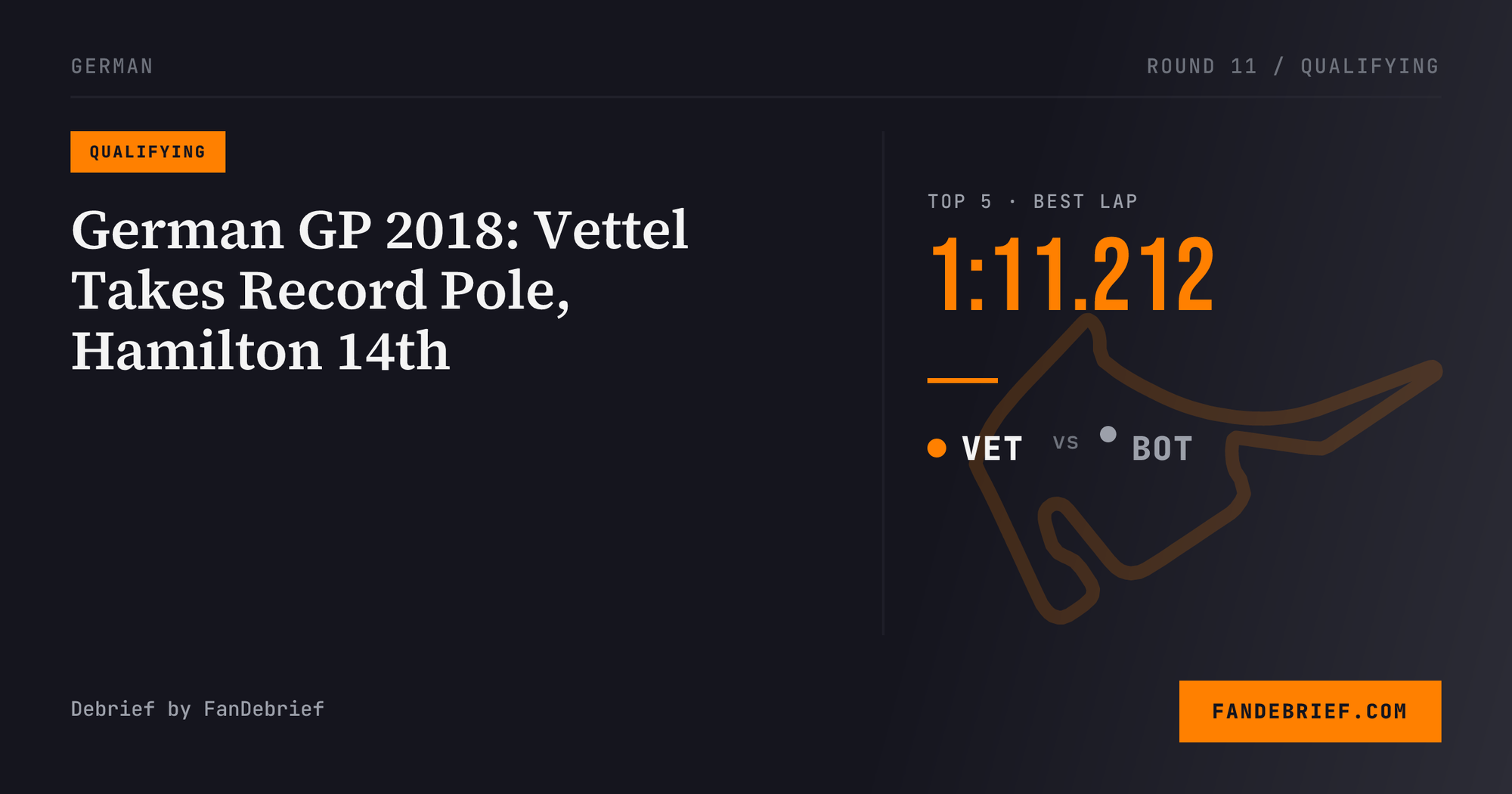
Vettel found more of it than anyone. His pole lap of 1:11.212 beat Bottas by two tenths of a second and Raikkonen by three tenths, with Verstappen's Red Bull a further four tenths back in fourth. That's four cars covered by six tenths at the front, tight enough to keep the garage watching, but the shape of it was Ferrari-Mercedes-Ferrari-Red Bull, exactly the order the front of this grid has settled into on its good weekends.
Where Vettel actually won the lap was the final sector. He was fastest through sector three five times across the session, by an average margin approaching a full second over the rest of the field, a chunk of time too large to explain away as track evolution. Raikkonen answered him in the middle sector, topping that split seven times, but it wasn't enough to close the gap where it counted. Vettel's own best sector one wasn't even his strongest weapon; it was that stadium-section pace in S3 that turned a competitive lap into a record one, and it's the clearest technical signal from the session about where Ferrari's advantage actually lives around this track.
Haas continued its habit of punching above its budget, with Magnussen fifth and Grosjean sixth, both inside the top six for the second time this year. Behind them, Hulkenberg out-qualified Sainz for the fifth time this season to lead the Renault pair home in seventh, with Sainz eighth. Leclerc took ninth for Sauber, extending a run of Q3 appearances that has become the form story of F1's midfield all summer, and Perez rounded out the top ten for Force India.
The data behind qualifying
Timing and telemetry from every car on track.


The moment that reshaped the grid
Hamilton was inside the top ten when it mattered least. His fastest lap of the session, a 1:13.012, came on just his second lap of running, and he'd covered only eight laps in total by the time his session ended. That is not a driver conserving tyres for a later run; that is a driver whose car stopped giving him laps to conserve. He was eliminated in Q1, in fourteenth, more than a second and a half slower than Bottas managed in the sister Mercedes across the same segment. For a driver sitting second in the championship, arriving at a circuit forty-five minutes from his team's own factory doorstep, it's about as public a way to lose your Saturday as this sport offers.
The gap between the two Mercedes tells its own story: Bottas in second, Hamilton not even completing the hour. That kind of split inside one garage doesn't happen because of a driving error; it happens because one car worked and the other didn't. Whatever the technical explanation, the timing sheet just shows a blank space where a two-time pole winner's Q2 and Q3 times should be.
The other stories
Ricciardo joins Hamilton among the big names who won't be racing from where their reputation suggests they should. He managed only six laps and a Q1 time of 1:13.318, one place behind Hamilton in fifteenth, on a weekend where Red Bull needed both cars punching at the front behind Verstappen's fourth. Alonso, Sirotkin and Ericsson made up the Q2 eliminations, with Alonso notably dipping onto the softer compound for a spell in the middle of his session, laps 11 through 13, before switching back to ultrasofts, a hedge that clearly didn't unlock enough lap time to carry McLaren into the top ten.
The speed trap told a different story to the stopwatch. Perez topped it at 326 km/h, with Ericsson second quickest through the trap despite his Q2 elimination and Raikkonen third, ahead of Vettel's own pole-lap top speed. Straight-line numbers rarely correlate cleanly with one-lap pace at a track built around a long-gone forest layout's leftover straights, but it's a reminder that Sauber and Force India weren't short on top-end; they were losing time somewhere else entirely. A red flag interruption during the session, following a yellow in track sector nine, briefly halted running too, the kind of stoppage that can cost a driver a crucial cool-down lap or a second attempt, though the timing sheet doesn't tell us who it hurt most.
What Sunday needs to answer
Vettel's pole is his to lose now, not to chase. Hockenheim has a recent habit of rewarding recoveries from deep in the field, and Hamilton has personal history with exactly that kind of drive at this circuit. Starting fourteenth with a car that only did eight laps on Saturday is a very different problem to solve than starting on pole with a Ferrari that just set the outright lap record, and that asymmetry, more than the two-tenths gap at the front, is the real story heading into Sunday.