Chinese GP 2018: Ricciardo Wins From Sixth on Fresh Softs
Daniel Ricciardo climbed from sixth on the grid to steal the Chinese Grand Prix, riding a Red Bull safety-car gamble and a string of outside-line passes while Max Verstappen's collision with Sebastian Vettel wrecked the Ferrari's afternoon.
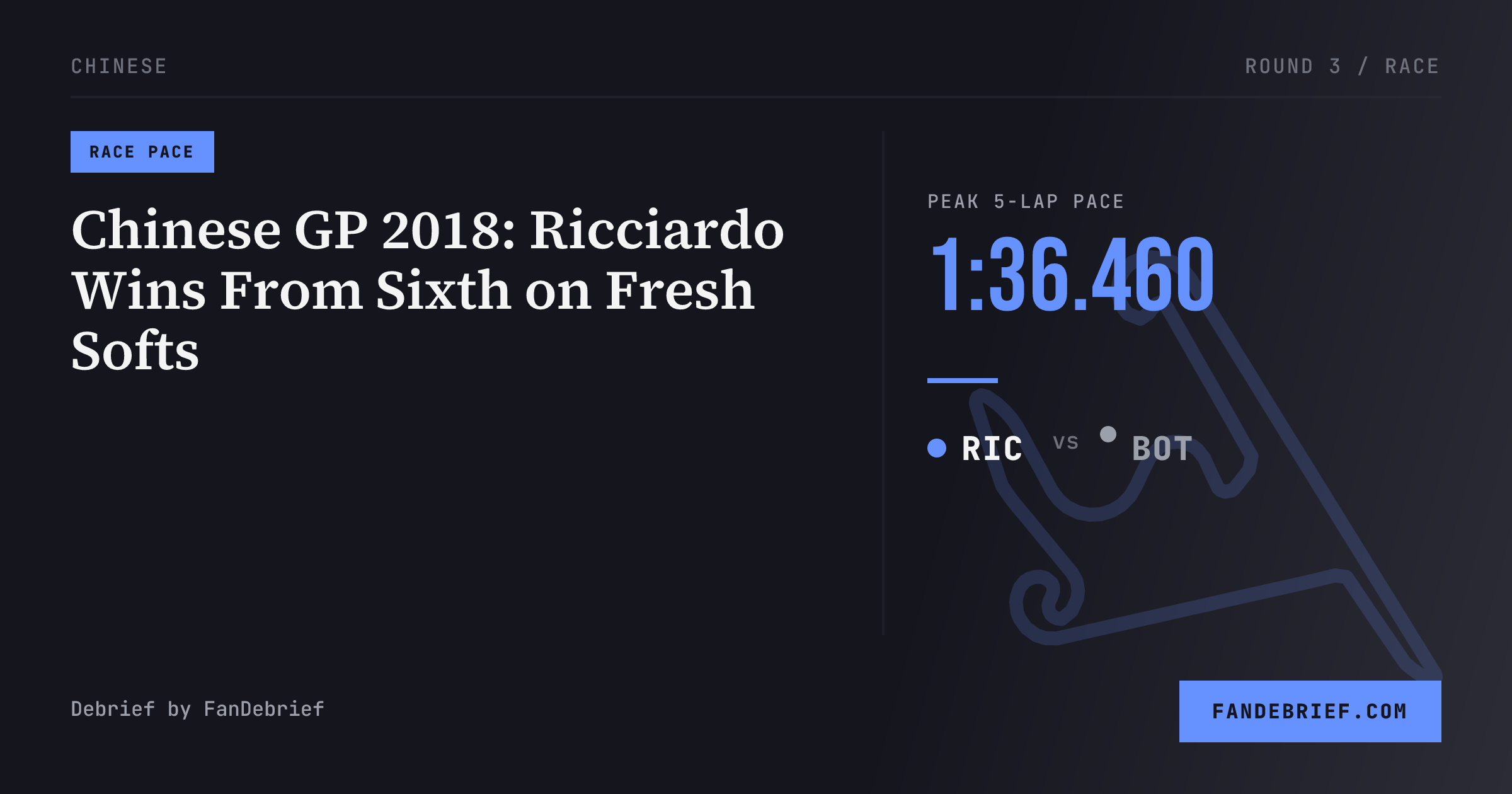
Ricciardo won a race he didn't lead until lap 45, on tyres nobody else had, in a car that was tenth-fastest through the speed trap. That sentence alone tells you this wasn't decided by outright pace. It was decided by a pit wall call made in the fifteen seconds after a Toro Rosso hit another Toro Rosso at the hairpin, and by a Dutchman who couldn't wait one more corner to make it stick.
Vettel arrived in Shanghai on top of the standings after wins at Albert Park and Bahrain, and for twenty laps he looked good for a third. He led off pole, comfortably enough that this looked like a straightforward afternoon for Ferrari. Then the pit cycle turned on him: Bottas undercut him out of the first round of stops, and by lap 21 the lead had already changed hands twice through strategy rather than overtaking, first to Raikkonen, then, on lap 27, to Bottas. Vettel's own stop came on lap 20, sending him back into a pack he'd started well clear of.
The hairpin that changed the race
The race's hinge point had nothing to do with the leaders. Down in the pack, the two Toro Rossos collided at the hairpin, and Brendon Hartley's car took the kind of damage that ends a Sunday: he never saw the chequered flag, retiring after 51 laps. Race control's timeline tells the story in procedure rather than drama, double yellows, blue flags waved at three separate cars trying to get out of the way, then the safety car on lap 31. Stewards later hit Pierre Gasly with a ten-second penalty for causing the collision. It's a forgettable footnote for Toro Rosso, who saw both cars finish outside the points, but for Red Bull up front it was the moment the race was won.
Ricciardo and Verstappen had already made their first stops together on lap 17, both switching onto tyres that were never going to get them to the flag on raw pace alone. When the safety car bunched the field on lap 31, Red Bull did it again, both cars in for a second change, this time onto soft rubber that nobody ahead of them was going to have. It's the kind of call that looks obvious in hindsight and reckless in the moment: you're gambling that the safety car period will neutralise the time lost in the pits, and that fresher tyres will do the rest once the green flag drops. The gap evolution proves it worked. At lap 25, before any of this, Bottas held nearly fifteen seconds on Ricciardo. By lap 35, with the safety car gone and the new tyres finally doing their job, that gap was under four seconds. Five laps later it was under three. By lap 45, Ricciardo was in front.
That's the number that matters more than any lap time from Shanghai: a fifteen-second deficit turned into a lead inside twenty laps, without Ricciardo ever being the fastest car on the speed trap (he was tenth, at 334 km/h, well behind Raikkonen's session-topping 343). This wasn't a car that out-dragged the field down the back straight. It was a car that had rubber the others didn't, at exactly the moment the race went live again.
The data behind the race
Timing and telemetry from every car on track.


Ricciardo's late charge, and Vettel's ruined afternoon
What Ricciardo did with that tyre advantage is the part that will stick in the memory longer than the strategy call itself. He didn't inherit second gear passes; he took them at the braking zones, into Hamilton, then Vettel, then Bottas for the lead, each one a dive rather than a wait. His fastest lap of the race came on lap 55, one lap from the flag, on tyres that were nine laps old by the time the chequered fell, quicker than anything Verstappen managed all afternoon and quicker than Raikkonen's benchmark from lap 39. The weighted race-pace numbers back up what the eye saw: Ricciardo's average across his stints was quicker than every other driver on the grid, comfortably clear of Raikkonen in second and Bottas in third.
Vettel's race unravelled twice over. First the strategy cycle dropped him from the lead into the pack; then, in the closing laps, Verstappen's second tyre advantage turned into a battering ram. Fighting for what was left of the podium, Verstappen went for a gap at the hairpin that wasn't there and hit the Ferrari, spinning both cars. Race control's message came through on lap 46: a ten-second penalty for Verstappen, causing a collision. It's worth being precise about what that penalty did and didn't do. Verstappen still crossed the line ahead of Hamilton on the road; the penalty applied afterwards dropped him to fifth, promoting Hamilton to fourth. Vettel, who'd started on pole, finished eighth, seven places worse off than where he lined up, and the polesitter's afternoon ended with Alonso muscling past him for seventh in the very last laps.
The Ferrari garage had a stranger split than the final gap suggests. Raikkonen's fastest lap of the race was over a second quicker than Vettel's best, and he brought the car home on the podium in third while his teammate dropped to eighth. Sector data shows Vettel was actually the man to beat through the middle sector for large stretches of the afternoon, fastest there on sixteen of the race's fifty-six laps, more than anyone else. It didn't matter. A car that's quick in isolated sectors on old tyres still loses to a car that's quick everywhere on new ones, and that was the whole story of Ricciardo's final twenty laps.
The rest of the field
Bottas will leave Shanghai wondering what might have been. He'd made the decisive move of the middle stint, taking the lead from Raikkonen on merit rather than through a pit cycle, and he held second all the way to the flag despite Raikkonen closing right up at the end. His pit crew were faultless too, the fastest stop of the race at 22.1 seconds, and his fastest lap carried the best average margin of anyone through the final sector. None of it was enough once Ricciardo had tyres eight laps fresher underneath him.
Further back, the Renault camp had a quietly strong day. Hulkenberg brought the car home sixth after starting seventh, and his race pace, sixth-best on the weighted rankings, tells you it wasn't a fluke of attrition. Alonso's afternoon was the standout recovery story of the midfield: starting thirteenth after a scrappy qualifying, he worked his way to seventh, gaining six places and capping it with that late pass on Vettel to add insult to the Ferrari's injury. Sainz brought the second Renault home ninth, and Magnussen picked up the final point for Haas in tenth.
Behind the points, it was a weekend to forget for Force India and for the second Toro Rosso, with Perez losing four places from his grid slot and Ocon unable to make more than a single position back. Grosjean's race fell apart entirely, seven places lost from a promising tenth on the grid, on a strategy that never left the ultrasoft tyre he started on.
What Shanghai tells us going forward
Ricciardo's win breaks a run that had belonged entirely to Vettel through the first two rounds of the year, and it does it in a way that should worry Ferrari more than the result alone suggests. Vettel didn't lose Shanghai on pace; he lost it on a safety car he had no control over and a title rival who couldn't hold his nerve at a hairpin. That's two different kinds of vulnerability exposed in one afternoon: a strategy that can be blindsided by a midfield accident, and a Red Bull garage that reacted to it faster than anyone else on the pit wall.
For Red Bull, the bigger story might be the one still unresolved. Verstappen had the same tyre advantage Ricciardo did, ran ahead of his teammate through the pit cycle, and still finished behind him after a penalty for a move he didn't need to make. Ricciardo showed in the same car, on the same strategy, exactly what patience combined with aggression at the right moment looks like. Whether Verstappen takes that lesson into the next race in Azerbaijan, a street circuit that punishes exactly this kind of overreach, is the question this result leaves hanging over Red Bull's season.