2026 Chinese Grand Prix: Antonelli Wins From Pole as Mercedes Locks Out the Front Row
Hamilton took the lead away from Antonelli at the first corner, yet the pole-sitter had it back inside two laps and never looked troubled again.
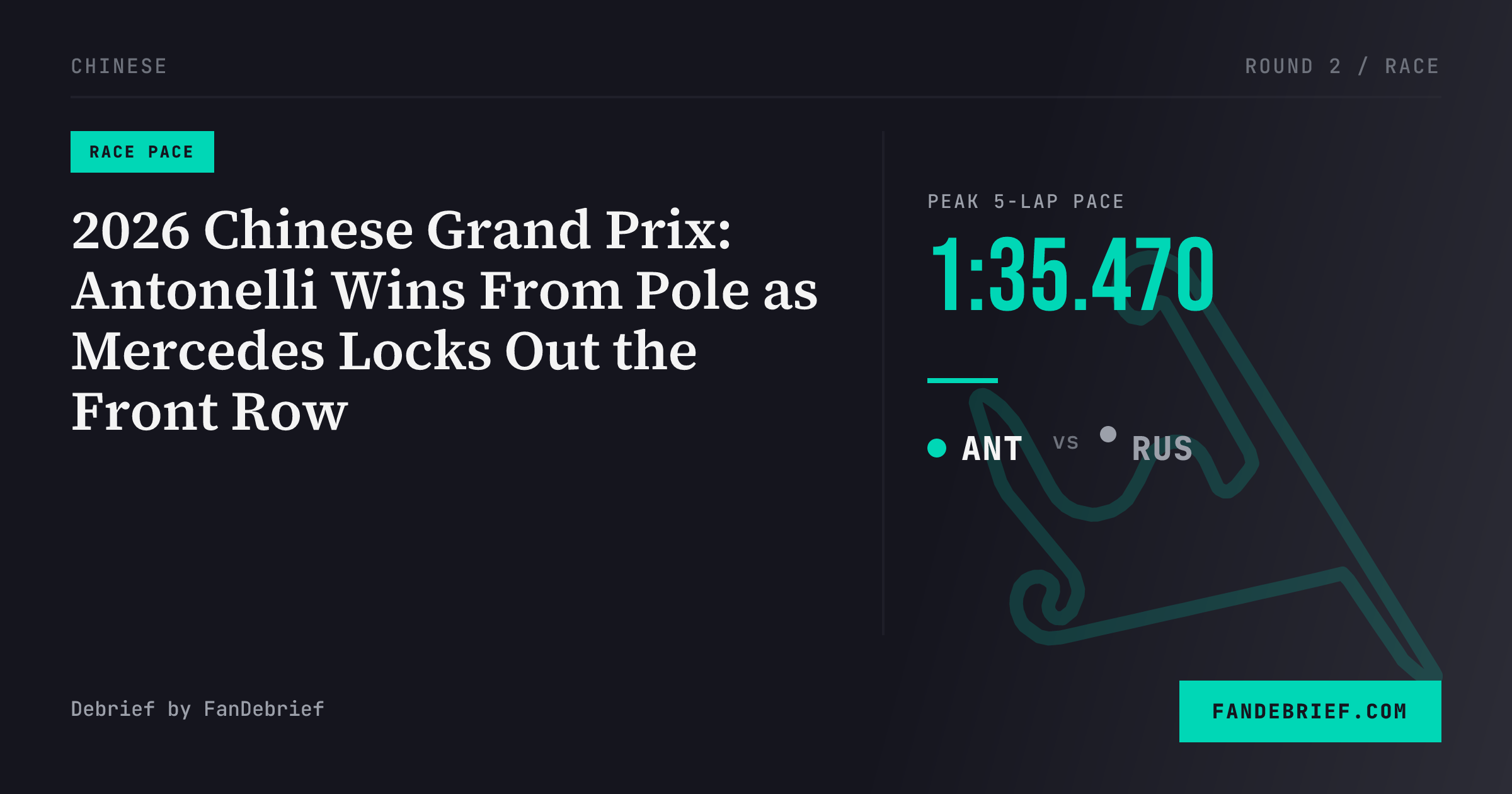
Hamilton had the run into Turn 1 that every pole-sitter dreads. For one lap, the biggest question in Shanghai was whether Antonelli's first pole position was about to mean nothing at all. Then, on lap two, Antonelli took the place back on track, and the rest of the afternoon became a demonstration of exactly why Mercedes locked out the front two rows of the timing screen.
This was not a start-to-finish snooze. It was a race with a real fight for the lead in the opening laps, a safety car that reshuffled half the pit lane, a Ferrari civil war for third, and a chaotic midfield that cost Aston Martin both its cars. But strip away the noise and the story is simple: Antonelli and Russell ran almost the same race pace all day, and Antonelli still finished five and a half seconds clear because of where and when he built his advantage.
Qualifying had promised exactly the top-four shape the race delivered. Antonelli took pole two-tenths clear of Russell, with Hamilton and Leclerc split by barely a hundredth in third and fourth, and the Ferraris more than three-tenths off the Mercedes front row. McLaren, by contrast, never got the chance to make its Saturday pace count; both cars failed to start, a blow that removed Piastri and Norris from the equation before a wheel had turned in earnest. In dry, mild conditions with track temperatures sitting around 23 degrees, this was always going to be a race decided by tyre management and pit-lane timing as much as raw speed, and so it proved.
The safety car that built Antonelli's cushion
Hamilton's move at the start was the cleanest overtake of the race, and for a lap Ferrari had exactly the response it needed to a Mercedes lockout. Antonelli's reply was just as clean; the lead change on lap two was the only one of the entire afternoon, and everything from that point was about margin, not position. By lap five Antonelli's advantage over Russell was still a modest 1.19 seconds, tight enough that nobody watching would have called the race settled.
Lap 10 changed the picture. A safety car came out just as Stroll's Aston Martin completed what turned out to be its final lap of the day, and the entire front of the field used the neutralisation to make its scheduled stop from medium to hard tyres in one clean window. Antonelli, Russell, Hamilton, Leclerc, Bearman and Gasly all pitted on that same lap, and when the field bunched back up under the safety car, Antonelli's gap to Russell had stretched to 7.32 seconds, purely a function of how the stops fell rather than any pace advantage on track. From there the margin breathed in and out with fuel loads and traffic, cresting at 9.58 seconds around lap 50 before easing back to 5.60 at the flag, but it never came close to disappearing. Antonelli had the race won in the pit window; the remaining forty-plus laps were about defending it.
Look at the sector data and the shape of that win becomes clearer still. Antonelli was the fastest car through the long, technical opening sector on 22 of the 56 laps and dominant again in the short middle sector, the back straight and hairpin, topping that split on exactly half the race distance. Russell's answer was sector three, the final technical run home, where he was quickest on 28 laps with an average margin of a bit over a tenth. It is a tidy split of a very evenly matched team: Antonelli owned the entry to the lap, Russell owned the exit, and the sum of those two halves gave Mercedes a 1-2 finish that was, at the front at least, never seriously threatened once the stops had cycled through.
The data behind the race
Timing and telemetry from every car on track.


Ferrari's fight decided by tenths, not talent
Behind the Mercedes cars sat the most entertaining fight of the day. Hamilton and Leclerc ran the identical one-stop, medium-to-hard strategy as the cars ahead of them, and split by only a few hundredths across the middle of the field's ultimate pace, they spent long portions of the race close enough to be genuinely racing for the final podium step. Leclerc actually set the faster single lap of the two Ferraris, a 1:36.011 to Hamilton's 1:36.092, yet it was Hamilton who finished third. The weighted race-pace numbers tell you why: Hamilton's average across both stints was quicker than Leclerc's by roughly three and a half hundredths a lap, a gap built lap after lap rather than in one flashy sector. It was the same story Ferrari has told all season in miniature, one car with the outright speed, the other with the race-day consistency, and on this occasion consistency won the podium argument. Hamilton's stop on lap 10 was also the fastest of the entire field, a 22.3-second stationary time that gave him a fractional head start in the tyre-management battle that decided the final rostrum place.
Off the podium, this was a race that rewarded patience over aggression almost everywhere you looked. Bearman took fifth from a starting slot of tenth, the best pure recovery of the day among the finishers, running the sixth-fastest race pace of anyone in the field, quicker than a struggling Verstappen and both Red Bulls. Lawson matched that theme from further back, climbing seven places from P14 to finish seventh for Racing Bulls, while Sainz produced the single biggest positional gain of the race, eight places, to cross the line ninth for Williams albeit a lap down on the winner.
The strangest number of the afternoon belonged to Red Bull. Hadjar and Verstappen were separated by barely a quarter of a second in outright race pace across the whole distance, essentially identical machinery performing identically. Yet Hadjar, running an unusual early stop from soft to hard tyres on lap one before a second change on lap 10, brought his car home eighth, while Verstappen, who had started two places ahead of him on the grid, was out of the race by lap 45 having slipped eight positions before retiring. Two cars with the same pace, two completely different afternoons; if Red Bull needed a reminder that reliability and race execution matter as much as raw lap time, that gap between P8 and a retirement is it.
The other storyline running through the lower half of the order was carnage for Aston Martin, who failed to bring either car to the finish. Stroll's day ended after just ten laps, while Alonso's race unravelled on lap 32 after a second tyre change the lap before. Neither retirement carries a stated cause beyond the classification itself, but a double DNF from one team is a bad afternoon by any measure. Further up the order, Ocon's race was compromised by a 20-second penalty for causing a collision, a decision handed down after he clipped Colapinto's Alpine at Turn 2 as he attempted a move down the inside; the Argentine recovered to snatch the final point in tenth, while Ocon's second stop to serve the penalty cost him a place he might otherwise have held. Colapinto and Gasly finishing tenth and sixth respectively gave Alpine both cars in the points on the same afternoon, and further down the order both Bottas and Perez picked up six-place gains of their own from deep on the grid, a reminder that this was a race where starting position mattered less than usual on a circuit rated easy for overtaking.
What should the paddock take into Suzuka? Mercedes have now won the opening two rounds of the season with two different drivers, Russell at Albert Park and Antonelli in Shanghai, and a team that can put both cars on the front row and still find half a second of pace advantage in the pit window is the team to beat right now. Ferrari have the speed to trouble them on a given lap, as Leclerc showed all afternoon, but Hamilton's podium was won on race-day discipline rather than outright pace, and that is the harder trait to manufacture on demand. For Red Bull, the maths is stark: identical machinery produced an eighth for one driver and a retirement for the other, and until that gap closes, Verstappen's season opener frustrations will keep following him from circuit to circuit.