Chinese GP 2019: Hamilton Beats Bottas Off the Line to Win
Bottas had pole by two hundredths of a second, but Hamilton had the start, and the whole afternoon in Shanghai followed from that one exchange at Turn 1.
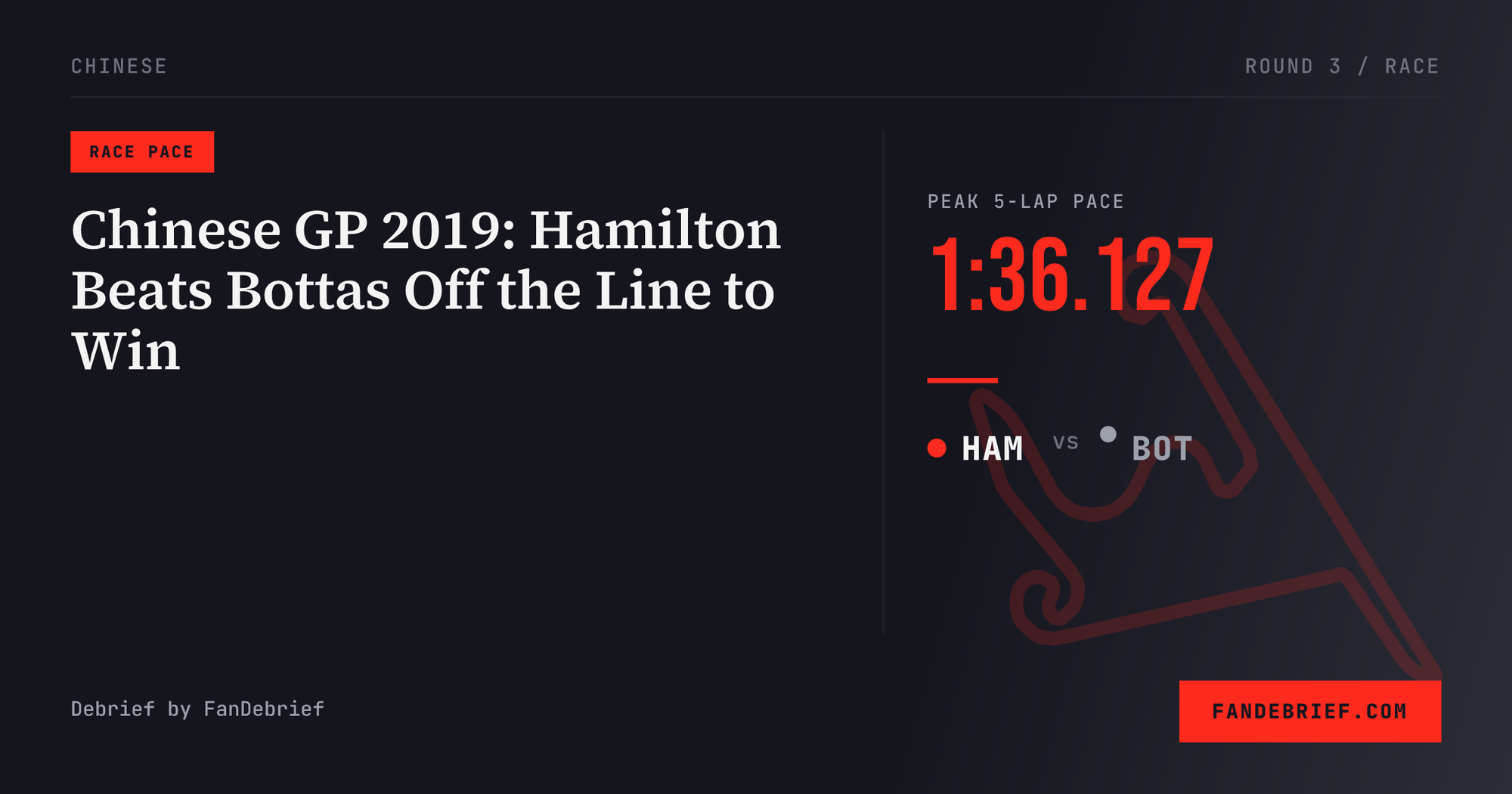
Formula One's 1000th world championship race did not take long to find its story. Valtteri Bottas had pole position by two hundredths of a second over his own teammate, the tightest front row Mercedes could hand him. By the first timing loop of the race, Lewis Hamilton was already through and clear, nearly two seconds up the road. Everything else that happened over the next fifty-five laps was Mercedes defending a lead that had been won before the cars reached Turn 6.
This was not a race decided by a strategic masterstroke or a late-race gamble. It was decided in the opening seconds, and then confirmed lap after lap by a Mercedes that was simply the fastest thing on the circuit all afternoon. Hamilton's average racing lap across the distance, 1:37.5, was the quickest of anyone in the field, Bottas a tenth and a half behind him in second. The rest of the grid spent the day rearranging itself behind two cars that were never seriously threatened.
Qualifying had promised something closer. Bottas took pole with a 1:31.547, Hamilton within two hundredths, and Sebastian Vettel headed the second row three-tenths back with Charles Leclerc alongside him. Max Verstappen was fifth, more than half a second off pole, and the gap from there back to the Renaults and Haas in the top ten stretched out quickly. On a weekend Formula One had spent building up as a landmark, a fourth Mercedes lockout of the podium's top two in as many events would have been nobody's shock prediction, but the manner of it, Hamilton converting the wrong end of the front row into a lights-to-flag win, was the story that actually unfolded.
The start that decided the podium's top two
The on-track gap between Hamilton and Bottas tells the whole race in miniature. Hamilton led by 1.98 seconds after the opening lap, stretched that to 5.5 seconds by lap 20, then watched it shrink to 1.5 seconds around lap 25 as Bottas cycled through his own pit stop a lap ahead of his teammate. It was the only moment all day the race looked like it might turn into an actual fight. Hamilton answered it by pitting the following lap and immediately building the gap back out, past 5 seconds by lap 35, past 6.5 by lap 40, and it never came back under six seconds again. The two Mercedes pitted for their final set of tyres on the same lap, 36, a tidy piece of synchronised pit-wall work that removed any lingering jeopardy from the second stops.
Ferrari's afternoon was messier by comparison, and self-inflicted. Leclerc started fourth and finished fifth, one place worse off than he started; Vettel started third and held it to the flag. Verstappen was the one who actually profited from the churn between them. His Red Bull pitted first among the front-runners, on lap 17, a lap ahead of Vettel and five ahead of Leclerc's first stop, and the timing of that call is the difference between Verstappen crossing the line fourth and Leclerc fifth. An early stop that jumps a queue is usually called an undercut for a reason, and this one worked precisely as advertised, vaulting Verstappen clear of a Ferrari that pitted later and never got the position back.
Sector data explains why nobody down that group of five ever looked like closing on the Mercedes ahead of them. Hamilton was the fastest car through the final sector, Shanghai's tight, technical run from Turn 11 to the flag, on 34 of the race's 56 laps, with an average margin approaching two-tenths. Leclerc was the sharpest through the long opening sequence, sector one, on 14 laps, but sector two and three both belonged to Hamilton, and in a lap that's mostly corners rather than straight, that's where a race gets won. Mercedes wasn't just quicker on Sunday; it was quicker in the part of the lap that actually decides pace.
The data behind the race
Timing and telemetry from every car on track.


The rest of the field, and a fastest lap that didn't matter
Gasly's afternoon deserves its own mention, if only because it produced the single quickest lap of the entire race, a 1:34.7 set on lap 55 after Red Bull sent him out on a fresh set of softs for one final stop nobody else on the lead lap bothered with. It didn't move him anywhere; he started sixth and finished sixth. But it's a reminder that raw one-lap pace and race-winning pace are different currencies, and Gasly's extra stop, three to Hamilton's two, bought him a fast lap and nothing else, while his teammate's earlier and better-timed single stop moved Verstappen up the order instead.
Further back, Ricciardo's return to the points was the quieter good story of the day. He ran a single pit stop, the leanest strategy of anyone in the top ten, and held seventh from start to finish without losing a place, his best result of a season that had given him nothing before this. His own side of the Renault garage did not share the afternoon; Nico Hulkenberg was out after 16 laps with a power unit failure, ending a day that never got started for the team's other car. Ricciardo's fastest lap of the race was over a second quicker than his retired teammate's had been, a gap that says less about a head-to-head and more about how little running Hulkenberg got to do before his engine gave out.
Sergio Perez and Kimi Räikkönen both climbed four places to finish eighth and ninth, Perez from a P12 start and Räikkönen from P13, each on a single-stop plan that clearly worked better than most of the two-stop strategies further up the order. Alexander Albon's day stood out even among that group: starting from the back of the field, he made a solitary pit stop hold up all the way to a tenth-place finish, ten places better than where he began, seeing off Romain Grosjean's Haas in the closing laps. It was the sort of afternoon a driver remembers.
The race lost two cars to collisions and one to mechanical failure. Daniil Kvyat picked up a lap 6 drive-through penalty for causing a collision and was later out of the race himself; Lando Norris's McLaren went the same way after 50 laps. Neither Ferrari nor Alfa Romeo, Haas, Williams, Mercedes, Red Bull, or Racing Point lost a car all day, a reminder that reliability, not just raw pace, still separates the teams running at the front from the ones scrapping in the middle.
Hamilton's win was his sixth at this circuit, and it arrived a year after Daniel Ricciardo had taken the race from pole won by Vettel, a reminder that Shanghai has a habit of not repeating itself from one April to the next. What it does confirm, three rounds into the season, is that Mercedes has won every race so far, Bottas in Australia, Hamilton in Bahrain, Hamilton again here, three different margins but the same team both times on the top step. Ferrari has been close enough in raw pace to make each of those weekends look winnable and not close enough to actually win one; Vettel said as much himself in the paddock afterwards, and the timing sheets back him up. Baku's long straights and heavy braking zones next will ask a different question of that Ferrari, and of a Red Bull that's now shown it can out-strategize a Ferrari when the moment allows. Whether either can turn proximity into an actual win is the story the next round needs to answer.