China GP 2026: Antonelli Takes Pole in the Hairpin Sector
Antonelli beat Russell by two tenths for pole in Shanghai, and the sector sheets say it was a hairpin, not the long back straight, that settled it.
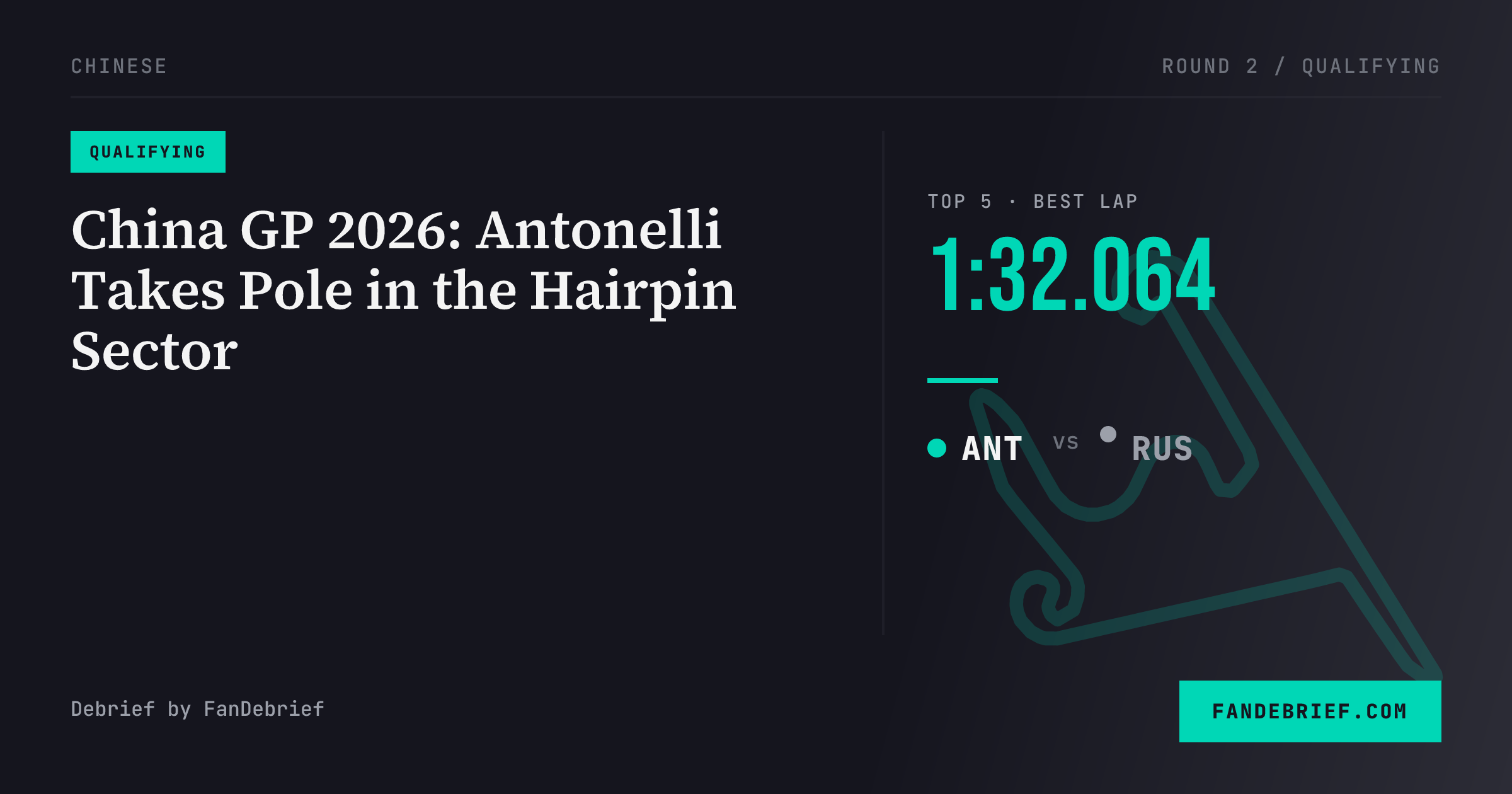
Andrea Kimi Antonelli put together the lap of the weekend when it mattered most, edging Russell by two tenths of a second to take pole for the Chinese Grand Prix. It's his first pole of the season, and it came at a circuit where the fastest way around isn't necessarily down the long back straight everyone talks about.
This session was decided in the sector nobody watches. Shanghai's middle sector is barely there, just the run to the back straight and the hairpin that follows it, yet that's precisely where Antonelli built his advantage. He topped sector two five times across the field's flying laps with an average margin of seven and a half hundredths, a number that sounds trivial until you realise it's roughly the size of his entire winning margin over Russell.
Coming into the weekend, Russell had won at Albert Park and arrived in China as the championship leader by seven points over Antonelli, with Mercedes holding a healthy gap over Ferrari at the top of the constructors' table. Shanghai's history offered little precedent either way: Piastri took pole and the win here last year, Verstappen the year before that. Neither Mercedes driver had anything to point to locally, which made the front-row lockout feel less like continuity and more like a statement.
The top of the timesheet tells a story of margins so fine they're almost abstract. Antonelli's pole lap went to Russell by two tenths, then to Hamilton by fourteen hundredths more, and Leclerc split the Ferrari pairing by just four thousandths of a second behind his teammate. Four cars, covered by under four tenths, is the kind of number that makes Sunday's opening laps into appointment viewing regardless of what the long-run pace suggested. Piastri and Norris rounded out the top six for McLaren, both a bit over half a second back, while Gasly's seventh for Alpine was the surprise of Q3, ahead of a Red Bull pairing that looked strangely ordinary in Verstappen's eighth and Hadjar's ninth.
Sector one belonged to Leclerc more often than anyone, four fastest sectors from the session with an average margin of nearly two tenths, which makes his final position all the more interesting: all that sector-one speed and he still ended up fourth, not on the front row. Russell answered in sector three, quickest there three times with an average edge of over two tenths, banking time through Shanghai's long final complex only to lose the lap in the middle sector where Antonelli made his stand. Qualifying laps are rarely won and lost in one place, and this one wasn't either, but the hairpin sector was the difference between pole and second on this occasion.
The gap that didn't show up in the result
The most instructive number from the whole session sits well down the order. Gasly, seventh on the grid, was actually half a second quicker than Antonelli through the final sector on his best lap, the exact same sector where Russell built his case. That kind of raw pace in isolation, buried six places back in the final classification, is a reminder that one blistering sector doesn't make a lap; Antonelli's lap worked because it was quick everywhere, not spectacular anywhere.
Tyre strategy through the session showed the Q3 runners doing their fastest work on softs across long runs rather than one-lap specials alone; Antonelli's average lap on his softs actually improved as the stint went on, degradation running slightly negative, evidence that Mercedes had the tyre working with them rather than against them all weekend. Leclerc's numbers told a similar story, laps getting quicker rather than slower deep into a long soft stint, which raises an obvious question for Sunday: if that pace holds into the race, fourth on the grid might understate what Ferrari have in the car.
Elsewhere the picture was less flattering. Verstappen's eighth for Red Bull, alongside Hadjar in ninth, leaves both cars mixed in with the midfield rather than fighting the Mercedes-Ferrari group at the front, a definite step back from the top-four form the sector sheets suggest they're capable of chasing. Further down, Sainz headed the Q1 eliminations in seventeenth for Williams, with a lap time deleted earlier in the session for exceeding track limits at Turn 2, one of several laps wiped off across the hour; Russell, Hamilton, Lindqvist, Law and Ocon all had times chalked off at various points, a reminder of how unforgiving Shanghai's limits are even for the frontrunners. Perez propping up the order in twenty-second, some four and a half seconds off pole, was the outlier of the whole session; nobody else was within three seconds of that gap.
Sunday's race is still to be run, and Shanghai's data all season has shown that pole here is no guarantee: neither of the last two winners started from anywhere but the very front, so Antonelli's task is now to convert. But the story qualifying leaves behind isn't really about the top two, it's about the middle sector nobody talks about deciding the front row, and about a Ferrari pace picture in the long runs that might make Sunday considerably harder for Mercedes to control than Saturday suggested.
The data behind qualifying
Timing and telemetry from every car on track.


