Miami Sprint Qualifying 2026: Norris Snatches Pole and Ends Mercedes' Perfect Run
Norris out-hustled championship leader Antonelli by two tenths in a nervy SQ3 shootout, and it was McLaren's upgraded floor, not raw one-lap pace across the board, that made the difference.
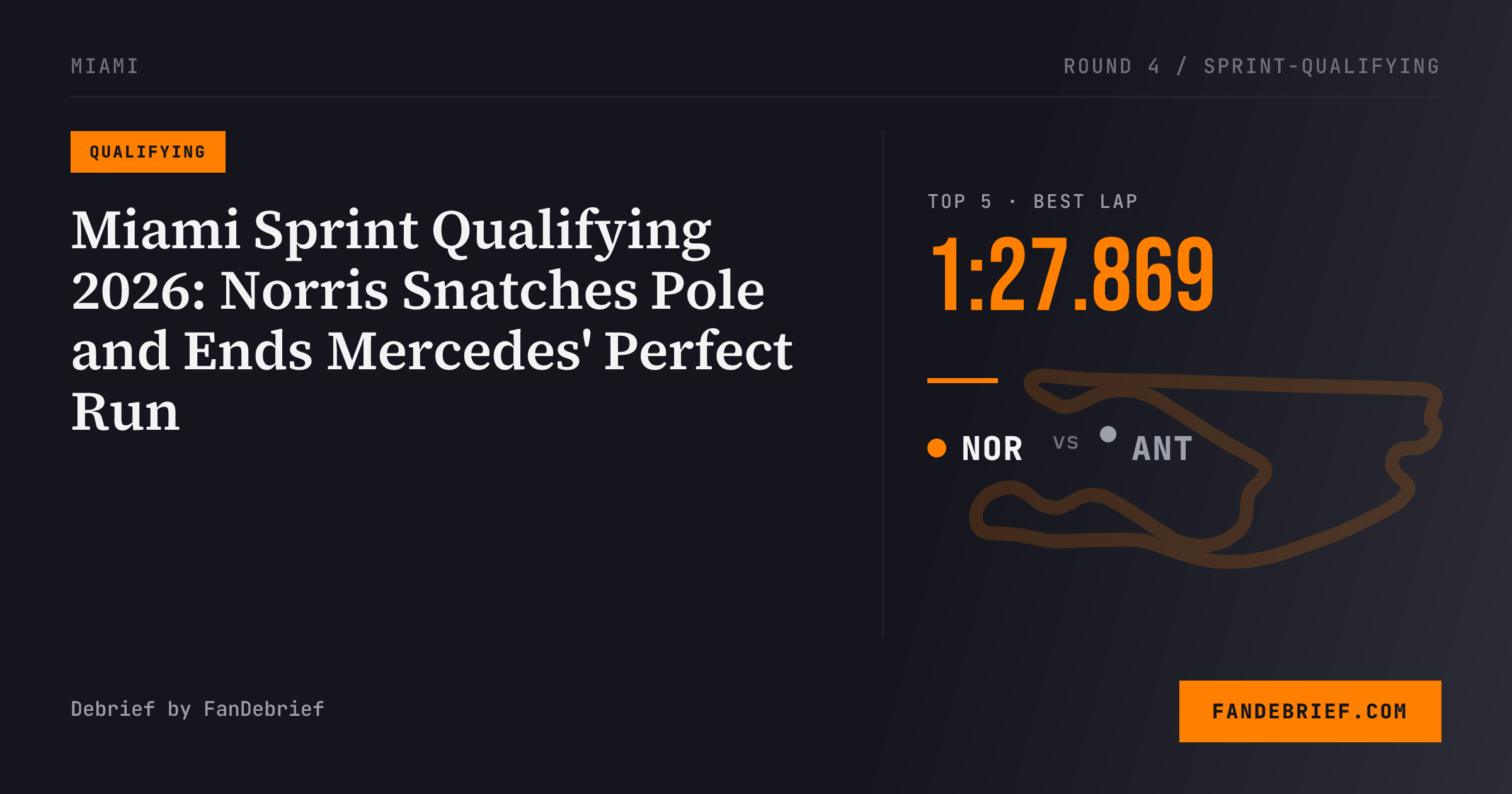
For three rounds this season, Mercedes had turned Saturday and Sunday afternoons into a formality. Not in Miami. Lando Norris crossed the line in SQ3, glanced at the board, and found himself top of a sheet that had belonged to Kimi Antonelli's team all year. Two tenths. That's all it took to flip the script.
This session is really about one number hiding inside a bigger one: Antonelli was faster than Norris through two of the three sectors on his best lap, yet he still lost pole by 0.222 seconds. The story of Miami sprint qualifying isn't that McLaren was suddenly the fastest car everywhere. It's that Norris found something in one specific place that mattered more than anywhere else.
McLaren arrived with new parts, and Ferrari and Red Bull brought their own updates too, after teams used a break to introduce changes rather than run consecutive weekends. Mercedes had won every race and every sprint so far this season between Antonelli and George Russell, so a queue of rivals turning up with fresh hardware in Florida's heat (air hovering around 30.6C, track over 52C) always had the look of a pressure test. It just wasn't obvious beforehand who'd pass it.
The sector that decided it
Antonelli's lap wasn't slow. Across the weekend he was the man to beat in the middle sector and thereabouts in the final one, and on his pole-losing run he still out-paced Norris in two of the three phases of the lap. But sector one cost him 0.277 seconds relative to Norris, more than the entire margin at the flag, and that was the whole ballgame. Norris' first sector was among the sharpest of anyone in SQ3; everything downstream of Turn 5 was almost beside the point once that gap was banked. It's the kind of detail that gets lost in a headline that just says "Norris on pole," but it's the actual explanation for why McLaren's name is at the top of the timesheet and Mercedes' isn't.
That single sector also explains why this didn't feel like a Norris masterclass from lights to flag. Piastri was barely a tenth behind his teammate in third, Leclerc split the frontrunners in fourth less than four tenths off pole, and Verstappen made it a five-car spread inside six tenths of Norris by fifth. Four different teams sat inside the top five. Nobody, Norris included, lapped this field into submission; he won a fight for hundredths in the one part of the circuit where it counted most.
Zoom out across the full lap-by-lap sector data and Norris' fastest-sector-two average margin looks enormous, over three seconds when he topped it, but that number is inflated by comparing across the medium-to-soft tyre swap during the hour, not a clean apples-to-apples read of raw pace. The number that actually decided pole is the 0.222s at the flag, built almost entirely in sector one.
Red Bull's awkward split
If Mercedes had a bruising afternoon by its own recent standards, Red Bull had a stranger one. Verstappen slotted into fifth, three tenths off Norris, which on its own reads as a solid recovery drive for a team hunting upgrades of its own. But teammate Hadjar was buried in ninth, nearly a full second slower across their respective best laps, a gap that dwarfs anything at the front of the field. That's not a car that's uncompetitive; it's a car that one driver is currently extracting far more from than the other, and that's a very different problem for the garage to solve than outright pace.
Further back, Alpine put both cars into the top ten shootout, with Colapinto eighth and Gasly tenth, Hadjar splitting the pair. Colapinto out-qualifying his more experienced teammate is the kind of subplot that would ordinarily lead a midfield write-up on its own; here it's a reminder that the fight for points on Saturday afternoon is getting tighter, not looser. Sainz and the second Williams both fell in Q2 despite Sainz's car touching 336km/h, the fastest speed-trap reading of the entire session, proof that a car can be quick in a straight line and still leave a session with nothing to show for it if the corners don't cooperate.
Behind them, Bortoleto, Hulkenberg, Bearman, Albon and Lindblad made up the rest of the Q2 casualties, while Lawson, Ocon, Perez and Bottas went out in Q1. Alonso and Stroll never posted a representative time at all, both having laps deleted for track limits at multiple points in the session, which left them at the very bottom of the sheet without a number next to their names.
What it means for the sprint
This was sprint qualifying, not the race itself, so nothing here has actually been won on the track yet. What Norris takes into the sprint is a pole built on one strong sector rather than a car that dominated everywhere, and that's a useful distinction: Antonelli starts alongside him having lost by a whisker, not by a mile, with genuine pace of his own to lean on once the lights go out. Mercedes had not been beaten to a pole all season before this, and how the team responds, whether Antonelli or Russell can turn sector strength into a start-line advantage, is the first thing worth watching when the sprint gets underway. The bigger picture, McLaren's upgrade actually working under race-week pressure, only gets confirmed if Norris can convert Friday's tenths into Saturday's points.
The data behind sprint qualifying
Timing and telemetry from every car on track.


