Miami Grand Prix 2026: Antonelli Holds Off Norris for a Third Straight Win
Lando Norris had the faster car for most of a Sunday that swung through five lead changes, yet Kimi Antonelli still crossed the line three seconds clear because he owned the one stretch of the Miami International Autodrome that decided everything else.
Kimi Antonelli spent the first thirteen laps of the Miami Grand Prix losing the lead almost as fast as he won it back. He spent the next fifteen watching Lando Norris pull nearly three seconds clear on pure pace. He spent the last twenty-five laps doing what he's done all season: closing the door and not opening it again. By the chequered flag the gap read 3.24 seconds. None of it was straightforward, and that's exactly why it's worth unpacking.
This was not the coronation the final margin suggests. Norris actually carried the faster car through the race, by the finest of margins, and for a decent stretch in the middle third he was demonstrably the quicker driver on track. What won Antonelli the race wasn't outright speed. It was one sector of the Miami International Autodrome that he made his own, lap after lap, while everything else stayed close enough to argue about.
A grid that promised exactly this kind of fight
Qualifying had set up a tight top six. Antonelli took pole at 1:27.798, but Verstappen was only 0.166s back in second, Leclerc a further 0.345s adrift in third, and Norris fourth just twenty milliseconds behind the Ferrari. Russell, Hamilton and Piastri filled out the rest of a top seven covered by seven-tenths. On a street track with a long back straight and only moderate overtaking difficulty, that kind of grid spread was always going to produce a race decided by execution rather than a runaway.
The track ran dry and hot, with track temperatures averaging 37C, conditions that tend to punish whoever mismanages a tyre stint on a surface that heats up fast. Nobody in this field would get away with mismanaging one for long.
The data behind the race
Timing and telemetry from every car on track.


Four cars gone before lap ten, then a race that kept changing hands
The opening laps were violent in the way Miami's early laps tend to be. Isack Hadjar and Liam Lawson were both out inside six laps, Nico Hulkenberg followed at lap seven after two separate pit visits, and Pierre Gasly's afternoon ended at lap five in a Turn 17 incident that collected another car. Four retirements before the race had even reached double figures, and the wreckage triggered a Safety Car at lap six that ran until lap eleven.
The lead itself changed hands five times, four of them on track. Antonelli grabbed it from Leclerc on lap four, lost it straight back to the Ferrari a lap later, and then watched Norris take it from Leclerc on lap 13. That's three different leaders inside the first quarter of the race, before the pit-stop cycle even started to matter. It's the kind of opening that tells you the fastest car on Saturday doesn't automatically translate into the easiest Sunday.
Verstappen's story ran on its own clock entirely. He pitted at lap six, remarkably early, right as the Safety Car neutralised the field, converting what could have been a lost lap into a free stop. It set up an ultra-long final stint on the hard tyre, more than fifty laps on one set, and it very nearly worked: when Norris finally made his own stop on lap 27, Verstappen inherited the race lead for a lap through the pit cycle. But his medium tyre in that opening stint had degraded alarmingly, over two tenths a lap by the time he pitted, the worst first-stint fall-off of anyone in the field, and it hinted at a car that was never entirely comfortable in Miami's opening corners. Antonelli passed him back on track a lap later, at lap 29, and from there the race lead didn't move again.
The sector that decided it
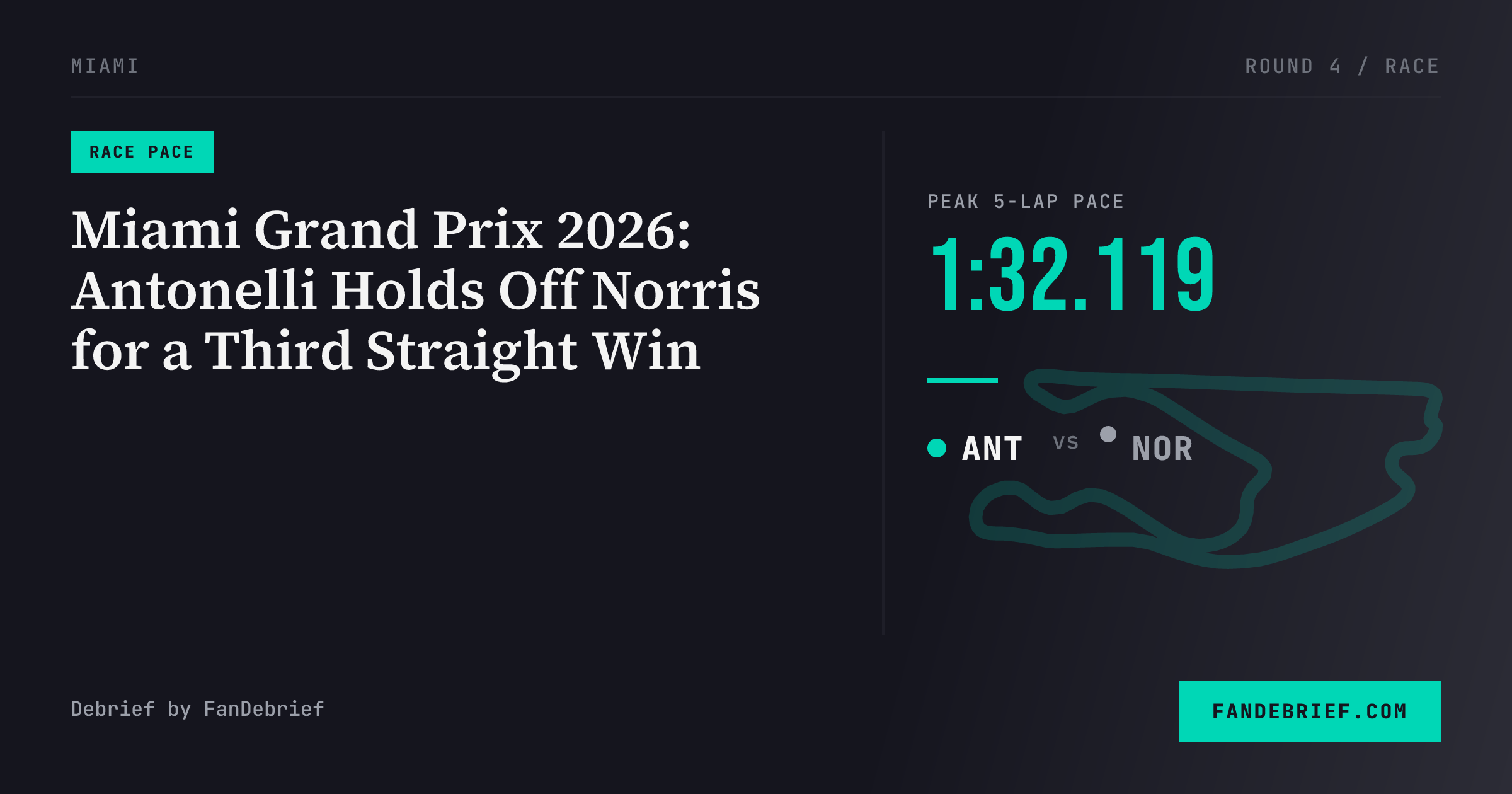
Here's the number that should worry McLaren more than the result did. Across the weighted average of every stint in the race, Norris was the fastest driver in the field, at 1:32.749 a lap, with Antonelli just nine thousandths of a second behind at 1:32.758. That is, for all practical purposes, a dead heat over 57 laps. Norris also topped sector one on 19 laps and sector three on 26, more than either rival, and he set the outright fastest lap of the race, a 1:31.869 on lap 35, with Piastri and Antonelli within a tenth of it behind him.
So how does a driver with a marginal pace disadvantage, on the same tyre strategy, win by over three seconds? Sector two is the answer. Antonelli was fastest through that stretch, the chicane complex and the long run down the back straight, on 36 of the 57 laps, more than the other two sectors combined for anyone else, and by an average margin approaching two tenths every time he did it. On a lap that decides itself through three phases, owning the longest and most technical of them on nearly two-thirds of the laps run is how you turn a wafer-thin average into a three-second winning gap. It also explains the mid-race wobble: when the gap between the two swelled to 2.88 seconds in Norris's favour around lap 20, it was Norris's sector-one and sector-three speed doing the damage. When Antonelli reeled it back in after the stops, it was sector two doing the pulling.
The strange footnote to the sector story belongs to Verstappen. His fastest lap through sector one was 0.657s slower than Antonelli's best there, a startlingly large chunk of time to lose in the opening five corners of a lap, and it's a fair guess that whatever cost him that time on his best lap was costing him similar time on most others. A driver who starts second and finishes fifth usually has an explanation somewhere in the sector sheet, and this looks like it.
Both front-runners' pit work was clean enough to be a non-story, which in itself says something. Russell's stop was the pick of the front-runners at 22.00s, Antonelli's not far off at 22.10s, and Norris's 22.60s. None of those numbers separated the race; the fastest stop of the entire afternoon, a 17.00-second effort from Valtteri Bottas, came with an asterisk attached, since Bottas served a drive-through penalty for speeding in the pit lane on the very lap he made it. This was a race won and lost on track, not in the pit lane.
The rest of Miami's afternoon
McLaren leaves Florida with a genuine double podium, Norris second and Piastri third after climbing four places from a P7 start, and on raw pace they have every right to feel this was closer to a maximum than the gap to Antonelli suggests. Russell's recovery to fourth, up one from his grid slot, keeps Mercedes's one-two intact in the constructors' battle even on a day their sister car had to fight for it.
Verstappen's fifth from a front-row start is the strategic story that almost paid off; Leclerc's eighth from third is the one that didn't. The Ferrari led twice in the opening laps and looked every bit the pole contender he'd been on Saturday, but a medium stint that degraded at three-hundredths a lap left him exposed later on, and he shipped five places by the flag. Hamilton, by contrast, had the quietest race of anyone in the top ten, starting and finishing sixth without gaining or losing a place all afternoon, comfortably behind the pace of both title leaders but never troubled either.
Further back, Franco Colapinto's seventh was a tidy, unspectacular recovery drive, made to look better by the wreckage of his teammate's weekend; Gasly's race ended after five laps in the Turn 17 incident, and any lap-time comparison between the two Alpines this weekend has to come with that caveat attached. Carlos Sainz and Alexander Albon both hauled Williams into the points from well outside the top ten, Sainz up four from P13 and Albon up five from P15, while Gabriel Bortoleto's Audi was the day's biggest single mover, up nine places to finish twelfth even after being lapped.
The four retirements were spread across four different teams, one each for Alpine, Audi, Racing Bulls and Red Bull Racing, a reminder that Miami's opening laps chew up cars that get even slightly out of position at Turn 1 or through the chicane that follows it.
What Canada should be watching for
Antonelli's third consecutive win, following victories in Shanghai and Suzuka, extends a run that started the season 72 points to 63 clear of Russell before this weekend even began, and Miami will only stretch that further. But the number that should actually worry Mercedes is the 0.009-second gap in average race pace. If Norris is genuinely matching Antonelli's underlying speed and simply needs to find a sector two of his own, Canada is a very different kind of circuit to test that on. Ferrari, meanwhile, has a tyre-management question to answer after Leclerc's slide from third to eighth, and Red Bull will want to understand exactly what cost Verstappen two-thirds of a second in the opening five corners before they try another early-stop gamble at Montreal.