Japanese GP 2026: Antonelli Wins by 13.7s After Safety Car
Oscar Piastri led for the best part of eighteen laps and looked the sharper car all afternoon, but a Safety Car that arrived on the exact lap Kimi Antonelli reached the pit lane turned Suzuka back into a Mercedes race.
Piastri had the lead by the time the field crossed the line to complete lap one, jumping the polesitter from third on the grid, and for a while it looked like the story of the afternoon would be a McLaren stealing a Mercedes home race. It wasn't. By the chequered flag it was Kimi Antonelli, starting from pole, who had the win, and the way he got there says more about Suzuka's pit windows than about anyone's outright pace.
This was a race won on the calendar of pit stops, not on a single overtake. Piastri led on the road from lap one, Antonelli reclaimed it through the sequence of stops that cascades through a pit-cycle race, and then a Safety Car landed on the exact lap Antonelli was already committed to the pits, turning what should have cost him time into a stop that cost him almost nothing.
How the front row became a pit-stop puzzle
Antonelli had taken pole by three tenths over teammate George Russell, with Piastri third and the top five covered by little more than six tenths, so the grid promised a tight opening lap. It delivered one: Piastri surged clear at the start and by the first racing lap already had a gap of three and a half seconds over Antonelli, who had dropped away from the front row he'd started on. Russell wasn't immune either; both Mercedes cars found themselves further back than their grid slots suggested once the lights went out.
What followed was a genuine tussle for the physical lead. Russell took it from Piastri on track on lap eight, only for Piastri to snatch it straight back a lap later. That on-track lead held until lap 18, when Piastri became the first of the front-runners to pit, handing the net lead to Russell, who was still out on his opening set of mediums. Russell led for three laps before his own stop on lap 21 passed the lead to Antonelli, the last man among the front-runners still to make his first stop. It's the classic mechanics of a one-stop race: whoever pits last, leads last, right up until they don't.
Antonelli's stop came on lap 22, and it landed on the same lap the Safety Car was deployed. The order of events matters here. Bearman had brought his Haas to a stop after 21 laps, and the yellow flags that followed turned into a full Safety Car the next lap, with double-waved yellows through the Turn 20 and 21 sector. Every driver who still had a stop to make effectively got it discounted, the field bunched up behind the pace car erasing the time a green-flag pit stop would normally cost. Antonelli, Hamilton, Gasly, Verstappen, Lawson, Bortoleto and Albon all cycled onto hards in that same window, lap 21 to 22, while Piastri, Leclerc and Norris had already made their stops on laps 18, 17 and 16 respectively, well before the yellow flags appeared, and got no such discount.
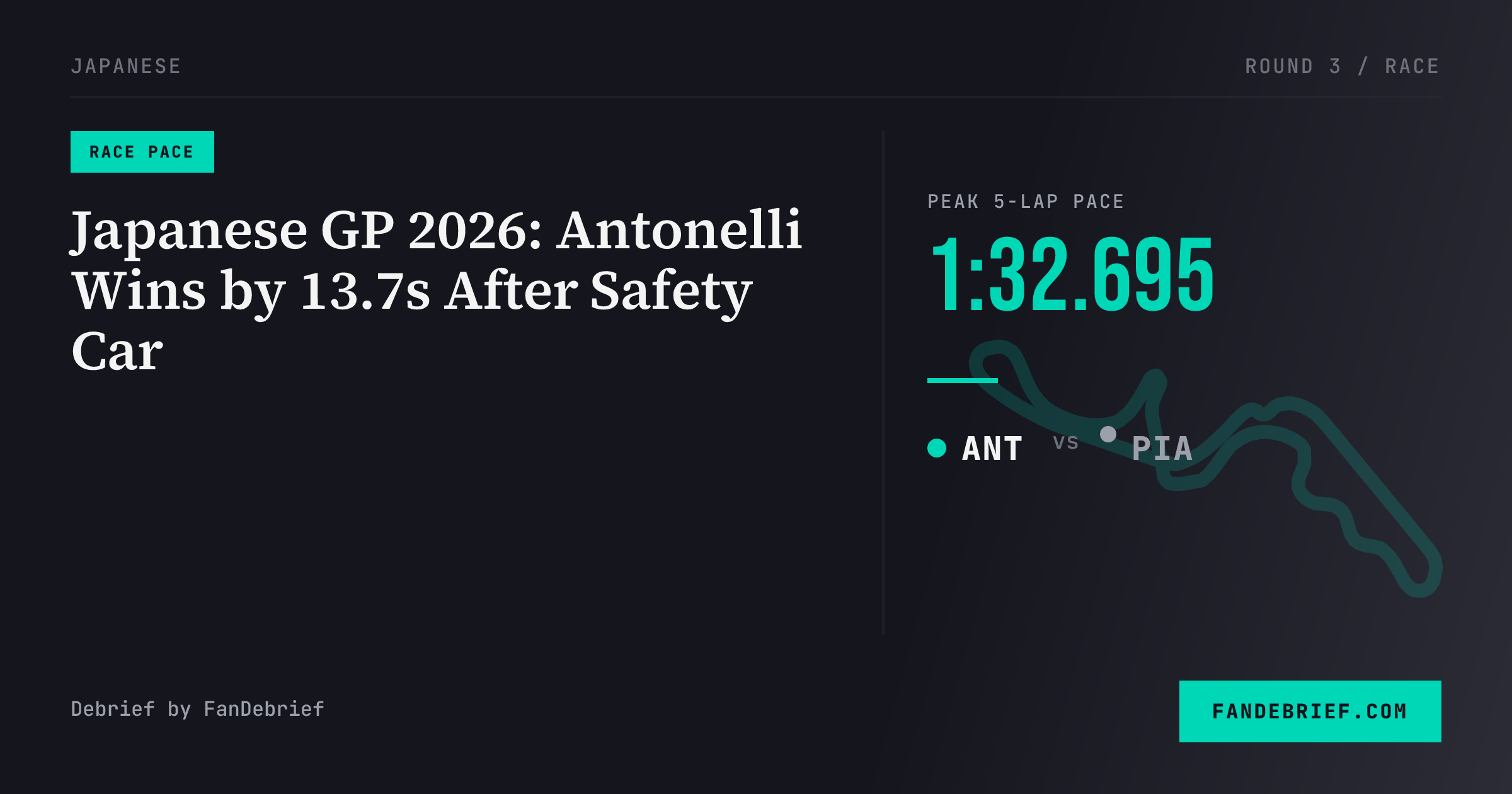
That's the decisive moment of the race. The gap between Antonelli and Piastri at lap 20, mid-cycle, briefly ballooned past 18 seconds as cars shuffled through the pit lane, then settled to a lead of under two seconds by lap 25 once the Safety Car had done its work and the race restarted on lap 27. From there it was a straight speed contest, and Antonelli had the fastest car left on the road. His weighted average lap across both stints, 1:33.811, was the quickest of anyone in the field, comfortably ahead of Piastri in second. That gap of roughly a quarter of a second a lap doesn't sound like much, but stacked over close to thirty laps it turned a photo-finish into a laughing margin. By lap 35 Antonelli was five seconds clear. By lap 45 it was over twelve. He crossed the line 13.68 seconds ahead of Piastri, and the last ten laps of that gap were pure and simple pace, not strategy.
Antonelli's sector work backs up the story. He was the fastest car through sector one on 21 of the 53 laps and fastest through the 130R-and-chicane sector three on 20 of them, the two sectors that reward exactly the high-speed rhythm Suzuka is famous for. Leclerc had the answer in the middle sector, fastest there 20 times, which tracks with Ferrari's strong recovery to third; but a driver who owns both ends of the lap at a circuit built on flow is going to be hard to pass, and nobody at Suzuka on Sunday found a way to try.
The data behind the race
Timing and telemetry from every car on track.


The other stories: Leclerc's climb, Verstappen's recovery, and a wild card at the back
Leclerc's third place, up one from his grid slot, was built on exactly that mid-sector strength, and it puts Ferrari on the podium for the second race running given Hamilton's result at the previous round. Hamilton himself was solid rather than spectacular in sixth, unchanged from his grid position, though his crew produced the fastest pit stop of the entire race at 22.90 seconds, a small but real marker of Ferrari's operational sharpness this weekend.
The more interesting recovery drive belonged to Max Verstappen. Suzuka has been his personal fortress; the season history here shows him taking pole and the win in 2023, 2024 and 2025, three years running. This time he didn't even make it out of Q2, and instead of extending that run he started 11th. What he did with the race afterwards mattered more than where qualifying left him: eighth at the flag, up three places, on a weighted race pace that ranked eighth as well, evidence that whatever went wrong in qualifying wasn't a Sunday problem. Liam Lawson made the bigger jump inside the points, up five places from 14th to ninth, the best recovery of anyone who finished in the top ten.
At Haas, the story split down the middle of the garage. Ocon salvaged a point in tenth while his teammate Bearman was out of the race after 21 laps, retiring before the Safety Car that his own stoppage triggered even had a chance to help anyone else; the gap between the two Haas drivers' best laps, well over a second, tells you which side of the garage was actually racing on Sunday. Further back, Albon's afternoon deserves a mention for sheer stubbornness: six pit stops, a scramble through soft and medium compounds late in the race, and the reward was 20th, a lap down. It's the kind of strategy that only makes sense if the alternative looked even worse, and on this occasion it didn't pay off. Stroll's day ended after 30 laps, and Bearman's after 21; neither retirement is attributed to anything beyond the bare fact of stopping, but both cost their teams a points opportunity that the sister cars, Ocon in tenth and a battling Alonso still on track, couldn't fully cover for.
This is Antonelli's second win in three rounds, and the Mercedes name has now been on the winner's trophy at every race so far this season, Russell in Melbourne and Antonelli in Shanghai and now Suzuka. Heading into this weekend Mercedes already held a healthy cushion over Ferrari in the constructors' fight, and a third straight team victory only stretches that lead further. What Sunday's race actually proved, though, is that Mercedes' advantage isn't just raw one-lap pace; it's a car that can lose the physical lead at the start, lose it again mid-race through the ordinary churn of pit strategy, and still come out the other side because the driver in it is simply faster once the tyres are on. Piastri had the start and the early pace to make this his race, and Ferrari had the sector two speed to make it a genuine three-way fight. Neither was enough. With a five-week gap before Miami, McLaren and Ferrari now have to find whatever Antonelli found in that second stint, because if Suzuka is any guide, the Safety Car helped him get to the front, but it was raw pace that kept him there.