Hamilton Wins Japanese GP 2018 From Pole, Vettel Sixth
Lewis Hamilton controlled Suzuka from the front row to the flag, but the number that actually tells you about the title fight belongs to Sebastian Vettel, who drove the fastest lap of the afternoon and still finished sixth.
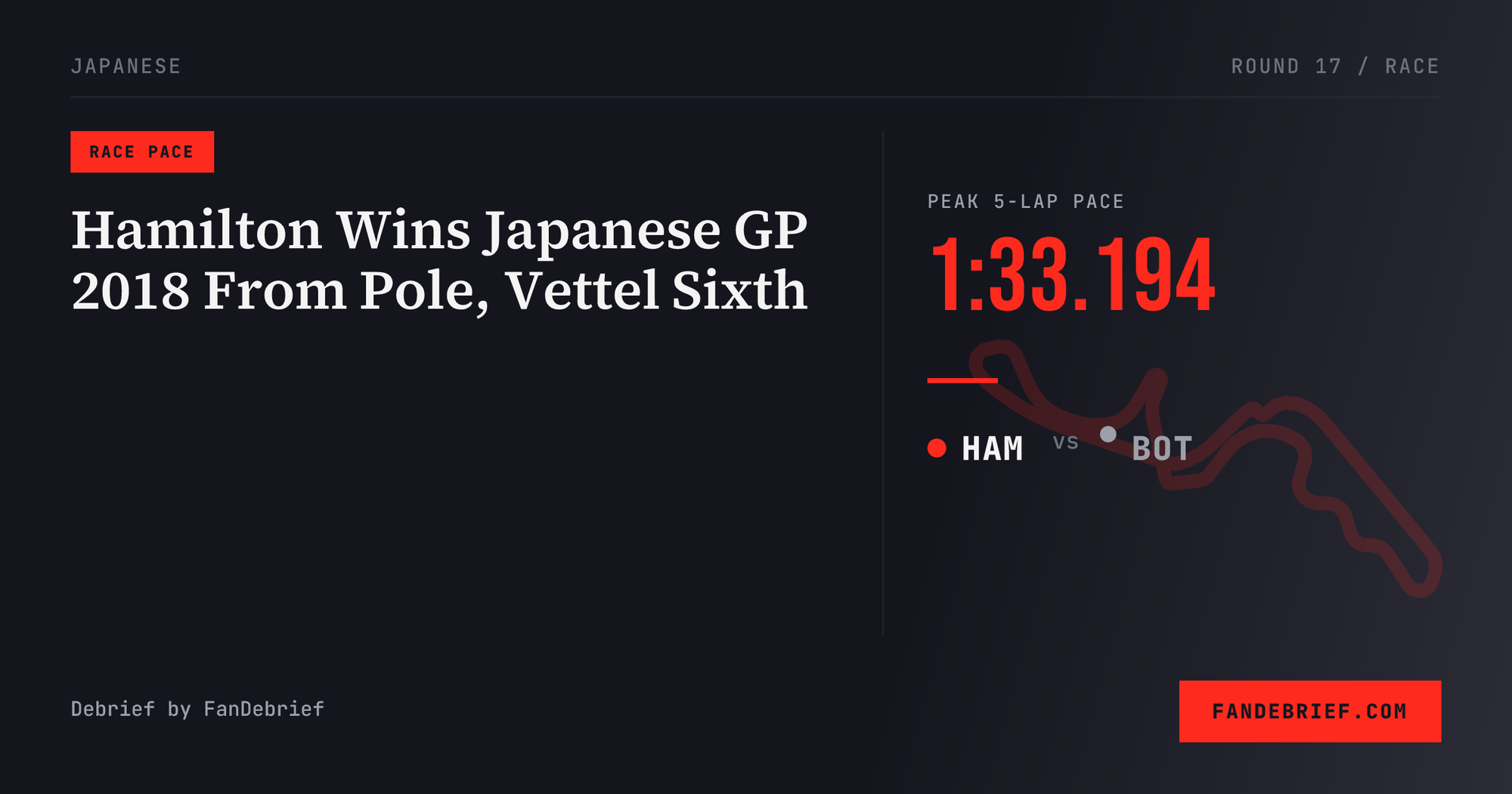
Verstappen's Red Bull was still trailing wisps of gravel dust when the safety car boards went up on lap four, and by the time the field crawled back to green three laps later, the story of this Japanese Grand Prix had already split in two. One story belonged to Lewis Hamilton, who simply drove away and never came back. The other belonged to Sebastian Vettel, who would spend the next 45 laps proving he had the fastest car at Suzuka and finishing sixth anyway.
That's the tension worth sitting with here. Hamilton's win was comprehensive, yet the number that actually says something about the title fight is Vettel's: a 1:32.318 on lap 53, four tenths quicker than anything Hamilton produced all afternoon, delivered from a car that never got closer than sixth in the classification. A fast lap in isolation is a parlour trick if you spend the race in traffic. Suzuka was the proof.
Hamilton arrived with a 50-point championship cushion over Vettel and left it untouched in terms of pure pace: pole by three tenths from Bottas, then a lights-to-flag execution that made the rest of the grid look like it was racing for something else entirely. This was also Hamilton's fourth straight win, stretching back through Sochi, Marina Bay and Monza, and it made Suzuka his again after victories here in 2017 and 2015. Weather played no part in any of it, dry and warm all weekend with track temperatures hovering around 37 degrees, the kind of conditions that reward the car that's simply quickest, and on Sunday that was the silver one.
The gap that never stopped growing
Hamilton's advantage over Bottas was 1.3 seconds on lap one. By lap 20 it was four and a half. By the flag it was 12.9 seconds, built lap by lap rather than in one decisive strike, which is the more damning version of dominance. Hamilton topped the timesheets in all three sectors across the race, fastest through the esses on 15 laps, fastest through the middle sector on 19, fastest through 130R and the chicane on 18, and his crew backed it up by producing the fastest pit stop of the day, 22.5 seconds when he swapped to mediums on lap 24. Nothing about the winning drive asked a question Mercedes couldn't answer instantly.
Bottas had the harder afternoon of the two silver cars, wrestling front-tyre issues that Hamilton didn't share, and he still had enough in hand to keep Verstappen at arm's length for the whole second half. That in itself says something about how comfortably this Mercedes one-two was banked; the sister car of the race winner was under pressure and Mercedes still finished twelve seconds clear at the front.
Behind them, Verstappen's afternoon was defined in the opening laps. He was handed a five-second penalty on lap five for leaving the track and rejoining unsafely, a call that would leave him fuming afterward, reportedly telling reporters the decision was “ridiculous.” Yet the penalty barely mattered to the final result: Verstappen still crossed the line in podium position and kept it after the time was added, third for Red Bull and second-best race pace of the entire field on a weighted average across his stints. A penalty that doesn't cost you the podium is really just a footnote, and that's exactly what it became.
The data behind the race
Timing and telemetry from every car on track.


Vettel's wasted afternoon
Which brings us back to the sixth-place Ferrari with the fastest lap of the race in its pocket. Vettel started eighth, gained only two places, and finished a lap's rhythm behind the podium. His race pace across the full distance, at just over 1:36 per lap on the weighted average, was the slowest of the front-running group, roughly a second and a half off Hamilton's afternoon-long tempo. But his tyre strategy told a different story: a long first stint on supersofts that ran from lap two all the way to lap 26, more than double the length of Hamilton's opening stint, followed by a switch to softs that let him get progressively faster right to the flag. That combination, an unusually patient first stint and a car still finding lap time on the final tour, is exactly the profile of a driver whose afternoon was compromised early and who spent the rest of it clawing back time nobody was going to give him. The single fastest lap of the entire Suzuka field arrived from that car on the very last lap, a full 0.467 seconds quicker than Hamilton's best all day. It changed nothing about where Vettel finished. It said everything about what might have been if the first ten laps had gone differently.
Räikkönen, in the other Ferrari, had the outright top speed of the weekend, clocking 318 km/h on the opening lap, quicker through the trap than anyone else all race. It didn't translate into position; he ran a short first stint on supersofts, pitted early on lap 17, and settled into fifth for the rest of the afternoon, a place he'd started and a place he finished, the tidiest and least eventful drive of anyone in the top six.
The drive of the day, by any measure, belonged to Daniel Ricciardo. Starting fifteenth after a miserable qualifying session, he worked his way to fourth, an eleven-place recovery that was comfortably the biggest gain inside the points. His race pace, fourth-best of the field on the weighted average, backs up what the eye suggested: this wasn't a fortunate strategy call, it was a genuinely quick car being driven hard through a field that had bunched up behind the early safety car.
The other stories at Suzuka
The midfield had its own mess to sort through. Fernando Alonso and Lance Stroll collided at some point in the race and both were handed five-second penalties on lap 22, Stroll for causing the collision and Alonso for leaving the track and gaining an advantage in its aftermath. Neither penalty changed much in isolation; Stroll ended up seventeenth after a two-stop race that never got going, while Alonso salvaged fourteenth from eighteenth on the grid, a four-place recovery undone by the time added back on.
Grosjean was one of the afternoon's quieter disappointments, starting fifth and finishing eighth, giving up three places across the distance on a strategy that never quite matched the pace shown by the cars around him. Ocon and Sainz both picked up modest gains to round out the top ten, Ocon two places up to ninth, Sainz three places up to tenth after climbing from thirteenth.
Sauber's afternoon was a study in contrasts. Charles Leclerc was over a second and a half a lap faster than teammate Marcus Ericsson across their respective fastest laps, genuinely quick machinery on a given lap. None of it mattered: Leclerc retired with a mechanical problem after 39 laps, officially classified eighteenth, while Ericsson, nursing the slower car, gained eight places to finish twelfth. It's a reminder that being classified ahead has nothing to do with being faster on a given Sunday; it has everything to do with still being running when the chequered flag comes out. Kevin Magnussen never got the chance to find out either way, retiring after eight laps with collision damage, and Nico Hulkenberg's Renault gave up an engine on lap 37 having run as high as it could manage. A virtual safety car in the closing laps briefly tightened the field back up, but by then the podium and the points were already settled.
What Suzuka leaves behind, heading into the United States Grand Prix, isn't really a mystery about who's fastest over one lap. Vettel proved on the very last tour that Ferrari can still find a lap that beats Mercedes outright. The mystery is whether Ferrari can ever put that lap somewhere in the race that actually matters, because four wins on the trot for Hamilton, built on start-to-finish command rather than a single flashy tour, is the kind of form that turns a 50-point lead into something that starts to look less like a fight and more like a formality.