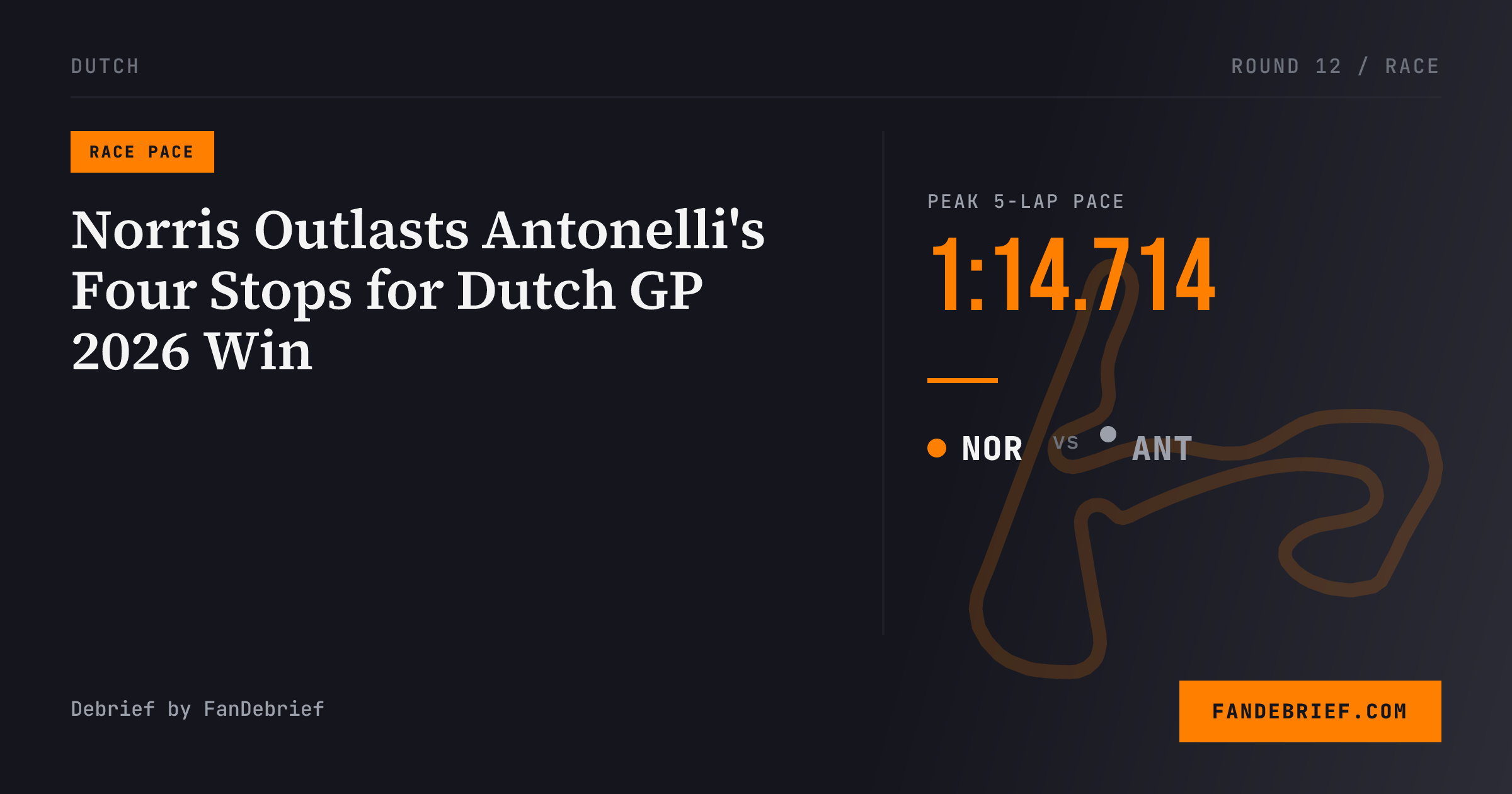
Norris Outlasts Antonelli's Four Stops for Dutch GP 2026 Win
Antonelli stole the lead within a lap of the restart, but Norris's extra stint on old rubber and a blistering pass at the final corner won Zandvoort back for McLaren.
The standing restart at Zandvoort lasted about as long as it takes to say Tarzan corner. Norris got the second start clean, just as he'd got the first, and Antonelli simply drove around him anyway, taking the inside line and the lead in one motion. That single overtake set the terms for the next seventy laps: could Norris's car do on strategy what it couldn't do on the grid?
It could, eventually, and that is the story of this Dutch Grand Prix. Norris lost the race lead twice, once on the road and once to a pit cycle he didn't control, and won it back both times, the second one for good with eighteen laps still to run.
Qualifying had promised exactly this kind of closeness. Norris's pole lap left Russell just a tenth behind in second, with Antonelli and Piastri covered by under a tenth and a half more; the top four were separated by less than a sixth of a second. Verstappen, meanwhile, lined up seventh, a lonely outlier for a home crowd that had come expecting more. Conditions on Sunday were dry, with a track baked to over 32 degrees, the kind of afternoon where tyre management, not raw pace, tends to decide a Zandvoort race.
It decided this one before the field had even completed a full lap. The opening lap produced a blizzard of yellow and double-yellow flags through the banked final sector, and by lap two the red flag was out and the race suspended. Verstappen's afternoon was over by then; he'd started seventh and the timing sheet shows him parked after a single lap, his home race finished before it had properly begun. It was, by outside accounts, his first retirement at his own Grand Prix since the circuit rejoined the calendar, which made the silence around the banking afterward feel heavier than a normal DNF ever does.
Antonelli's return serve, and the hard tyres that undid it
When the field restarted, Antonelli's move on Norris was immediate and total. From there Mercedes built out a lead that peaked at over two seconds by lap 20, with Norris looking for answers rather than an opening on a track where passing is famously hard work. Norris had gone to soft tyres early, running that compound from lap 3 to lap 21, while Antonelli stretched a medium tyre all the way to the same point before switching to hards. The tyre logs are unambiguous about what happened next: on hards, Norris was suddenly the quicker car, and the gap that had ballooned to Antonelli's advantage began closing back down through the middle of the race.
The lead changed hands four more times through the pit cycles that followed, first swinging to Hamilton on lap 22 when the Ferrari found itself up front simply by staying out longer, then back to Antonelli on lap 25 as the sequence completed. Norris inherited the lead again strategically on lap 40. It was Hamilton, again, who briefly held it on lap 48 during the next round of stops, before Norris finally settled the matter on lap 54, passing him back on the road for a lead he would not relinquish. From that point the gap to Antonelli only grew: over twelve seconds by lap 60, still more than eleven at the flag. A late Virtual Safety Car for cleared debris interrupted the final laps twice, at 55 and again at 70, but neither reset the gap Norris had built.
The number that will end up on the results sheet, 11.54 seconds at the line, tells you Norris won comfortably. It undersells how much of that race Antonelli actually led. This was Mercedes committing to a fourth pit stop that its rival never needed, and a driver who genuinely had the race by the throat for the best part of thirty laps before the hard-tyre stint took it away from him.
The data behind the race
Timing and telemetry from every car on track.


Ferrari's quiet double, Alonso's loud one
While the lead battle absorbed most of the afternoon, Ferrari were having arguably their most complete race of the year without ever threatening the podium. Hamilton finished fourth, up from fifth on the grid, and Leclerc fifth, up from sixth, both gaining a place apiece on a track where gaining anything is hard. Buried in the lap-time data is a fact that will annoy both of them: Leclerc's weighted race pace of 1:17.270 was the fastest of anyone in the field, ahead of Norris, Antonelli and Piastri. He was untouchable in the banked final sector too, fastest there on 32 of the 72 laps. A car that quick finishing fifth is either bad luck or bad timing, and on this occasion it looks like the latter; Leclerc's four-stop strategy simply cost him track position he never fully recovered.
Further back, the Alonso and Stroll split told its own story about pace versus circumstance. Alonso started eighteenth and finished ninth, a nine-place recovery drive built on a two-stop strategy that kept him out of trouble while faster cars ahead pitted around him. Stroll started one spot behind him and was out of the race by lap 45. The gap in raw speed between them is stark: Alonso's best lap of the day was 1:16.946, Stroll's was 1:17.883, a difference of 0.937 seconds that goes a long way toward explaining why one Aston Martin salvaged points from deep in the field and the other didn't make it to the flag.
The midfield had its own theatre. Turn 3's track limits claimed laps from half the grid over the course of the afternoon, with time deletions handed to Hulkenberg, Lindblad, Stroll, Sainz, Colapinto and others at various points, a sign of just how tightly the stewards were policing the exit of Zandvoort's opening corner. Lindblad and Colapinto both served drive-through or time penalties for yellow-flag infringements, Lawson picked up a ten-second penalty of his own late on without losing his seventh place, and Sainz was handed ten seconds for causing a collision in the closing laps. Piastri, meanwhile, lost two positions from his grid slot despite a race pace nearly identical to the podium finishers, and picked up a black-and-white flag for driving erratically at lap 38, the kind of moment that reads as a small crack in an otherwise tidy season for the Australian. Hulkenberg's climb from thirteenth to eighth, a step ahead of Alonso, was the quiet highlight of an Audi weekend that otherwise stayed out of the headlines, both cars bringing it home unlike the misfortune that hit Haas, who retired both cars, or Cadillac and Williams, who each lost one.
Zandvoort's tyre story ultimately reduces to a simple contrast: three stops against four. Norris's crew found a way to make his hard tyres last from lap 22 to the chequered flag without a compound change costing him anything, while Antonelli's Mercedes needed an extra visit to the pits that its rival never had to make. On a circuit where the physical act of overtaking is genuinely difficult, that one stop was worth more than any move on the road, until Norris made the move on the road anyway.
This was Norris's second win in as many rounds, following his victory at the Hungaroring last time out, and it puts a McLaren driver on a run other than Antonelli for the first time all year. Whether it's the start of something sustained or a one-off born of a favourable tyre split will start to become clear at Monza, a circuit that rewards straight-line speed and low drag rather than the technical, banked corners that suited Norris's car here. If McLaren's hard-tyre pace at Zandvoort was a genuine step forward and not a track-specific quirk, Antonelli's championship lead is about to get a great deal more interesting to watch.