Gasly Beats the Tow Train to a Maiden Italian GP Pole
Pierre Gasly built his first pole in nine years of trying out of the tow, not the fastest car, and left a grid full of bigger names wondering how Alpine solved Monza's slipstream puzzle first.
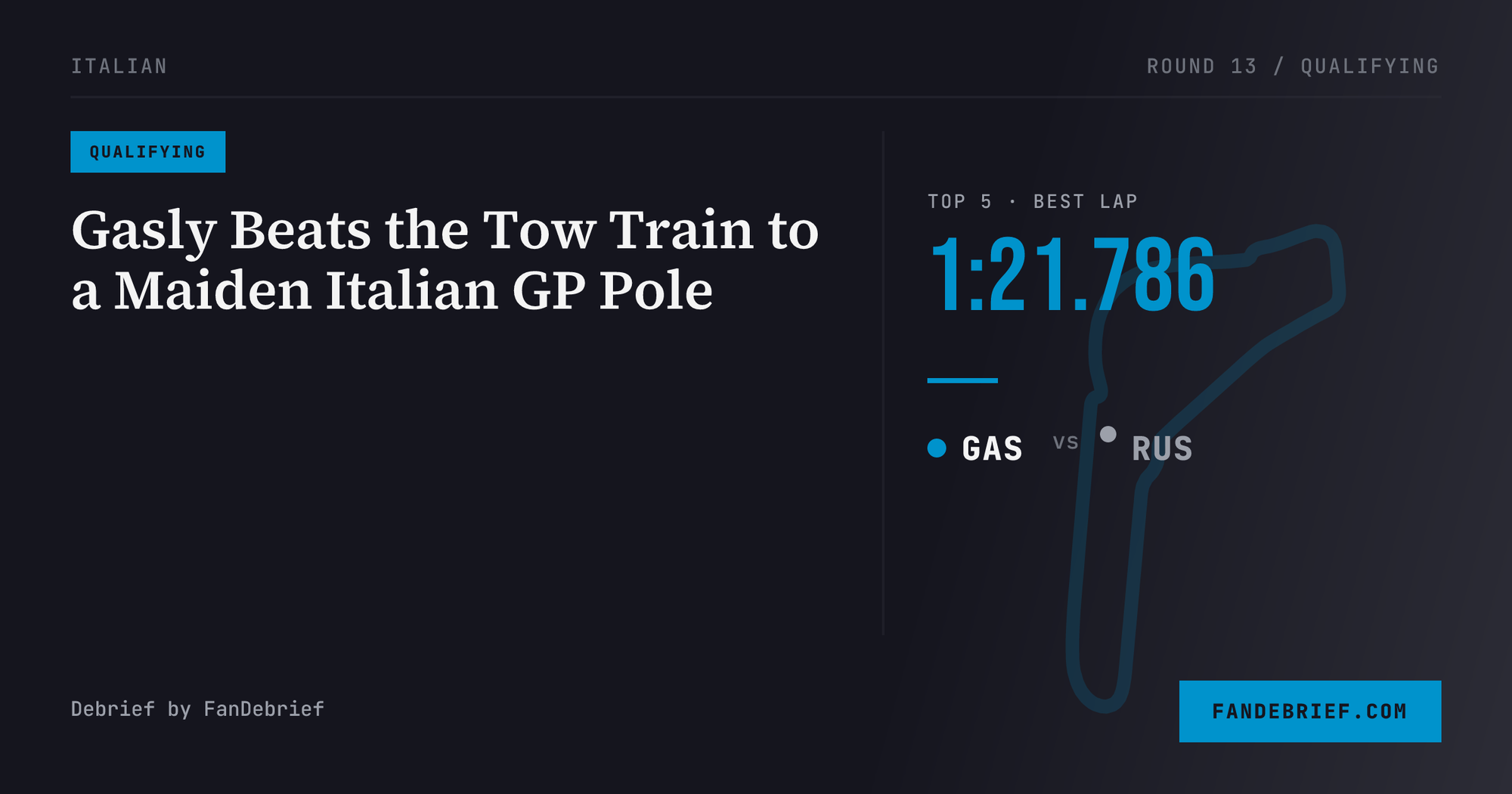
Watch the replay of the final Q3 runs at Parabolica and it looks almost casual: a line of cars nose to tail, drafting off one another down the Monza straights like it's any other Sunday afternoon. What came out of that line was anything but casual. Pierre Gasly crossed the stripe and took the first pole position of a Formula 1 career that had run without one for years, and by the time the timing screens settled, Alpine, not Mercedes, not Ferrari, not the two McLarens fighting for the championship, sat on top of the Monza grid.
This was a session won on the draft, and Gasly and Alpine read the physics of the Temple of Speed better than anyone else in the field. That's the story of this qualifying hour: not raw car speed, but who queued up the tow correctly and who got burned doing it.
Monza in September is the lowest-downforce weekend of the year, a track where slipstream trains decide lap times as much as setup does, and Saturday delivered exactly that kind of chess match. It was dry and warm, track temperature pushing past 53 degrees, the sort of conditions where degradation barely factors and the whole hour becomes a game of positioning. Every serious contender ran the session on softs from the first lap to the last; nobody was managing tyre life, they were managing traffic.
The top ten tell you how tight it was. Gasly's pole lap of 1:21.786 headed a group where half a second covered every car that reached Q3, from his own time down to Arvid Lindblad in tenth. Squeeze that further: the top five, Gasly, Russell, Piastri, Leclerc and Hamilton, were separated by barely a quarter of a second. Monza doesn't usually produce grids this compressed, but a low-downforce circuit rewards small differences in drag and tow management far more than it punishes a driver for lacking half a tenth of raw pace, and Saturday showed exactly that.
Russell looked, for a moment, like he'd done enough. His lap of 1:21.846 briefly had pole written on it, and he backed it up with the fastest speed trap of the entire session at 338 km/h, quicker through the zone than anyone else on the grid including Gasly. But Gasly's advantage wasn't straight-line speed, it was what he did in the middle sector. Gasly was the fastest car through the Lesmos and Ascari complex more often than any other driver across the session, and when his final lap landed, it beat Russell by six hundredths of a second, a gap smaller than the time it takes to blink. Russell had the tow and the terminal velocity; Gasly had the sector that actually decided the lap.
Deleted laps and a McLaren garage with questions
Oscar Piastri was fastest through the first chicane on his opening Q3 run and looked set to be the story of the session in a different way, third overall on 1:21.966. But his final attempt went off script: track limits at Turn 1 cost him a laptime, the second such deletion of his afternoon after an earlier one in the same corner. His teammate suffered an almost identical fate. Lando Norris had a lap wiped for the same infringement at the same corner, and where Piastri still salvaged third, Norris was left classified ninth, over four tenths off pole, in a car that Turn 1 simply wasn't being kind to on Saturday. For a team with two championship contenders, starting P3 and P9 on a weekend where Monza's very layout makes overtaking straightforward is a strange place to be, and it will sting more if Sunday's race doesn't let them claw it back cheaply.
Ferrari's afternoon was its own quiet drama. Charles Leclerc and Lewis Hamilton ended up fourth and fifth, split by just seven thousandths of a second, a margin so small it barely registers as a gap at all. That's about as tight as a teammate battle gets, and it's the kind of number that will get replayed all week regardless of what either car does on Sunday.
Further back, Arvid Lindblad produced the single biggest gulf on the timesheet. The Racing Bulls rookie reached Q3 in tenth while his more experienced teammate Yuki Tsunoda was out in Q1, and the margin between them, over a second and four tenths, is not a rounding error. That's the kind of number a young driver puts on a resume. Max Verstappen, meanwhile, quietly owned the final sector of the lap more than anyone else in the field, over a third of a second up on the flying lap through the Parabolica when he was fastest there, even as he ended up sixth overall, further proof that at Monza this weekend, no single sector guaranteed the whole lap.
Mercedes' Kimi Antonelli, the championship leader coming into this round, had his own final-lap trouble: a deleted lap for track limits at Turn 1 late in the session left him seventh rather than fighting at the front, a reminder that this corner claimed more than one big name on Saturday.
Gasly arrives at this pole from tenth in the championship standings with 35 points, a country mile behind the fight at the top, which is exactly why this result matters beyond one lap. Monza is rated among the easiest circuits on the calendar to overtake, so a maiden pole for a midfield-quick car doesn't guarantee a maiden win; the slipstream that built Saturday's grid will be just as available to the cars behind him on Sunday. Whether Alpine can defend a lead into Turn 1, with Russell tucked in his mirrors and two McLarens with everything to prove starting further back than they wanted, is the real test the sport now gets to watch.
The data behind qualifying
Timing and telemetry from every car on track.


