Russell Holds Off Faster Leclerc to Win Dutch GP Sprint
George Russell led every lap to win the Zandvoort sprint, but the timing sheets say the fastest car of the afternoon belonged to Charles Leclerc.
Four hundredths of a second, the width of a wing mirror, separated pole from second on Saturday morning at Zandvoort. By the chequered flag on the sprint, George Russell had turned that sliver of an advantage into a lights-to-flag win, the Mercedes driver never once relinquishing the lead across 24 laps around the banking. It looked, from the outside, like total control.
It wasn't quite that simple. Russell had the perfect launch and the clean air to defend, yet the fastest car in the field for most of the afternoon carried a different number on its side. This sprint is really a story about the gap between winning a race and having the pace to deserve it.
The margins at the front
Sprint qualifying had squeezed the top four into a tenth of a second: Russell's pole lap at 1:11.567, Norris four hundredths back in second, Leclerc at plus 0.055s in third, and Piastri completing the front two rows at plus 0.099s. Verstappen and Hamilton filled row four, more than half a second off the pace, an early hint that Red Bull and the second Ferrari were fighting a different weekend to the four cars ahead of them.
That grid order barely survived the first lap of the sprint intact. Russell held station at the front throughout, but behind him the places shuffled: Leclerc climbed from third to second, Antonelli moved up from fifth to fourth, while both McLarens slipped backward, Norris from second to third and Piastri from fourth to fifth. A sprint that started as a five-car cluster ended with Leclerc the only driver among the front-runners to have gained a position by the flag.
The move that decided second place came from Leclerc, working past Norris to complete the climb up the order. It fits the sector data. Leclerc set the fastest time through the banked final corners, sector three, on 12 of the 24 laps, with an average margin there of seven hundredths of a second over the field. That's exactly the kind of advantage that turns into a pass out of the last corner and down the straight.
The data behind the sprint
Timing and telemetry from every car on track.


Russell's lead was never as safe as it looked
The gap between Russell and Leclerc tells the real story of the sprint's tension. Russell led by 1.72 seconds after the opening lap, stretched that to 2.34 seconds by lap 10 as Leclerc worked through traffic, and then watched it shrink back to 1.36 seconds by the flag. That's a lead that peaked in the middle of the race and eroded for the second half, not the profile of a driver cruising to a comfortable win.
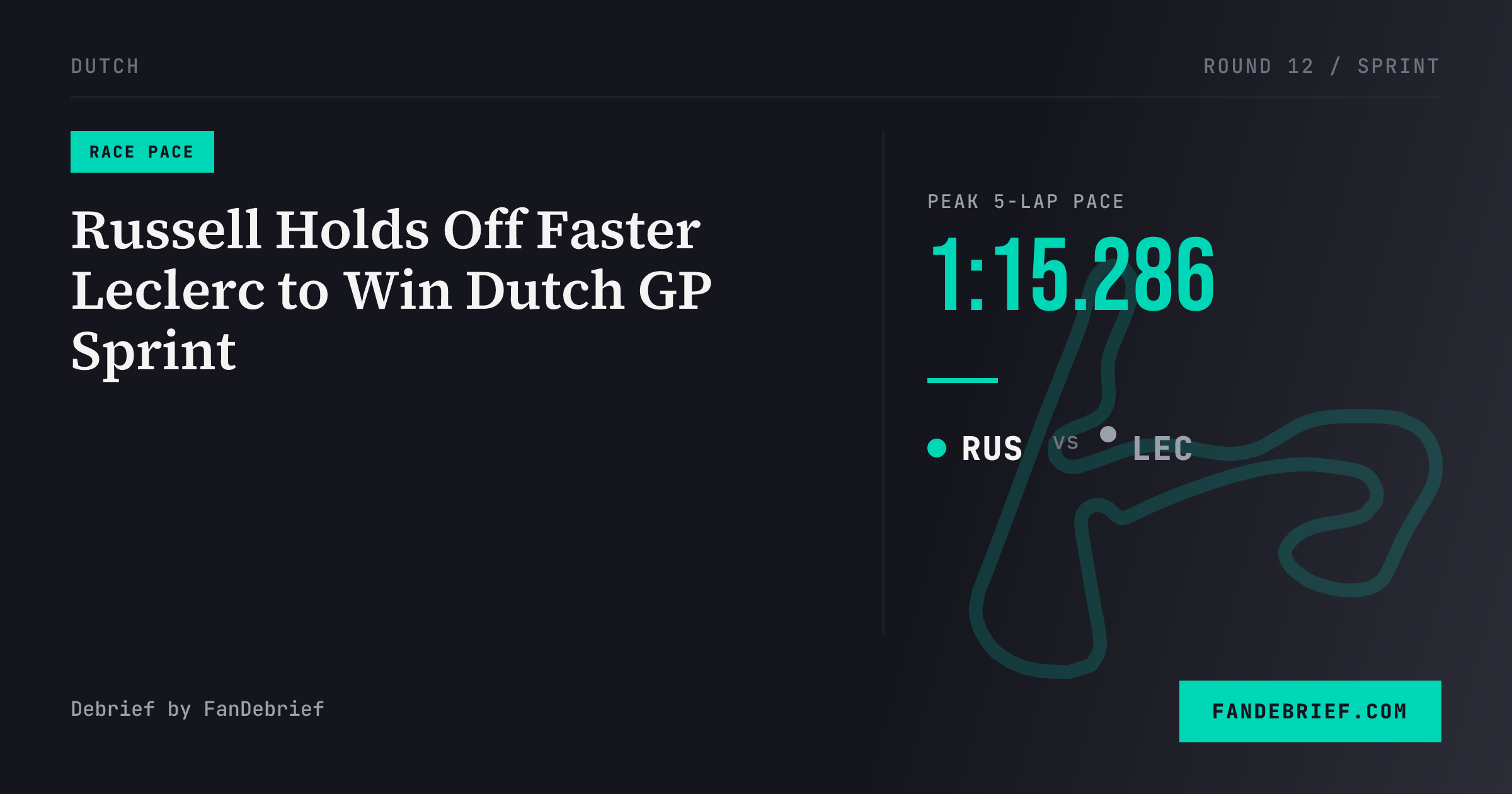
The weighted race-pace numbers explain why. Across the full run, Leclerc's average racing lap was two hundredths of a second faster than Russell's, the two of them practically identical and both comfortably clear of the rest of the field. Antonelli was third on raw pace, Norris fourth, and the second Ferrari of Hamilton seventh. Russell won this sprint on the strength of clean air and a start that never let Leclerc close enough to use it, not because his Mercedes was demonstrably the fastest thing on track. That's a fine distinction for the standings, but it matters for Sunday, when a longer race gives the quicker car more laps to find a way past.
Sector dominance backed up the closeness at the sharp end. Antonelli was fastest through the opening sector on 14 of the 24 laps, Norris held sector two on nine occasions, and Leclerc's sector-three strength was the one that actually moved a position. No single car owned the lap; three different teams held a piece of it.
The other stories: Hamilton's top speed, Verstappen's gap, and two retirements
Hamilton's afternoon was a curiosity worth flagging on its own. The Ferrari driver posted the fastest top speed of the entire field, 320 km/h, yet that straight-line advantage translated into nothing better than seventh, his weighted race pace the slowest of the top seven. Top speed without the cornering pace to match it is a common trap at a circuit as tight and banked as this one.
Further back, Verstappen brought his Red Bull home sixth, but the gap to his team-mate for the weekend, Lawson, tells its own story: Verstappen's fastest lap was roughly a second and a half quicker than Lawson's, and Lawson finished 11th, outside the points. That's a bigger swing than anything at the front of the field managed, and it points to a Red Bull that's still searching for consistency across its garage even when the lead car is solid.
Two cars didn't see the chequered flag as classified finishers. Nico Hulkenberg's sprint ended after just seven laps, his single pit stop swallowing more than twenty minutes before he was sent back out laps down and lapped. Sergio Perez's Cadillac made it to 21 laps before he too was retired and lapped. Neither team lost both cars: Hulkenberg's Audi team-mate Bortoleto brought the sister car home ninth, agonisingly outside the points, while Perez's Cadillac team-mate Bottas finished the race, albeit a lap down. Gasly held on to the final point in eighth, with Lindblad rounding out the top ten for Racing Bulls.
The sprint result puts a marker down for Sunday. Leclerc had the pace to win this one and didn't have enough laps to prove it; a full Grand Prix distance gives him more room to try again, and it sets up a genuine three-way fight between Mercedes, Ferrari and McLaren rather than the procession the final gap suggested. Whether Russell can defend for 72 laps the way he did for 24 will be the question that actually decides the weekend.