Russian GP 2018: Bottas Beats Hamilton to Pole by 0.145s
Valtteri Bottas beat Lewis Hamilton to pole by a tenth and a half at Sochi, while Red Bull chose to abandon the fight before it started.
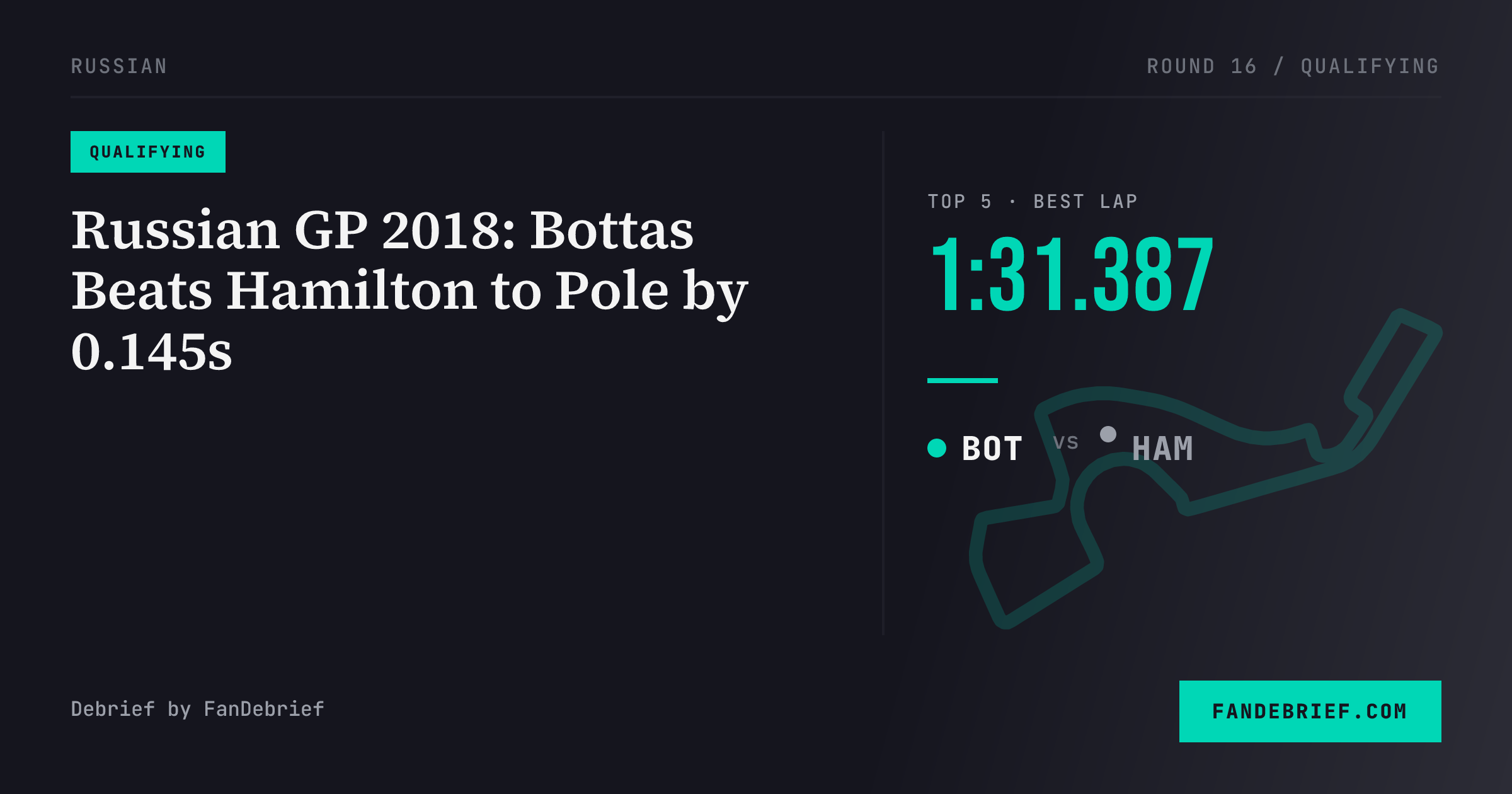
Valtteri Bottas crossed the line at Sochi and immediately knew. Hamilton had aborted his own final run moments earlier, and by the time the timing screens settled, Bottas had denied his teammate pole position by a tenth and a half, 1:31.387 to 1:31.532. It's a margin that sounds trivial until you watch it happen live: half a car length, no more, in a session Mercedes had controlled from the moment the garage doors opened.
This was a qualifying hour about margins, not shocks. Mercedes locked out the front row again. Ferrari never got close enough to make it interesting. And Red Bull, saddled with grid penalties they knew were coming, simply chose not to bother finishing the job.
The front-row gap was tight, but the gap behind it told the real story of where everyone stood. Vettel's best effort left him 0.556 seconds off pole in third, more than four tenths adrift of Hamilton, and Raikkonen slotted into fourth a further three tenths back. Between the two Mercedes and the two Ferraris, there wasn't a genuine fight; there was a class gap Ferrari couldn't close no matter how many sets of tyres they threw at it.
A midfield that qualified closer than the front row
Where Sochi actually got tense was five rows back. Magnussen split the front-runners from the pack with a lap 1.794 seconds off pole for Haas, an eye-catching result on a track that's usually merciless to midfield cars. But it was the four cars behind him, Ocon, Leclerc, Perez and Grosjean, that produced the session's tightest scrap: those four were separated by barely three-tenths of a second, with Leclerc's career-best Sochi lap for Sauber landing him seventh ahead of a Racing Point and another Haas. Ericsson rounded out the top ten for Sauber, completing a rare double top-ten qualifying for the team.
The sector data explains why that midfield pack stayed so bunched: Bottas's pole lap carried almost a full second of advantage through the middle sector over Perez's effort in eighth, a gap that shows exactly how much time separated genuine Q3 pace from a car just scraping into the final segment. Nobody in that group had anything spare; every tenth in the middle sector had to be earned.
The tyre strategies in Q3 tell their own story about how the front-runners managed the hour. Bottas, Hamilton, Vettel and Raikkonen all shuffled between compounds, running hypersofts early, switching to ultrasofts for the middle segment, then reverting to a fresh set of hypersofts to nail down the final runs that decided the front two rows. The midfield teams didn't bother with the swap: Ocon, Leclerc, Perez, Grosjean and Ericsson all worked through the entire session on a single set of hypersofts, evidence that Force India, Sauber and Haas simply didn't have the pace cushion to gamble on a compound change and needed every lap of consistent rubber they could get.
The data behind qualifying
Timing and telemetry from every car on track.


Red Bull left the session early, on purpose
The most consequential story of the hour, though, belonged to the team that didn't try to set a competitive time at all. Verstappen and Ricciardo both posted quick opening runs, Verstappen's 1:33.048 and Ricciardo's 1:33.247 good enough to have troubled the top ten on raw pace, and then neither car returned to the track. Verstappen managed only five laps all session, Ricciardo four; both cars were parked with grid penalties already locked in, and there was nothing left to gain from pushing further. It's a reminder that not every lap in this sport is about the lap; sometimes the smartest move is knowing which sessions not to fight.
At the other end of the grid, five drivers never got out of Q1: Hartley, Alonso, Sirotkin, Vandoorne and Stroll all ran their session on short, low-lap-count stints and simply weren't quick enough to survive the cut, a full second and more off the pace that got Ericsson through in tenth.
Sochi's long back straight also punished the idea that qualifying pace and top speed always travel together. Perez's Racing Point hit the highest speed-trap reading of the entire session, faster than either pole-sitting Mercedes, a sign of just how much drag those Mercedes and Ferrari cars were willing to carry through the corners in exchange for the downforce that actually won them the front two rows.
Hamilton goes into Sunday still carrying his 40-point championship cushion over Vettel, but he'll start it from the outside of the front row rather than the inside, and Bottas will have first crack at the long run to Turn One. Given how comfortably Mercedes cleared the field here, the pole fight inside the same garage may end up mattering more on Sunday than anything Ferrari or Red Bull can throw at either of them. Round 17 in Japan is next, and Red Bull will want a session where they're actually racing for something.