Hamilton Wins Singapore 2018 From Pole, Verstappen Second
Lewis Hamilton controlled every lap of a physical Marina Bay night, but it was Ferrari's tyre call on Sebastian Vettel that turned a contest into a procession.
Nobody in the Marina Bay paddock expected Lewis Hamilton to be starting this one from the front. Red Bull and Ferrari had owned every practice session, yet Hamilton produced a Saturday lap that flipped the weekend on its head and then, on Sunday, simply refused to let anyone near him for 61 laps. After Red Bull and Ferrari dominated practice, not many predicted pole position for Lewis Hamilton in Singapore.
This race was really two stories layered on top of each other: Hamilton doing exactly what a driver on pole at the hardest circuit to overtake on the calendar is supposed to do, and Ferrari handing second place to Max Verstappen through a tyre call that never needed to happen. Four lead changes flashed across the timing screens during the race, and every single one of them came from the pit cycle, not a wheel-to-wheel pass. That tells you almost everything about how this one was actually won.
Qualifying had been the shock. Hamilton's pole lap arrived from nowhere on a weekend where Mercedes had looked, at best, third-fastest, and it left Verstappen at two-tenths and Vettel over six-tenths back in third. It was a record-extending 79th pole position of his career, with his title rival managing only third on the grid. The form book said Ferrari and Red Bull should have controlled the front two rows; Hamilton tore it up on a single Saturday evening lap, and Sunday's race never gave anyone a reason to think it had been a fluke.
A safety car on lap one, then nothing but tyres
The race barely got going before it needed cleaning up. At Turn 3, the two Racing Point cars collided, and Racing Point Force India teammates Sergio Perez and Esteban Ocon made contact, sending Ocon into the wall, triggering a safety car that ran from the opening lap to lap four. Ocon was done for the day; everyone else shuffled back into line once the green flag flew, with Hamilton, Verstappen and Vettel holding station at the front exactly as they'd started.
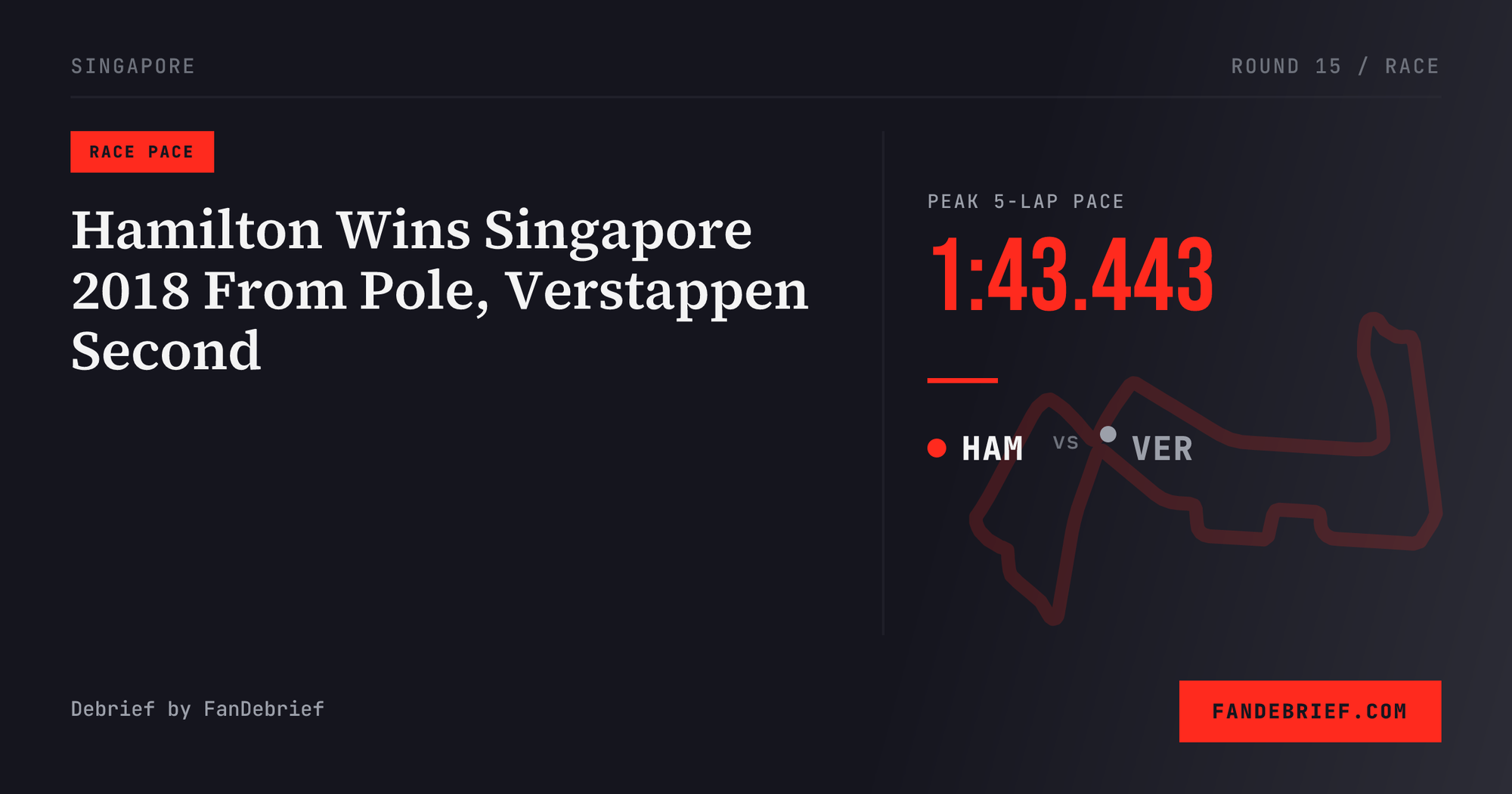
From there the race pace told its own story. Hamilton's weighted average lap across his stints was the fastest in the field, at 1:45.502, with Verstappen just a tenth and a half behind at 1:45.658. That's a margin so small it should have produced a fight. It didn't, because everything downstream of the first pit stops widened rather than narrowed the gaps. On-track, Hamilton led Verstappen by around two seconds through the opening laps, and when the first round of stops scrambled the order around lap 15, the margin briefly inverted, Verstappen actually edged 0.39 seconds ahead on track before Hamilton's own stop restored him to the front. By lap 20 Hamilton was nearly four seconds clear again, and the gap only grew from there: five seconds by lap 35, over eight and a half by the chequered flag.
Sector dominance across the race split three ways, which is itself revealing of how tight the true pace was even as the results diverged. Räikkönen was fastest through the twisty opening sector on 16 of 61 laps, Verstappen owned the middle sector on 22 laps, and Hamilton's car came alive in the final sector, fastest there on 24 laps and by the biggest average margin of any driver in any sector, a quarter of a second. That final-sector speed, run after run, is where Hamilton actually built and defended his race.
The data behind the race
Timing and telemetry from every car on track.


The tyre call that decided second and third
Here's the moment that shaped the podium order behind Hamilton. Vettel had genuinely raced his way past Verstappen in the opening laps and looked set to chase Hamilton down. Instead, at his one and only stop, Ferrari sent him onto ultrasofts for the remaining 47 laps rather than the more durable soft. Ferrari dealt him a lousy hand by switching him to the ultrasoft compound instead of the more resilient soft at his one and only pit stop. Hamilton and Mercedes made the opposite call, going long on softs that averaged 105.1 seconds a lap with degradation of just six-hundredths of a second per lap, essentially flat. Verstappen's Red Bull ran the identical soft-tyre plan and matched that pace almost exactly. Vettel's ultrasofts, by contrast, averaged nearly 106 seconds even though they weren't wearing out any faster; the tyre itself was simply the slower package for that stint length on this track. Ricciardo, who also switched to ultrasofts at his stop, finished a place and a strategy behind Vettel with almost identical numbers, both Red Bull and Ferrari's ultrasoft runners conceding time to the soft-tyre cars every single lap.
The net effect: Verstappen inherited second without ever passing Vettel on track, and Vettel's third place, seven-tenths quicker in raw pace terms than his soft-shod title rival on his best lap of the day, mattered nothing once the tyre choice was locked in. It's a reminder that on a street circuit where overtaking is rated hard for good reason, the pit wall's tyre call carries more weight than the driver's raw speed in the cockpit.
The midfield's alternate route to the points
While the front six ran conventional hypersoft-to-something-durable strategies, three cars in the second half of the grid tried something different, and it worked. Alonso, Sainz and Leclerc all skipped the hypersoft entirely, starting on ultrasofts and running them all the way to around lap 37 or 38 before a late switch. Each of them gained four positions, with Alonso rising from P11 to seventh, Sainz from P12 to eighth, and Leclerc from P13 to ninth. It's the kind of one-stop patience that a physically brutal, degradation-light Marina Bay night rewards, and it produced the closest thing to a genuine strategic upset in the race, three cars jumping the pack that started directly ahead of them without a single overtake needed once they were in clean air.
At the other end of that story sits Romain Grosjean, and Kevin Magnussen alongside him for a different reason. Grosjean qualified eighth, comfortably the best of the Haas pairing, but a five-second penalty for ignoring blue flags on lap 44 compounded a stint on soft tyres that was actually getting slower rather than faster, and he fell seven places to finish 15th. Magnussen's afternoon was stranger still: his fastest lap of the race, a low 1:41.9 set on a three-stop strategy, was over a second quicker than Hamilton's race-winning best lap, yet he finished 18th after his middle stint on softs degraded badly. It's the clearest evidence in the whole field that outright pace and race result had almost nothing to do with each other this weekend; Magnussen had the fastest car on track at some point and still lost two grid positions by the flag. It was, at least, a first fastest lap for a Danish driver and for Haas as a team.
Perez's race unraveled after the first-lap collision that ended his teammate's evening. He needed three stops in the end, and a drive-through penalty for causing a further collision left him 16th, nine places worse off than he'd qualified. Sirotkin's Williams, forced into an early precautionary stop for debris after the opening-lap incident, picked up its own five-second penalty for forcing another driver off track, a knock-on consequence of a first corner that cost Racing Point both cars' afternoons in different ways.
Hamilton's win did more than take the chequered flag first. It stretched his championship lead over Vettel to 40 points with six rounds remaining. Given that this venue has now produced back-to-back Hamilton victories, and that Ferrari's tyre-choice error at the one moment it mattered proved more costly than any lap-time deficit, the pattern heading toward Sochi is unmistakable: Mercedes is winning the strategic calls as convincingly as it's winning the laps, and Ferrari cannot afford to get a single pit-stop tyre decision wrong again if this title fight is going to stay alive.