Russian GP 2018: Hamilton Beats Bottas on Pit Strategy
Bottas led off pole and Verstappen inherited the net lead from nineteenth on the grid, but every swing on the timing screen in Sochi came from the pit lane rather than the track, and Hamilton was the one still holding it when the chequered flag fell.
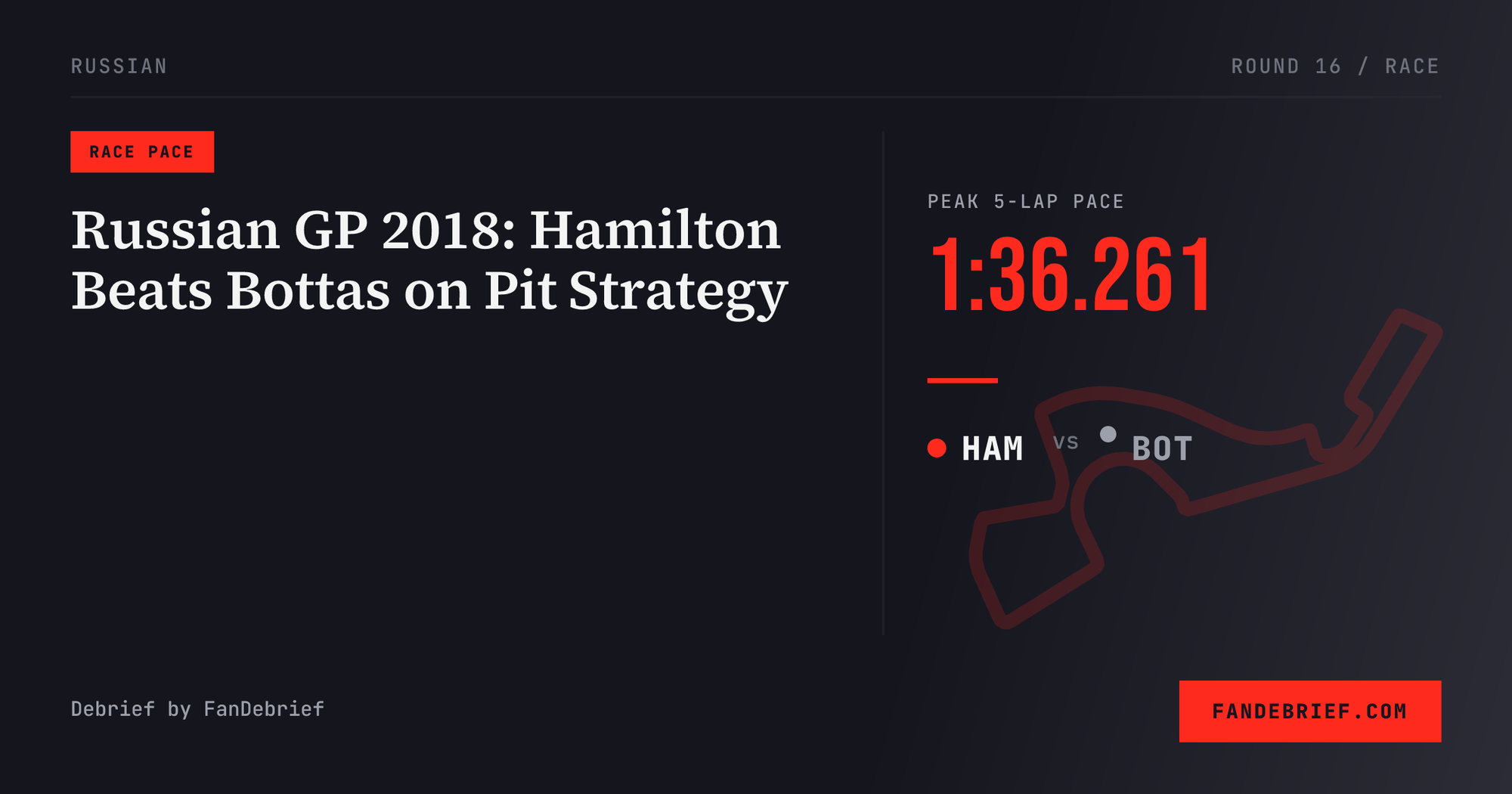
Valtteri Bottas took pole in Sochi by a comfortable margin, led the opening lap, and spent the first quarter of the race exactly where a pole-sitter should be: out front, with clean air and a gap that never dropped below 1.3 seconds. By the chequered flag it was Lewis Hamilton standing on the top step, more than two and a half seconds up the road. Nothing about that reversal happened on the circuit itself.
That's the story of this Russian Grand Prix. Four times the effective lead of the race changed hands, and the timing data records every single one of them as a pit-cycle swing rather than a pass on track. This was a race decided at the pit wall, not through Turn 3, and the man who ended up on the right side of the sequence was Hamilton.
The setup
Qualifying had been tight at the front: Bottas's 1:31.387 held off Hamilton by a mere 0.145s, with Vettel over half a second back in third and Räikkönen fourth. But the grid that actually formed on Sunday looked nothing like that top four suggested, because Red Bull arrived in Sochi with both cars carrying grid penalties. Verstappen lined up nineteenth, his teammate Ricciardo eighteenth, both of them staring at a whole grid's worth of cars to pick off in a race that would run dry, under a Sochi sky reading a mild 24.8C in the air and just under 30C on track. Conditions gave nobody an excuse.
The data behind the race
Timing and telemetry from every car on track.


Four lead changes, none of them on track
For the first dozen laps this looked like a straightforward Bottas afternoon. He nursed a gap in the 1.3 to 2-second range over Hamilton, the kind of buffer that lets a driver dictate the pit-stop timing rather than react to it. Then lap 12 arrived: Bottas came in first, switching from ultrasoft to soft, and the net lead swung to Hamilton, who was still out on older rubber. Two laps later Hamilton made his own stop, and the effective lead passed to Räikkönen, who had yet to come in. Räikkönen pitted on lap 18, and for the next 24 laps the man leading the Russian Grand Prix on the timing screen was Max Verstappen, who had started nineteenth.
Verstappen's route to the net lead wasn't an accident of qualifying chaos: it was a deliberate strategy call. He started on the soft, effectively the hardest compound in Sochi's allocation that weekend, and stretched that stint all the way to lap 43 before switching to ultrasofts for the run to the flag. Ricciardo, starting eighteenth, ran the identical plan, soft from lap 2 to lap 39 before his own switch to ultrasoft. It's why both Red Bulls were the biggest movers of the afternoon, Verstappen up fourteen places to finish fifth and Ricciardo up twelve to finish sixth, on a weekend where the car had no business fighting for the podium.
The irony is that Verstappen's pace in that long middle stint was arguably the best of anyone's all day. He set the fastest final sector on the race track more often than any other driver, 26 of the 53 laps, with an average margin over half a car's length quicker than the field. Against Räikkönen specifically, he was over seven-tenths quicker through that final sector on his best lap, yet he still finished behind the Ferrari. Starting from nineteenth costs you more than any single sector can give back; Verstappen's charge proved the Red Bull could be the fastest car on the road in stretches, but a grid penalty and forty-plus laps of traffic put a hard ceiling on what that pace could actually convert into.
When Verstappen finally pitted on lap 43, the net lead swung one final time, back to Hamilton, and it stayed there. By lap 50 he held a gap over Bottas of two and a half seconds on the road, and that's roughly where it finished, Hamilton crossing the line 2.55s clear at the flag.
The sectors that didn't add up to the fastest lap
Here's the detail that makes this race more interesting than a simple strategy story: nobody dominated the lap sheet outright. Vettel was fastest through the first sector more often than anybody, 22 of 53 laps. Bottas owned the middle sector, fastest 24 times. Verstappen, as already noted, ran away with the final sector. Split three ways like that, the fastest lap of the race by the raw numbers actually belonged to Bottas, with Hamilton and Vettel within hundredths.
And yet look at the weighted race-pace ranking across full stints rather than single laps, and Hamilton comes out on top, with Bottas an almost imperceptible margin behind and Vettel third. That's the real answer buried in the sector data: nobody blitzed this race on outright speed, the difference between the front-runners was measured in tenths of a second across 53 laps, but Hamilton's average across both tyre stints edged it. He didn't need the fastest single lap. He needed to be quickest on average when it mattered, and the pit sequence to fall his way, and both of those things happened.
Hamilton's Mercedes also had the highest top speed of the entire field, 339 km/h, well clear of anyone else, a reminder that even in a race decided by strategy and sector-by-sector trading, the raw power advantage was sitting there in reserve whenever a straight opened up.
The other stories
Behind the top six, Leclerc brought his Sauber home seventh after starting from the same spot on the grid, a tidy, unspectacular result built on a hypersoft-to-soft strategy that held its shape all race. Magnussen and the Racing Points of Ocon and Perez rounded out the points, all three of them losing ground from where they started, Magnussen and Ocon each dropping three places and Perez two, in a midfield that was clearly quicker in qualifying trim than over a full grand prix distance.
It wasn't a good weekend for Sainz or Sirotkin, who lost six and five places respectively from their starting spots, both ending up outside the points on days where their tyre strategies simply couldn't claw back what they lost in the opening laps.
Toro Rosso's afternoon ended early for both cars. Gasly retired after four laps with a brake issue, and Hartley followed him out with the same problem after four laps of his own, a double retirement that left the team with nothing to show from Sochi. Stroll's Williams, for what it's worth, posted the single fastest pit stop of the race at 29.10 seconds, a small consolation on a weekend where the car finished fifteenth.
What Sochi tells us heading to Japan
Hamilton's win extends a run that now stretches across three consecutive rounds, Monza, Singapore, and Sochi, and it stretches his championship cushion further still, having come into this weekend already 40 points clear of Vettel. Bottas, for his part, took pole and still finished second, extending a winless run that a strong qualifying lap in Sochi wasn't enough to break.
The bigger signal, though, is what Verstappen and Ricciardo showed with a strategy that had nothing to do with grid position. Both Red Bulls ran a tyre plan built for recovery, not for outright pace, and it worked well enough to net a top-six double from the back two rows. With Japan next and Red Bull unlikely to be starting from the back again, the question worth carrying forward is simple: if that car and that pace can do this much damage from nineteenth on the grid, what does it look like from somewhere near the front?