Canadian GP 2018: Vettel Takes Pole by Under a Tenth
Vettel beat Bottas to pole by well under a tenth of a second at Circuit Gilles Villeneuve, breaking Hamilton's grip on Montreal pole that had lasted three straight years, even as the top six were separated by barely a third of a second.
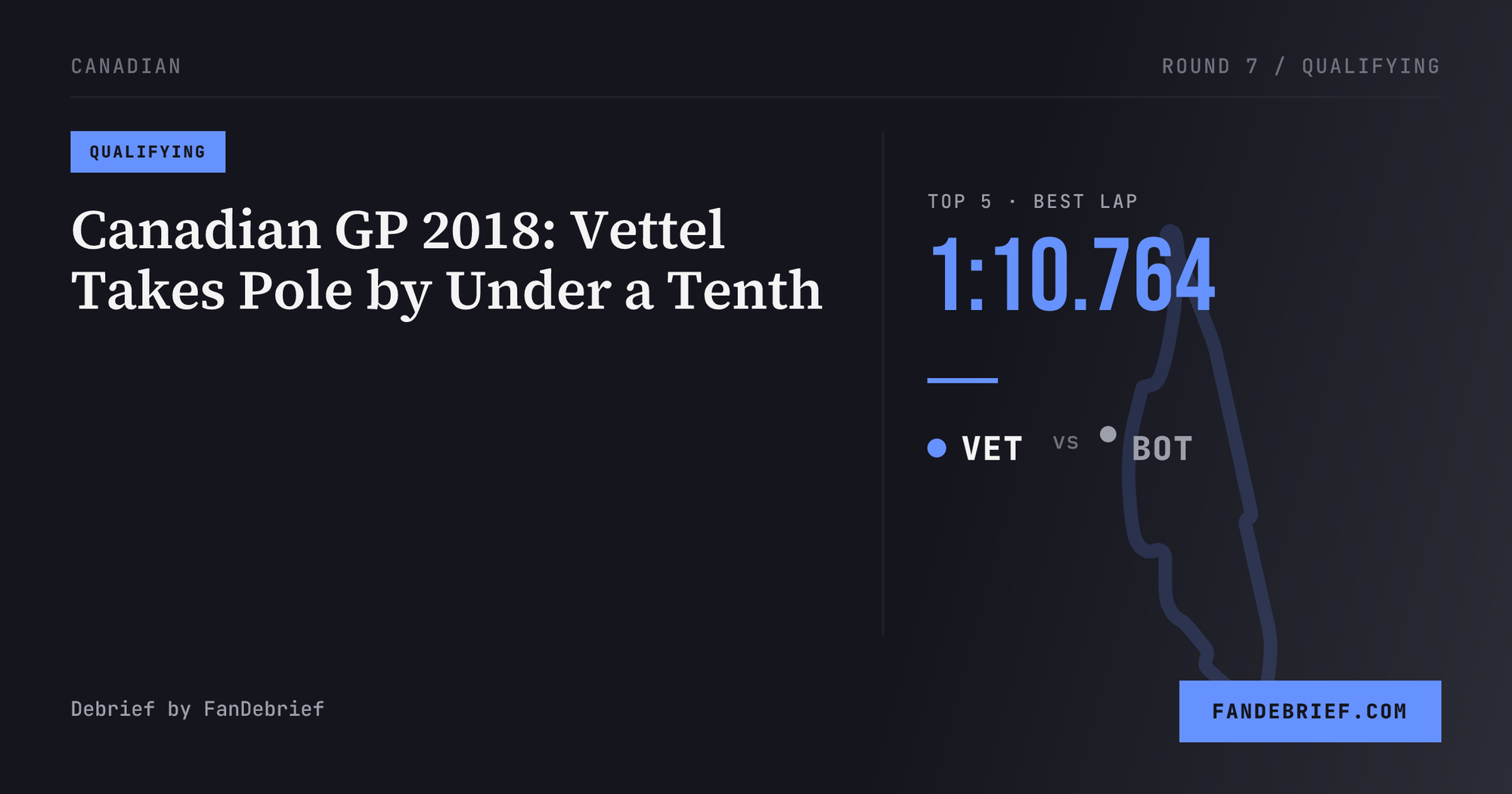
For three years running, pole position at the Circuit Gilles Villeneuve had belonged to Lewis Hamilton. Not this one. Sebastian Vettel took it by a margin so small it barely registers on a stopwatch, and in doing so closed a chapter Hamilton had owned since 2015.
This was a session where nobody dominated, yet somebody still had to win it. Vettel's pole lap didn't own the fastest first sector, didn't own the fastest middle sector, and still it was enough, because the moments that mattered were split across three different cars.
Vettel arrived in Montreal 14 points behind Hamilton in the standings, Ferrari still chasing a response to Daniel Ricciardo's Monaco win the round before, where Vettel himself had been second and Hamilton third. The track favours low drag and heavy braking, all the way down to the Wall of Champions chicane that closes the lap, and with the air sitting around 23 degrees and the tarmac considerably hotter, there was no shortage of grip to find. What there wasn't, all weekend, was a single dominant name. Verstappen had topped every practice session, Hamilton had looked the smoothest through Saturday morning, and neither of them ended up on pole.
Qualifying's first half hour was pure theatre for the wrong reasons. Fewer than ten seconds into Q1, Romain Grosjean's Haas began smoking seconds after he'd left the garage, and the problem was serious enough that he had to stop the car before the pit lane exit line rather than risk it on track. Marcus Ericsson, following him out, drove straight into the smoke cloud and lost the rear at the exit of turn nine, putting his Sauber into the wall. Neither driver set a competitive time; Grosjean posted none at all, and Ericsson's best lap left him more than three seconds off the pace in nineteenth, a gap of almost two full seconds to teammate Charles Leclerc, who made it comfortably into Q2.
Leclerc's own session ended in P13, but not before he put the fastest speed-trap number of anyone all weekend on the board, a reminder that a Sauber running light on downforce can still be electric in a straight line even when it can't find the lap time to match. Further back, the midfield produced its own small mystery: Kevin Magnussen's Q2 time was actually quicker than the lap that got Sergio Perez into Q3, yet it was Magnussen who went home in eleventh. Qualifying doesn't always reward the fastest lap in isolation, it rewards the fastest lap in the right segment, and Perez's Q3 appearance, however marginal, mattered more than Magnussen's better-but-wrong-session number.
The Wall of Champions calls it
Once the serious business of Q3 began, the story was margins, not gaps. Bottas was the driver who most consistently owned the opening sector across the hour, yet it was Vettel who found the decisive time where it counted most: through turns eleven to fourteen, the technical run to the Wall of Champions, where he was fastest more often than anyone else on track. Hamilton, for his part, was the man who most often set the benchmark through the middle sector, the exact opposite problem to Bottas's: quick where it mattered least on this particular Saturday. Hamilton finished fourth, three-tenths off pole, an awkward number for a driver many had expected to be fighting for the top spot.
Raikkonen's own final lap unraveled at the front of the circuit rather than the back. On his last try in Q3, he suddenly had a lot of understeer entering Turn 2 and struggled to turn the car round, and that one moment cost him any chance of improving on fifth. Ricciardo, sixth, never looked entirely at home over the walls that frame this track, ending up two-tenths adrift of his Red Bull teammate.
Vettel's own read on it afterwards was simple enough. Pole position is always important, and for Scuderia Ferrari this track and this country mean a lot, he said, a nod to the circuit's Villeneuve heritage that carries extra weight for a Ferrari driver. On the tyre calls that shaped the hour, with the front six shuffling between hypersofts and ultrasofts through Q1 and Q2 before returning to the softest compound for the final assault, choosing the ultrasofts for the start of the race was a pretty straightforward decision for Ferrari, in his words, a strategic groundwork laid inside a qualifying hour that was, on the surface, only about single laps.
Hamilton, typically candid, put his own afternoon down to execution rather than pace. Sebastian simply did a better job when it counted in Q3, he admitted, and there wasn't much in the numbers to argue with him: the top six were covered by little more than a third of a second, and Vettel had simply used his better than anyone else did.
The data behind qualifying
Timing and telemetry from every car on track.


Ocon's streak and a Sauber running hot
Behind the top six, Nico Hulkenberg took seventh ahead of Esteban Ocon, with Carlos Sainz and Sergio Perez rounding out the ten. It marked the first time in 2018 that Ocon had qualified in the top 10 at consecutive races, a small but real marker of progress for a Force India that has had to fight harder than its results always show, while Sauber and Williams remained the only two teams yet to reach Q3 in 2018, a gap that Leclerc's raw speed alone couldn't close. The gulf between that group and the Q3 six was stark in the middle sector alone, where Vettel's own best lap was well over half a second quicker through sector two than Ocon's best effort, the kind of number that explains why the fight for eighth felt like a different sport to the fight for pole.
Grosjean's exit was the harshest story of the day, a car that had shown real pace in practice reduced to a smoking shell seconds after leaving the garage, guaranteeing him the back of Sunday's grid before a single meaningful lap had been set. Ericsson's abrupt end, triggered directly by that same smoke, only compounded a difficult weekend for Sauber's second car even as Leclerc kept building his case as the team's future.
What Saturday leaves for Sunday is a headline margin that flatters nobody's certainty. Vettel takes pole having found his edge only in the final sector, at a circuit where the recent history belonged entirely to Hamilton, and where this year the top six go into race day separated by barely a third of a second. Whether Ferrari can convert a lap record into a race win depends on exactly what decided qualifying, who does the most with a small advantage, and who blinks first into the Wall of Champions.