Antonelli Canada 2026: Fourth Win in Five as Russell Stops
Kimi Antonelli banked his fourth win of the season in Montreal, but only after teammate George Russell's Mercedes went silent from the lead; behind them Hamilton edged Verstappen for the final podium spot while McLaren's front-row start collapsed into a lost weekend.
For twenty-nine laps, this was George Russell's afternoon. He'd started it from pole, he'd traded the lead with his own teammate four times on the stopwatch, and he was doing exactly the kind of driving that wins a Grand Prix at Circuit Gilles Villeneuve. Then his car went quiet, and the race became somebody else's story.
That somebody was Kimi Antonelli, and this is the uncomfortable truth about his fourth win of the season: he didn't have to be the fastest car for most of it. He had to be the last Mercedes standing, and once Russell parked it on lap 30, the rest was a procession he controlled from the front, sector by sector, all the way to a chequered flag he crossed 10.77 seconds clear.
Montreal has been kind to Mercedes lately, and history rhymed here before the lights even went out. Russell took pole at this venue last year too, and converted it into a win; this year he took pole again and looked every bit as strong through the opening third of the race. The grid split into two tyre camps at the start, with several midfield cars, Piastri, Norris, Hulkenberg, Bortoleto, Sainz and Perez among them, gambling on intermediates while the frontrunners all lined up on softs. It set up an uneven first few laps before the true pecking order settled, and Russell and Antonelli spent the next half hour making sure nobody else got a say in who led.
Lap 30: the retirement that decided it
The lead changed hands five times in this race, and four of those swaps were the real thing: on track, wheel to wheel, no strategy involved. Antonelli led off the start, lost it to Russell on lap 6, took it back on lap 22, lost it again on lap 25, and then reclaimed it for good on lap 30. That last swing wasn't a straight fight; Russell's retirement handed it over. One lap after Russell went out, the Virtual Safety Car came out too, and the whole leading pack used the neutralised laps to cycle from soft to medium tyres without losing time to each other. Antonelli emerged from that pit sequence with the sort of clean air Russell had been denying him all race.
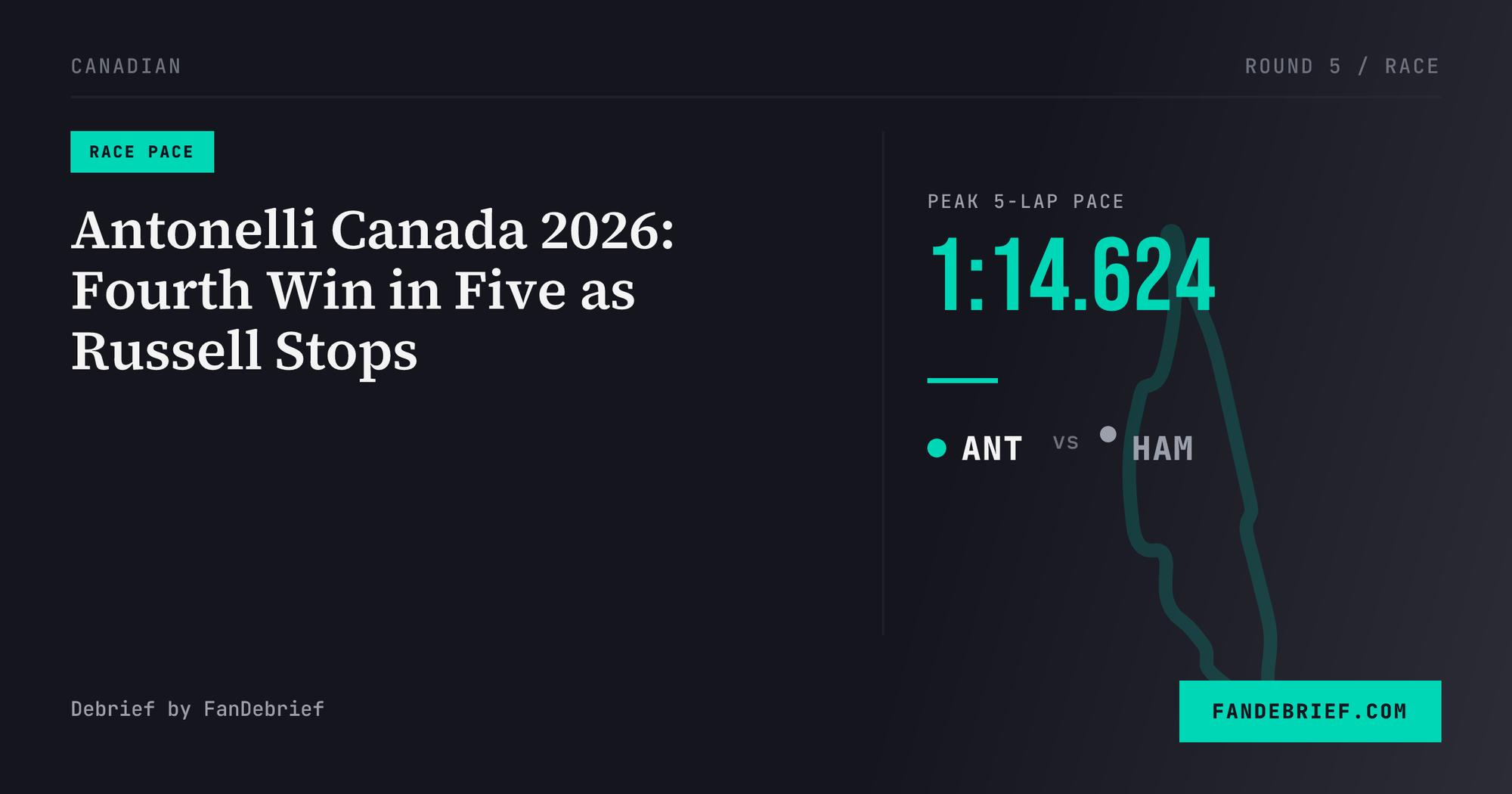
What the timing chart shows next is a driver who had nothing left to prove but kept proving it anyway. The gap over Hamilton, who inherited second once Russell's Mercedes stopped counting, swelled to 14.28 seconds by the time the VSC hit, contracted back down into single figures through the middle laps as Hamilton found his own rhythm, then grew again in the closing stretch to the 10.77-second margin at the flag. Antonelli set his fastest lap of the entire race on lap 68, the very last one. That's not a driver coasting home; that's a driver making sure nobody watching mistook the result for a gift he didn't also earn. Across the race he was the fastest car in every sector more often than anyone else on the grid, topping sector one on 29 of the 68 laps and doing it by an average of a tenth and a half each time. Even against Leclerc, who finished fourth and comfortably clear of the rest of the pack, Antonelli's best sector-one time was three-quarters of a second quicker. That's the kind of margin that turns a lucky inheritance into a legitimate victory.
The data behind the race
Timing and telemetry from every car on track.


McLaren's front row that vanished
If Mercedes' story was messy but ultimately triumphant, McLaren's was just messy. Norris and Piastri lined up third and fourth on the grid, the kind of starting spot that should have put both cars in the podium conversation. Neither finished anywhere close. Piastri picked up a 20-second time penalty for causing a collision and needed a third pit stop to nurse his car home, sliding from P4 on the grid to eleventh at the flag, seven places worse off than where he started. Norris never even got that far; his race ended after 39 laps, sitting in the retirement column alongside Perez, Alonso, Albon and, most strikingly, Russell himself. One car retiring from a two-car team tells you nothing conclusive, but McLaren losing one driver to a technical stoppage and watching the other serve a penalty for a collision on the same afternoon is not a coincidence you can wave away as bad luck alone.
Behind the top four, the podium picture came together more honestly than the headline suggests. Hamilton started fifth and finished second, gaining three places the hard way, matching Antonelli's one-stop strategy almost lap for lap and running the second-fastest race pace of anyone in the field across the weighted average of his stints. Verstappen did the same trick from sixth on the grid, also gaining three places, and set the outright fastest lap of the race on the final tour, a 1:14.398 that even beat Antonelli's own best effort by a slender margin. The top three by race pace, Antonelli, Hamilton and Verstappen, were separated by less than two-tenths of a second across their entire stints. This was close, competitive racing at the front even after the retirement that reshuffled the lead.
Leclerc's fourth place deserves its own mention, because he did it from eighth on the grid, the biggest gain of anyone inside the top ten bar Hadjar. Hadjar himself crossed the line fifth on the road but was carrying a 20-second penalty for more than one change of direction, a stop-and-go infringement, and still finished a lapped but clearly quick fifth; without the penalty the timing would have flattered him further, but the classification is the classification. Colapinto's sixth for Alpine, up four places from a P10 start, was one of the tidier midfield drives of the day, while Lawson climbed five places to seventh for Racing Bulls and Gasly six places to eighth for Alpine, both doing the unglamorous work of picking off cars that dropped out or bogged down in the pack.
The retirements told their own separate stories. Aston Martin lost both its cars, Stroll and Alonso, though Stroll's was the far longer stint before trouble struck on lap 64 while Alonso's ended on lap 24. Cadillac lost both of its cars too, Bottas and Perez, Bottas after an eventful afternoon that had already earned him a ten-second penalty for speeding in the pit lane. Williams split its result down the middle, Sainz climbing six places to ninth while Albon retired after just 12 laps; the gap between the two Williams drivers' best race laps, over a second and a third, says everything about how differently their afternoons went. None of the other constructors lost more than a single car, which makes the Russell retirement and the McLaren double disappointment stand out even more starkly against a field that otherwise held together.
The forward look from here points squarely at Monaco. Antonelli arrives with four wins from five rounds and a habit of turning messy afternoons into clean results, whether by pace or by attrition. But Russell's retirement from a race he was controlling is the kind of result that a team cannot simply file away as bad luck twice running, and if Mercedes wants to turn this into a genuine sweep of the championship rather than an ongoing lottery over whose car survives, they need an answer before the next street circuit punishes any repeat. McLaren, meanwhile, arrive at Monaco with more questions than answers: a front row start that yielded nothing, a penalty for causing a collision, and a technical retirement, all in the same afternoon. Whether that was a one-off bad weekend or the start of a wider pattern is exactly the story worth watching when the cars roll out again.