Russell Beats Antonelli to Canadian GP Pole in One Sector
George Russell out-qualified his championship-leading teammate by four hundredths of a blink to claim a third straight pole at this circuit, even as Kimi Antonelli owned two of the three sectors.
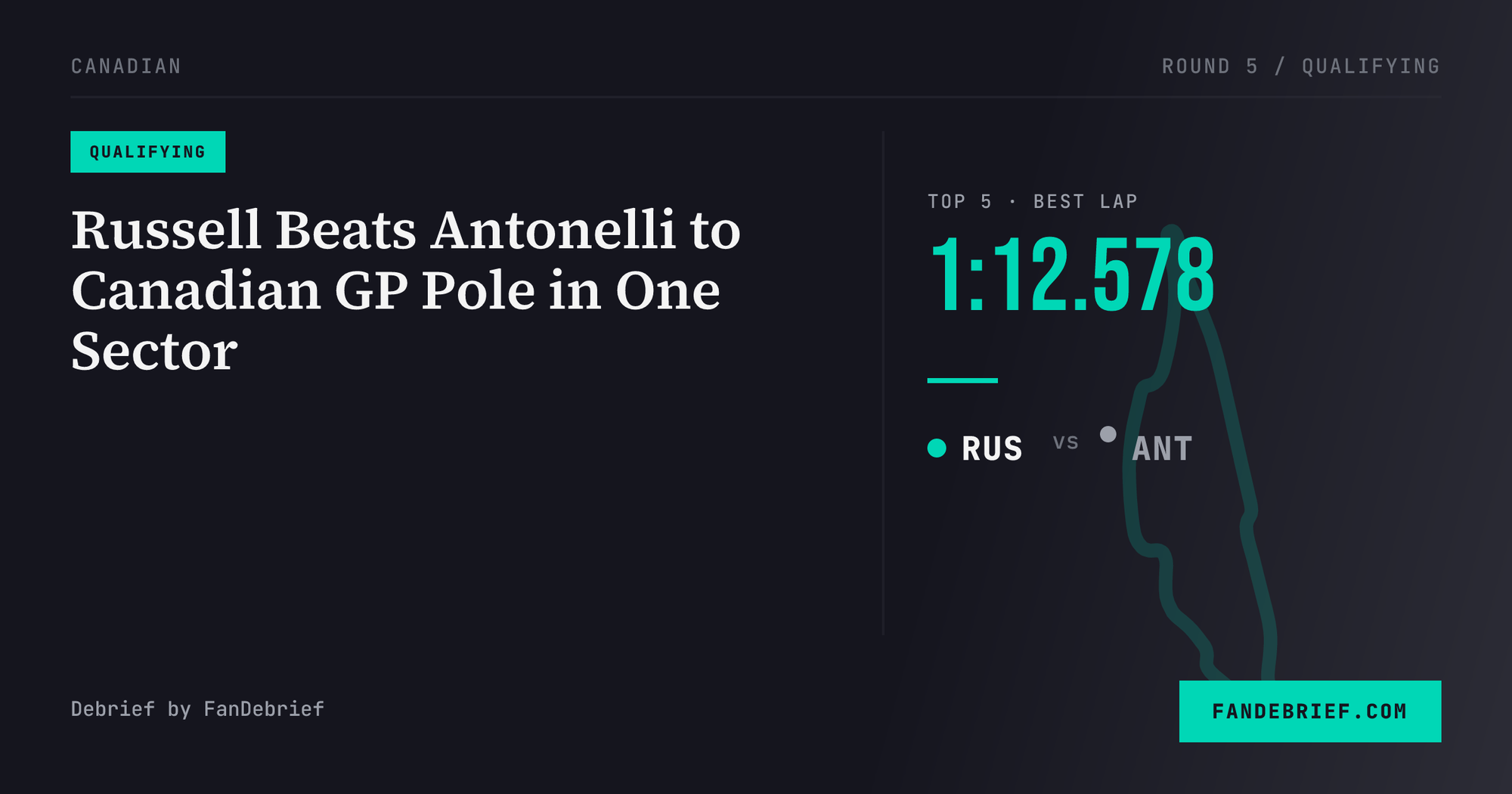
Pole position in Montreal came down to one sector out of three, and George Russell owned exactly the right one.
Kimi Antonelli was quicker through the opening six corners and quicker still through the Wall of Champions chicane that closes every lap here. On raw sector times, the teenager had the faster car on this circuit. Yet Russell's session was built around the middle sector, Turns 7 to 10, where his 22.902s beat Antonelli's 23.061s by enough to flip the whole lap. Add it up and Russell took pole by 0.068 seconds, a gap you could lose in a hand's width of a steering wheel.
That is the story of this qualifying hour: a Mercedes front row that looks, on paper, like a formality, but was actually a genuine fight decided by fractions in one specific corner sequence. This matters beyond Saturday. Antonelli arrives in Canada leading the championship on 100 points to Russell's 80, having won the last round in Miami from pole. Russell also took pole position for the main race, where he and Antonelli again battled in the opening stages. A Mercedes front row with a 20-point championship gap sitting behind it is not a quiet Saturday story, it is the opening exchange of a much longer one.
This is also comfortably familiar territory for Russell. Montreal is something of a specialty track for him, with this marking his third consecutive pole at the venue, following on from pole in 2024 and pole-and-win in 2025. The catch is that a Russell pole here hasn't always meant a Russell win: 2024's pole did not convert into victory. With Antonelli six-hundredths back on the timesheet and hungry to close a 20-point gap, that history is a warning as much as a comfort.
McLaren's session tells its own quieter story. Lando Norris beat Oscar Piastri by a little over half a tenth, both McLarens comfortably inside half a second of pole and locking out the second row. Norris was the strongest driver anywhere on the circuit through the middle sector across the whole session, topping that segment nine times in twenty-nine timed laps with an average edge approaching three-tenths. That is real, repeatable pace, not a single lucky lap, and it puts him third on the grid ahead of a teammate who, on this evidence, simply didn't have an answer for it.
Ferrari's Saturday was messier. Charles Leclerc actually set the outright fastest first-sector time more often than anyone else in the field, six times in twenty-nine laps, with an average margin over half a second. None of that speed survived intact: a deleted lap for exceeding track limits at Turn 14 in Q1 cost him time he never fully recovered, and he qualified eighth, three places and three tenths behind teammate Lewis Hamilton in fifth. A driver with the best sector-one pace on the grid starting three rows back is the kind of contradiction that makes Sunday interesting rather than settled.
Verstappen's Saturday raised its own question. He qualified sixth, one place clear of rookie teammate Isack Hadjar, and neither Red Bull cracked the top ten in the session's outright speed-trap rankings; every one of the top ten fastest cars through the speed trap came from a rival team. On a circuit with three DRS zones and a long final straight into the chicane, that is not a small thing to be missing.
The final chicane was the theme of the whole session, not just Leclerc's undoing. Ollie Bearman had a lap deleted there in Q2 for exceeding track limits, and Liam Lawson lost time to the same corner before missing the cut to Q3 by a tenth. The Wall of Champions earned its name again on Saturday; it just claimed lap times rather than bodywork.
Further down, Arvid Lindblad and Franco Colapinto both reached Q3, ninth and tenth respectively, a genuinely eye-catching result for two of the grid's newer names against more experienced machinery. Lindblad had a lap time deleted at the chicane along the way, which only sharpens how tight his margin over the rest of the midfield really was. Nico Hulkenberg missed out by three hundredths of a second, the tightest Q2 knockout margin of the afternoon, ahead of Lawson, Bortoleto, Gasly, Sainz and Bearman. In Q1, Ocon, Albon, Alonso, Perez, Stroll and Bottas made up the group that didn't progress; none of that is a retirement or a failure, simply the run plans and lap times that didn't clear the cut in a session this competitive.
Sunday starts with Russell and Antonelli sharing a front row separated by four hundredths of a second's worth of sector-two grip, a McLaren pairing that looked comfortably the second-fastest package all session, and a Ferrari split by real pace but wider by position than it should be. If Montreal's history of pole-sitters winning holds again, this is a Mercedes fight to lose. If it doesn't, the gap between Leclerc's sector-one speed and his eighth-place grid slot is exactly the kind of thing that turns into a first-lap story.
The data behind qualifying
Timing and telemetry from every car on track.


