Abu Dhabi GP 2018: Hamilton Takes Pole by 0.04s From Bottas
Lewis Hamilton banked another pole under the Yas Marina lights, but it was the final sector, not the straights, that separated the front row from the rest.
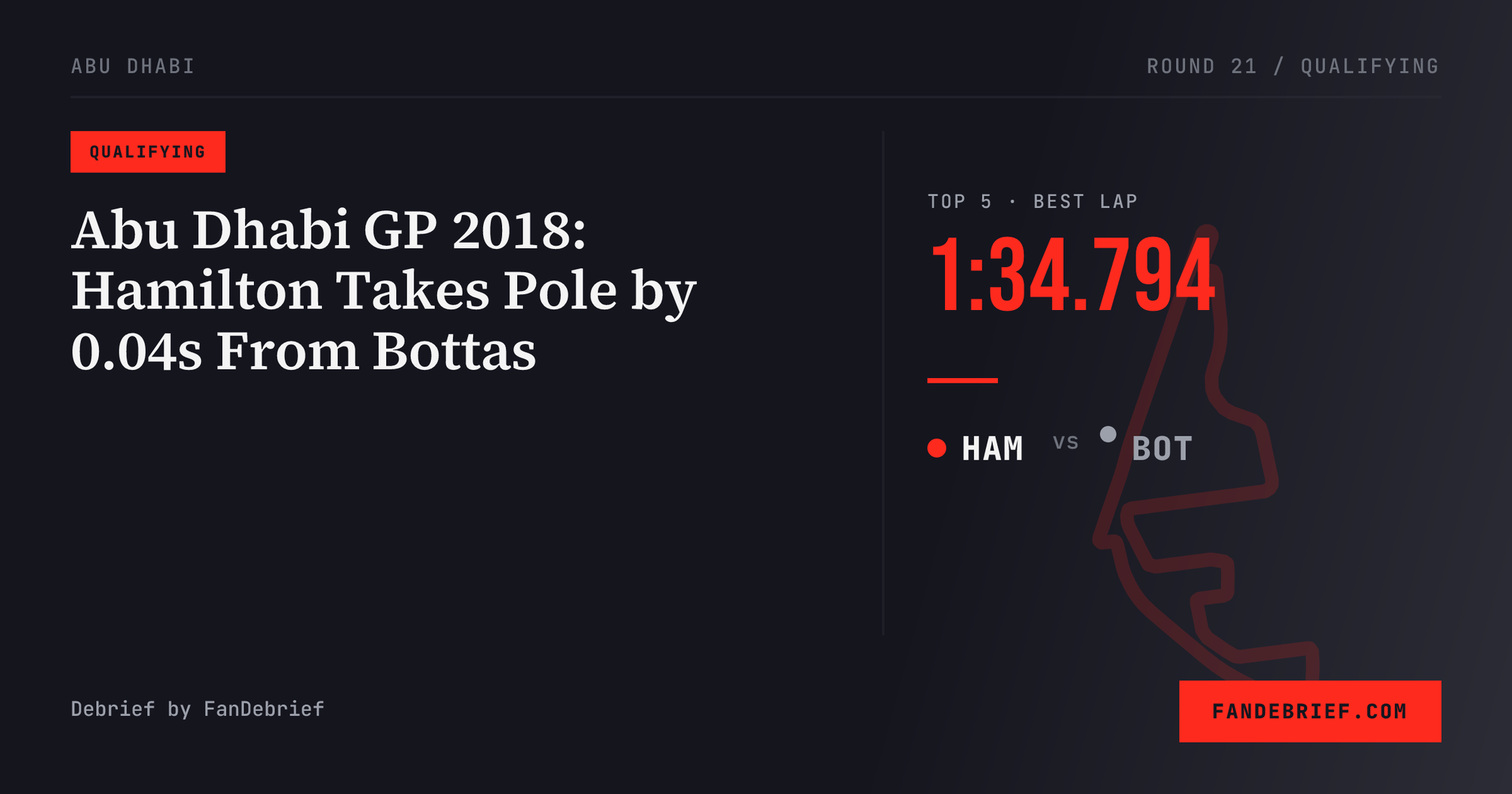
Under the lights at Yas Marina, the top six drivers in qualifying were separated by less than eight tenths of a second, and yet the story of the hour was decided in one corner sequence: the traction zone that closes out the lap. Lewis Hamilton took pole by four hundredths over teammate Valtteri Bottas, but the more telling number sits further down the sheet, where Hamilton was 1.18 seconds quicker than Charles Leclerc's Sauber through sector three alone.
This was a session about where the lap time actually lived, not who looked fastest on paper. Mercedes carried a straightforward speed advantage into the weekend, yet the margins between second and sixth on the grid stayed microscopic all the way to the chequered flag, and it was the final sector, the traction-heavy run through turns twelve to sixteen, that did the separating.
Mercedes arrived at the season finale with a commanding position in the standings, Hamilton on 383 points to Sebastian Vettel's 302, and the team had just won at Interlagos with Hamilton taking both pole and the race. The pattern continued here. Hamilton's own recent history at this circuit is mixed, he had pole and the win in 2016, but lost out to Bottas here in 2017, and reclaiming top spot on a track record lap felt like a statement heading into the last round of the year.
A four-hundredths margin that hid a bigger gap
Three chequered flags fell across the hour as the field worked through Q1, Q2 and Q3, and by the time the lights dimmed for the final runs, Hamilton had it covered. His pole lap beat Bottas by four hundredths of a second, tight enough to feel like a coin flip, but Vettel's Ferrari was already three tenths back in third, and Kimi Raikkonen a further quarter-second behind that in fourth. The top four were covered by little more than half a second, close on paper, decisive in practice.
What made the difference wasn't outright speed everywhere on the lap. Vettel actually matched or bettered Hamilton's pace through the opening sector on his best lap, but lost time relative to the Mercedes through the middle of the circuit and again in the final sector, the same pattern that has followed Ferrari at this track for years. Hamilton's own fastest lap split it perfectly: quick enough in sector one, untouchable in the middle sector, and comfortably ahead of Leclerc's Sauber in the final third of the lap despite the Sauber carrying more raw speed on the straights.
That contradiction, a car that was quicker at the speed trap finishing nearly a second and a half back in the final sector, tells you almost everything about how this circuit rewards traction over top-end pace. Daniel Ricciardo's Red Bull found 1.273 seconds on Leclerc in that same final sector, enough to drag him up to fifth on the grid despite a chassis that had nothing for the Ferraris or Mercedes on the straights. Yas Marina's long runs to the grandstand hairpin and through the marina section punish a car that can't put power down cleanly, and on Saturday night that was where the grid order was actually written.
The data behind qualifying
Timing and telemetry from every car on track.


The photo finish for the last seat in Q3
If the front six was about sector three, the back of the top ten was decided by margins too small to see with the naked eye. Esteban Ocon squeezed into ninth ahead of Nico Hulkenberg by two thousandths of a second, a gap that exists only on a timing screen, never on a stopwatch a human could read. That's as close as qualifying gets.
One place further back, Romain Grosjean's Haas beat Charles Leclerc's Sauber to seventh by 0.045 seconds, a genuine best-of-the-rest scrap between two Ferrari-powered cars that had no business being that close given the difference in each team's season. Leclerc's own recent form made eighth a fair reflection of where Sauber has been trending rather than a fluke, and his top speed of 335 km/h, the fastest of the entire field, only sharpens the point that his car had the legs on the straights but still couldn't out-drag Grosjean once the sector-three stopwatch started.
The Haas garage had the bigger story at the other end of that battle. Grosjean's teammate Kevin Magnussen never got out of Q2, ending up thirteenth, 1.117 seconds off Grosjean's pole-round time, a reminder that identical machinery doesn't guarantee identical Saturdays. Fernando Alonso missed the cut for Q3 as well, going out in Q2 in fifteenth, while the Q1 casualties, Brendon Hartley, Pierre Gasly, Stoffel Vandoorne, Sergey Sirotkin and Lance Stroll, were separated by less than seven tenths across all five of them, proof that the very back of the grid was every bit as tight as the front.
Max Verstappen's Saturday was the outlier among the front-runners. Sixth, nearly eight tenths off pole, was a weak return for a driver who had been a factor in the previous two rounds, and the gap to his own teammate Ricciardo, more than a tenth and a half, was the widest of any front-running pairing on the sheet. Whatever wasn't working in that Red Bull on a Saturday night, it wasn't a car problem Ricciardo was sharing.
Sunday's race carries no title stakes for Hamilton, who arrives with an 81-point cushion over Vettel and Mercedes 67 points clear of Ferrari in the constructors' table, but pole position on a circuit where overtaking is rated moderate at best still matters enormously. If sector three decided Saturday night, it's worth watching whether the same traction zone becomes the passing opportunity, or the wall, once the lights go out on Sunday.