Hamilton Wins Abu Dhabi 2018 by 2.66s on One-Stop Plan
Lewis Hamilton claimed his eleventh win of a title year that had been decided weeks earlier, yet the final stint showed a Ferrari that suddenly had the legs to make it interesting.
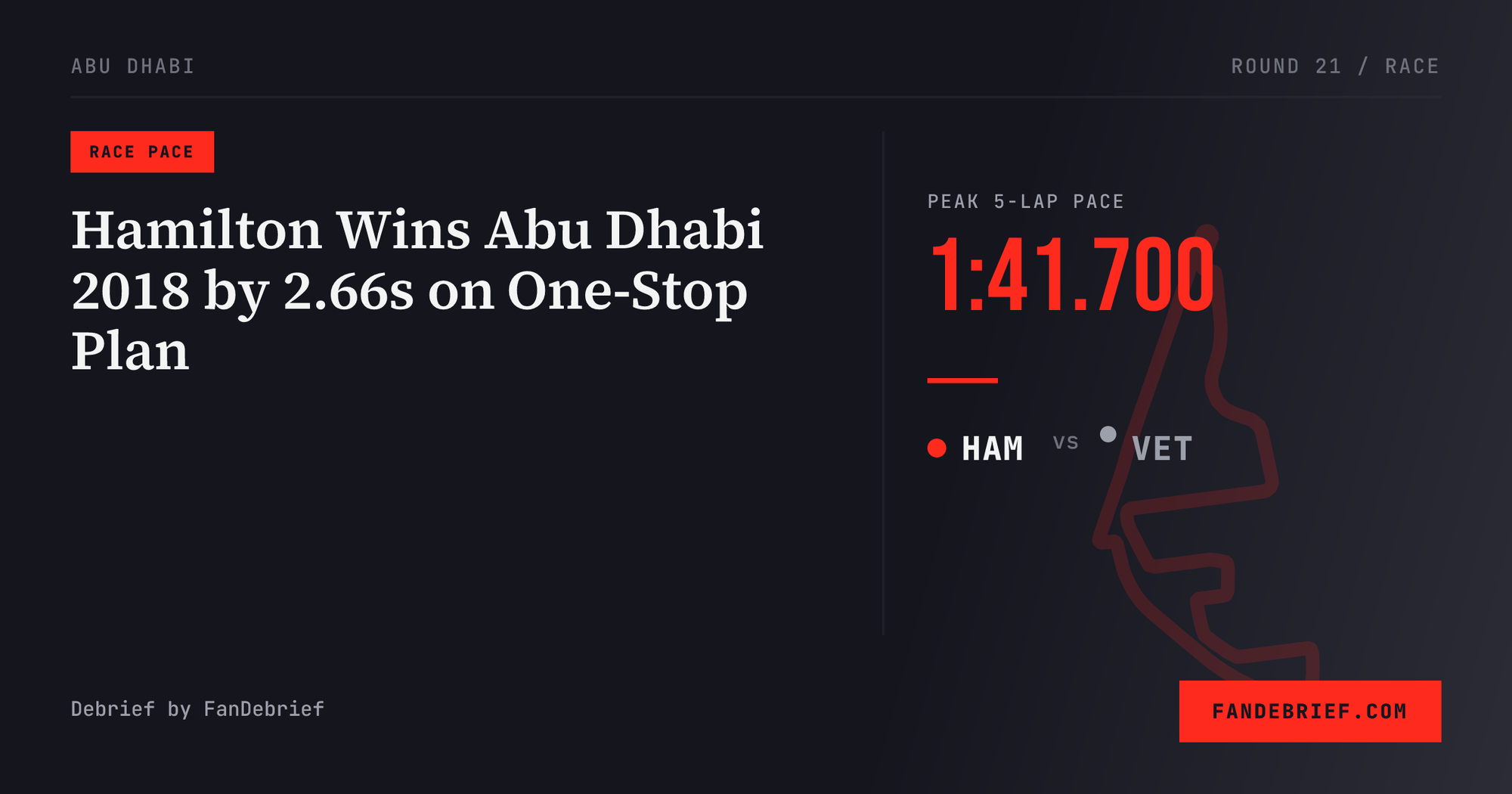
By the time the chequered flag dropped over Yas Marina, the obvious story had already written itself: Lewis Hamilton, champion crowned weeks earlier, strolling to another win to close out a season nobody else had come close to touching. The timing screens told a sharper tale. Across 55 laps, the fastest weighted race pace of anyone in the field belonged not to Hamilton but to the man he'd already beaten to the title.
This was a Grand Prix Hamilton won on tyre management and one perfectly timed pit stop, not on outright speed. Vettel had the legs to make the closing laps uncomfortable; he simply never got them under him early enough to use.
Hamilton had locked out the front row in qualifying, pole by 0.162s over teammate Valtteri Bottas, with Vettel a further one-and-a-half tenths back in third and Kimi Räikkönen fourth. Under dry skies and a track hovering around 33°C, the grid carried more farewells than usual for a season finale: this would be Fernando Alonso's 311th and final Formula One race, and Charles Leclerc's last outing for Sauber before he moved to Ferrari for 2019. Nobody, least of all Räikkönen, expected his own send-off in Ferrari red to end quite so abruptly.
The lap-one chaos, and the retirement that handed Hamilton the race
The race barely settled before it needed settling again. A first-lap collision put Nico Hülkenberg out on the spot, his sole completed lap ending in retirement and a Safety Car that ran from lap one to lap four while the marshals cleared the mess. Multiple accounts from the weekend describe that opening-lap contact as Nico Hulkenberg's Renault being sent barrel-rolling into the tyre wall after a collision with Romain Grosjean's Haas, with Grosjean's own car damaged enough to lose two places by the finish but not enough to end his afternoon.
The race had barely gone green again before it turned decisive. On lap seven, Räikkönen's Ferrari lost power and rolled to a stop, ending Kimi Raikkonen's Ferrari race after just seven laps of the season-ending Abu Dhabi Grand Prix due to a loss of power on the main straight. The Virtual Safety Car that followed was the single biggest strategic gift of the day, and Hamilton took it: he pitted from ultrasofts to supersofts on that exact lap, the only stop he would need all race. It was a stop dressed up as routine that was anything but.
What followed was a masterclass in tyre life that the timing sheets make plain. Hamilton's supersofts ran from lap eight all the way to the flag, 48 laps on one set, and rather than fading they got quicker, degrading at minus 0.072 seconds a lap. Vettel, who didn't switch to his own supersofts until lap 15, found a similar trend on his tyres, improving at minus 0.057 seconds a lap, but he was chasing a car that had already banked eight laps of clean air and track position.
The order behind Hamilton for the next half hour had almost nothing to do with overtaking and everything to do with the pit cycle. The lead-change log tells the story bluntly: of four changes at the front, only the opening-lap shuffle happened on track: the rest were pure strategy. Hamilton handed the nominal lead to Bottas when he made his own stop on lap eight, Bottas handed it to Ricciardo when he pitted on lap 17, and Ricciardo handed it straight back to Hamilton on lap 34 when his own extended stint finally ended. None of it changed who was actually winning; it just shuffled who was leading the strategy clock while the real race unfolded underneath.
The data behind the race
Timing and telemetry from every car on track.


Vettel's quiet storm
And that's precisely why the final stint mattered more than the comfortable-looking gap suggested. Hamilton's lead over Vettel swelled to 11.80 seconds by lap 20, still commanding at 8.13 seconds on lap 30, but from there it eroded steadily: 5.86 by lap 40, 4.43 by lap 50, and just 2.66 seconds by the chequered flag. Vettel was quietly eating into a margin that had once looked unassailable, and he did it with genuinely superior underlying pace: his weighted race average of 1:43.651 was the fastest of anyone in the field, narrowly ahead of Hamilton's 1:43.694. He backed it up by setting the outright fastest lap of the race, and doing it on the penultimate lap, exactly the kind of late flourish that suggests a driver who'd found something in reserve rather than a driver already beaten.
Sector data explains where that late pace came from. Vettel was fastest through sector one on 29 of the 55 laps, by an average margin of 0.126 seconds each time, and Abu Dhabi's twisting final sector, which accounts for the biggest single chunk of the lap-time spread around Yas Marina, was where he gained the most across the afternoon. Hamilton, tellingly, didn't top a single sector's lap tally outright across the whole race. He won this one on race management, not one-lap speed, and the final margin, under three seconds after a race that had briefly stretched past eleven, is the proof.
Two Mercedes, two plans, one podium miss
Bottas started alongside Hamilton on the front row and never had the day his pace deserved. His weighted race average of 1:44.119 sat within half a second of his teammate's, competitive enough to have stayed in the podium fight, but Mercedes ran him on a different plan entirely: an extra pit stop, first onto supersofts on lap 16, then back onto ultrasofts on lap 40 for the run to the flag. Two stops against Hamilton's one cost him track position he never fully recovered, and he slipped from second on the grid to fifth at the flag, passed in the shuffle by Vettel, Verstappen and Ricciardo in turn.
Behind the Mercedes duel, Red Bull ran its own experiment in opposites. Verstappen, starting sixth after a difficult Saturday, switched from hypersofts to supersofts on lap 17 and was rewarded with the sharpest sector-two pace in the field, fastest through that section on 13 of 55 laps. Ricciardo went the other way, extending his opening ultrasoft stint all the way to lap 33 in the hope that Hamilton would be forced into a second stop and hand the race away. It never happened. Ricciardo's pit crew matched the fastest stop of the day at 21.10 seconds, tied with Verstappen's own effort from lap 17, but by the time he rejoined, the race was already decided by track position banked weeks of laps earlier. He crossed the line fourth, his teammate ahead of him for the final podium spot, in what turned out to be a wistful final outing for the team he'd helped drop into contention through the year.
Further back, Charles Leclerc signed off his Sauber career with a solid seventh, defending hard against a chasing Sergio Perez for most of the run, while teammate Marcus Ericsson's day ended on lap 25 with a power loss retirement that left a gulf of over three seconds a lap between the two Sauber drivers by the end. Carlos Sainz produced the best recovery drive of the afternoon, climbing from eleventh on the grid to sixth, five places gained, while his own teammate Hülkenberg didn't even complete a single lap. Perez matched that kind of progress from further back, up six places from fourteenth to eighth, and Lance Stroll's climb from twentieth to thirteenth was the single biggest positional gain of the entire grid, even if it landed outside the points.
Alonso's farewell carried its own small drama. He gained four places from his grid slot to finish eleventh, agonisingly one place and one point short of a storybook final scoreline, and picked up three separate five-second penalties, fifteen seconds in total, for leaving the track while chasing Magnussen's Haas for that last point. It was a fittingly combative way for a two-time champion to bow out, all effort and no reward, and Hamilton and Vettel gave him the space to enjoy it: both title rivals flanked his McLaren for a set of doughnuts on the cool-down lap once the podium formalities were done.
What this tells us heading into the winter
Strip away the season-long gap in the standings and this result reads differently than the final classification suggests. Ferrari's Vettel didn't just chase Hamilton home, he out-paced him for most of the afternoon and only lost the race to a stop he couldn't have taken himself, because the Virtual Safety Car that made it possible was triggered by his own teammate's misfortune, not his. That's a marker worth remembering: on pure race pace at the last round of 2018, the gap between the constructors' top two was smaller than 383 points to 302 ever suggested. Verstappen's recovery through the order from a lower grid slot, and Sainz's clean run from eleventh to sixth, both point the same direction: whoever gets the strategic calls right early in 2019 is going to be very hard to catch late.