Hamilton Wins 2018 Brazilian GP as Ocon Hits Verstappen
Verstappen drove the race of his season from fifth on the grid, but a lapped Force India and a moment at Turn 2 handed Lewis Hamilton a win he had not earned back on merit that afternoon.
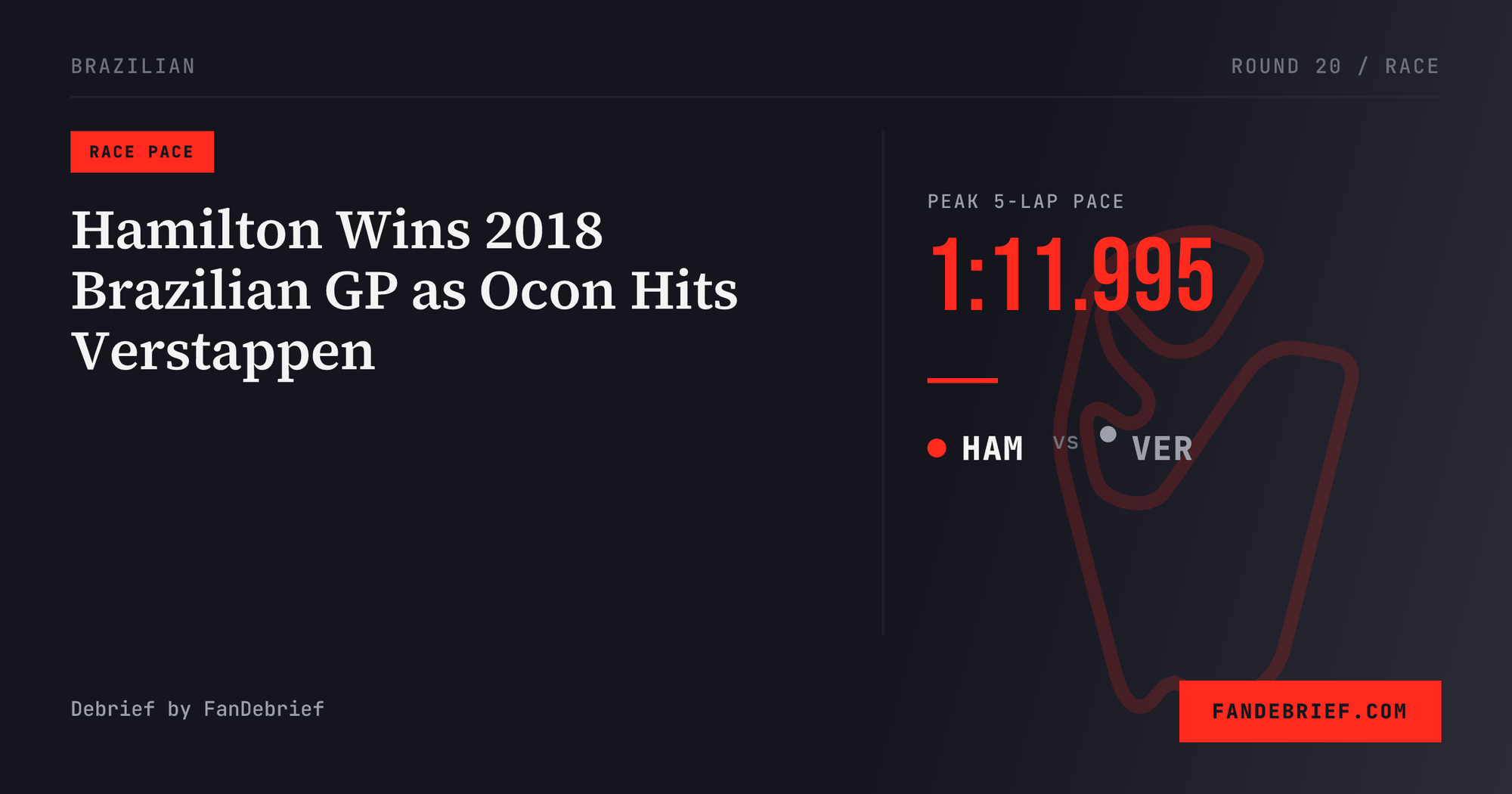
For forty-three laps, the Brazilian Grand Prix belonged to a car that started fifth on the grid. Max Verstappen spent the first third of the race cutting through the Ferraris and the second Mercedes like they were traffic, and by the time the pit cycles had settled he was leading Lewis Hamilton's own home race by the better part of two seconds. Then, on lap 44, a Force India that was two laps down decided it still had somewhere to be, and by the time the double waved yellows cleared in the second marshalling sector, the race lead was back in Hamilton's mirrors for good.
This was not a win Hamilton had to fight for on pace. The numbers underneath it argue he was, for long stretches, the third-fastest Mercedes-adjacent car on the grid that afternoon, and the story of the race is really the story of how he still ended up on the top step.
The front row that promised more than it delivered
Hamilton took pole by well under a tenth from Vettel, with Bottas and Räikkönen covered by less than two-tenths behind them. It was the kind of Saturday that suggested a Sunday decided by clean starts and strategy calls, not fireworks: the top six on the grid were separated by half a second, with Verstappen fifth and Ricciardo sixth after Q3. Dry, warm conditions, track temperature pushing 40 degrees, gave nobody an excuse to blame the weather for what came next.
What came next was Verstappen simply refusing to stay in fifth. He scythed past Kimi Raikkonen, Sebastian Vettel and Valtteri Bottas in the first ten laps of the race before taking the lead from Hamilton, a Red Bull that, by outside reporting, hadn't led a lap around Interlagos since 2013, suddenly setting the pace at the front. The pit cycle briefly scrambled the picture: when Hamilton came in first, off lap 19 onto the medium, the on-track gap swung to Verstappen by nearly eighteen seconds, a number that says nothing about pace and everything about who happened to be mid-stop when the leaderboard froze. Ricciardo's own stop cycle shuffled the effective race lead again at lap 36 and lap 40, but by the time the sequence settled, Verstappen was genuinely ahead of Hamilton on the road, not just on strategy paper, by close to two seconds.
That is the version of this race that should have finished with a Red Bull on the top step for the second race running, since Verstappen had also won the previous round in Mexico. It didn't, and the reason sits entirely on lap 44.
The data behind the race
Timing and telemetry from every car on track.


Lap 44 and the collision that flipped it back
Esteban Ocon, running two laps down, was entitled to try to unlap himself, and the timing screens show exactly what that decision cost everyone involved. A double yellow flew through track sector two as the Force India and the Red Bull came together, both cars losing time in the tangle, and when the dust settled it was Hamilton, not Verstappen, who came through as the new race leader. Ocon was handed a ten-second stop-go penalty for causing the collision, the harshest sanction short of disqualification, confirming where the stewards laid the blame.
What the data does not let you ignore is how close Verstappen still came. By lap 45, one lap after the incident, Hamilton's cushion was 5.45 seconds. Lap by lap it shrank: 3.99 at lap 55, 2.12 at lap 65, down to 1.47 seconds at the chequered flag. That is not the profile of a driver nursing a car home; it is the profile of a driver closing hard on a leader who had nothing left to give back and just enough laps left to survive. Verstappen had no words for the finish afterward, and by several accounts he was considerably less composed in the moments right after climbing out of the car, with an angry confrontation with Ocon in the weigh-in room that followed the two of them off the circuit and into the headlines. It was, by outside reporting, the first major incident between a backmarker and a race leader since the 2001 Brazilian GP, a coincidence sharpened by the fact that the collision this time involved the son of the driver on the other side of that one.
Hamilton, for his part, called the closing laps something close to racing at its best, and arithmetic backs the sentiment even if the manner of the win will always carry an asterisk in Red Bull's garage: it was his tenth win of the season, on a weekend where his own race pace was not even the fastest Mercedes lap of the day.
The strategy story underneath the headline
That last point deserves its own attention, because Hamilton did not win this race by being the quickest car in it. His weighted race pace across the afternoon was a 1:13.340, but Bottas was over a second quicker per lap on average at 1:13.345... no, the reverse: Bottas's raw race pace was quicker than Hamilton's, and so was Vettel's. Bottas ran an extra pit stop compared to Hamilton and was still 1.255 seconds faster per lap in race trim, yet finished fifth to Hamilton's first. Vettel told the same story from the other side of the garage: an extra stop, 0.964 seconds faster per lap than Hamilton, and a sixth-place finish four spots worse than where he started. Both Mercedes and Ferrari found more raw pace with two stops than Hamilton found with one, and both finished behind him anyway. That is not a coincidence you can wave away; a one-stop that keeps you out of pit lane trouble and out of traffic is worth more over a race distance than a tenth or two of lap time, and Hamilton and his strategists proved it again at Interlagos.
Räikkönen made the one-stop approach look even better, matching Hamilton's strategy shape and coming home third from a P4 start, gaining one place while Vettel lost four. Ricciardo told a completely different version of the same afternoon: he'd qualified sixth but lined up eleventh for the start, and from there produced the drive of the day, gaining seven positions to finish fourth on a single stop, topping the sector-one speed charts for more laps than anyone else in the field and setting the outright fastest speed trap reading of the race at 337 km/h. If Verstappen was the story of the middle of the race, Ricciardo quietly built the best recovery drive nobody was talking about afterward.
The rest of the field
Sauber's afternoon split down the middle of the garage. Leclerc brought his car home seventh from a P7 start, clean and unspectacular in the best sense, while his teammate Ericsson, who'd out-qualified him into sixth on the grid, was out of the race by lap 20 after a collision, the gap between their fastest laps eventually stretching past three seconds by the end. Hulkenberg's race ended in the same period, retiring with overheating after 32 laps having started 13th, a quiet DNF compared to the drama further up the road but a lost result for Renault all the same.
Further back, Fernando Alonso picked up a five-second time penalty for ignoring blue flags, a frustrating footnote to a McLaren weekend that had already started from 17th, while Stoffel Vandoorne salvaged something from a P20 start by gaining six places. Grosjean and Magnussen brought both Haas cars home in the points, eighth and ninth, on pace that sat respectably mid-pack across the weighted rankings, and Perez rounded out the top ten from twelfth on the grid for Racing Point.
What Abu Dhabi needs to answer
Verstappen arrives at the season finale having now taken a genuine race lead in back-to-back grands prix, and Interlagos did nothing to suggest his pace was the problem; Mercedes' own drivers were faster than Hamilton in a straight-line race-pace comparison, and Verstappen was faster than all of them for the laps that mattered. What Red Bull still needs to find is a race where none of that gets undone by someone else's mistake. Hamilton, meanwhile, heads into the last round of the year with his tenth win of the season banked and Mercedes still holding a 55-point cushion over Ferrari in the constructors' fight heading into Brazil. The result at Interlagos didn't answer who had the faster car that day. It only answered who was still holding the lead when the chequered flag came out, and after a race like this, that distinction is the whole story.