Antonelli Wins Spanish GP 2026 on a Lap 14 VSC Pit Stop
Kimi Antonelli turned a mid-race Virtual Safety Car into his eighth win of the season, and Lando Norris never lost the Spanish Grand Prix lead on track, only in the pit lane.
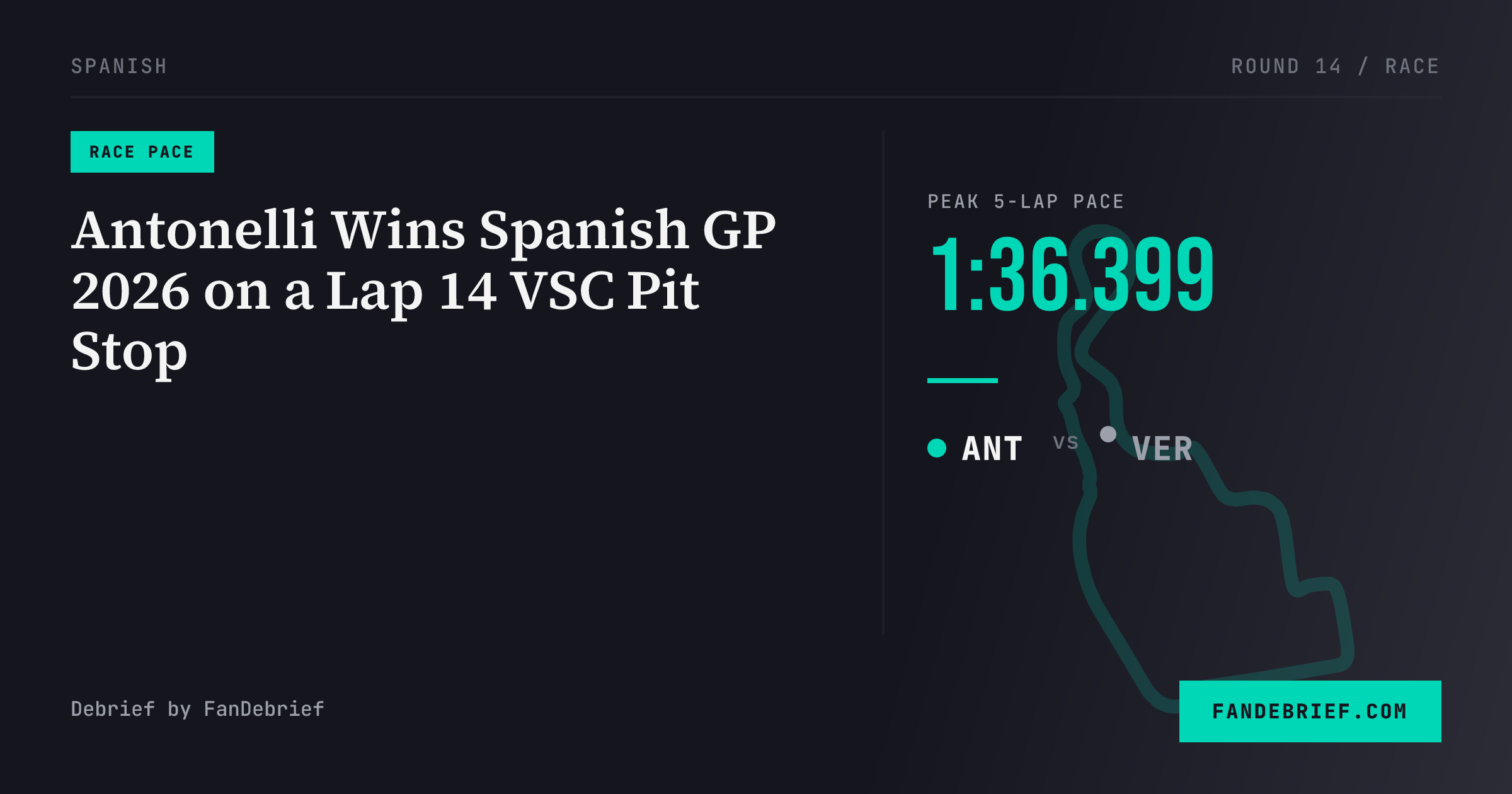
Lando Norris did everything right on Saturday and most of Sunday. He took pole by eleven thousandths of a second, the tightest front row of the weekend, and he led the Spanish Grand Prix from lights to the moment it mattered. None of it was enough, because this race was never going to be decided by who was fastest through Turns 1 to 5. It was decided by who was in the pit lane when the Virtual Safety Car came out, and Kimi Antonelli's Mercedes was in exactly the right place.
That is the story of Spain in one line: two lead changes all afternoon, and neither of them happened on track. Antonelli took his eighth win of the season not by passing Norris but by out-thinking the pit window around him, then holding a car that was quicker across the middle sector at arm's length for the final third of the race.
Antonelli went into the weekend with a 267-point championship lead built on seven wins already this season, and Norris's pole, just 0.011s clear of the Mercedes, was the closest anyone had got to denying him all year. Verstappen split the two title protagonists in P3 after a 0.140s gap on Saturday, with Hamilton and Leclerc close behind on the second row. On a circuit built around high aero loads and dirty air that punishes anyone following, that qualifying order looked like it might simply hold station for 57 laps. It didn't, and the reason had nothing to do with overtaking.
A Virtual Safety Car that rewrote the order
A VSC on lap 14 changed everything. Antonelli, Verstappen, Norris, Russell, Colapinto, Lindblad, Hulkenberg, Ocon and Perez all cycled through the pits inside that window, and the queue behind the virtual delta is where this race actually turned. Verstappen had started on softs and used the VSC to switch to hard tyres on lap 14; Antonelli, who'd started on mediums, made the same call on the same lap. Norris followed a lap later. On paper it looked like business as usual up front.
Charles Leclerc didn't stop. He'd started the race on hards and simply stayed out, and stayed out, and stayed out, running a single stint from lap 1 all the way to lap 48. That decision is why the timing sheet shows a lead change at lap 16 from Norris to Leclerc with no car anywhere near the McLaren on track: Leclerc inherited the effective lead purely by not pitting while everyone else did. He held it, on strategy, for more than 30 laps, before his own stop finally came at lap 48 and handed the lead straight back, this time to Antonelli, who had built enough of a buffer by then to make the position stick.
That's the whole plot of the race laid bare in the lead-change column: strategic, strategic, nothing else. Zero on-track passes for the lead in 57 laps around a track built to make exactly that outcome likely.
Once Antonelli was in front for good, he controlled it rather than dominated it. The lap-by-lap gap to Verstappen tells that story cleanly. Verstappen briefly led by 0.77s on the opening lap before the queue sorted itself out; from there Antonelli was never headed, stretching to as much as 7.4 seconds around lap 20 before Verstappen's hard tyres came good and clawed it back down to 1.76 seconds by lap 50. Verstappen never got a look at the lead in that final push. Antonelli found another gear at the flag, pulling the margin back out to 4.35 seconds by lap 57, a gap that looked comfortable on paper but had been anything but for the ten laps before it.
The data behind the race
Timing and telemetry from every car on track.


The fastest car of the day finished fifth
Here's the number that should needle Mercedes and Russell in equal measure: across the weighted average of his stints, Russell's race pace of 1:38.398 was actually quicker than Antonelli's 1:38.345 only by the smallest of margins in the order, but Russell's own team-radio-free tyre story reads differently. Russell ran an extra pit stop, two to Antonelli's one, switching from hard to medium and back to hard again rather than the simpler medium-to-hard the race winner used. He was 0.443 seconds a lap faster than Antonelli in raw pace and still finished fifth to his win. That's not a small gap papered over by track position, that's the story of the day: the extra stop, and the traffic that came with running through a pack of backmarkers on a circuit where following is a genuine handicap, cost more than the pace gained back.
The same theme shows up again against Verstappen. Russell was 0.622 seconds a lap faster than Verstappen through the final sector, the long right-handed run that makes up the back third of the lap here, and still finished three places behind him. On a track engineered to punish dirty air, being the quickest car in isolation counted for less than being in clean air at the right moment.
Leclerc's numbers back up the same idea from another angle. His long first stint on hards was patient rather than spectacular, but it put him in position to inherit a lead nobody else was fighting for, and when he switched to softs for the run to the flag he was suddenly the sharpest car on the grid through the middle sector, fastest there 20 times across the race. He finished fourth, one place clear of Russell, on a strategy that asked for almost nothing except staying out and waiting.
Sector dominance underlines who actually had the answer on raw speed. Antonelli was fastest through the opening sector 19 times and the closing sector 21 times, the two components of the lap that reward precision on the brakes and confidence through the fast final corners. Leclerc's 20 fastest middle sectors were the McLaren and Red Bull's problem to solve and neither did; Norris's own fastest lap of 1:36.680 came in five tenths shy of Russell's benchmark lap of 1:35.587, set late on lap 49 when the Mercedes had space to actually use its pace.
Hamilton's afternoon fell apart in six laps
While the front of the field argued about tenths, Lewis Hamilton's race disintegrated entirely. He'd qualified fourth, one place off the podium places on raw pace, and never got the chance to use it. His opening stint on soft tyres degraded by more than three and a half seconds a lap, an alarming number even accounting for early fuel loads, and it came with laptime after laptime deleted for track limits before a black-and-white flag warning arrived on lap 6. One pit stop into the afternoon, on lap 6, he was out of the race. For a driver sitting third in the championship coming into the weekend, a six-lap Sunday in Spain is about as bad as it gets, and Ferrari's other car went the opposite direction entirely, Leclerc's patient one-stop turning into a podium finish.
The retirements column had four other names in it. Sainz picked up a 10-second time penalty and never recovered, retiring on lap 43 after three stops trying to work around it. Perez and Stroll both fell out earlier, on laps 31 and 13 respectively, and Bottas' race ended on lap 54 having completed 54 of the 57 laps. None of the multi-car teams lost both entries; Ferrari and Aston Martin and Williams each got one car home and lost the other, and Cadillac was the only team to lose its full pairing.
Further back, the midfield produced the kind of gains that don't make headlines but decide championship points. Colapinto climbed from P9 to P7 for Alpine, both of its cars finishing. Lawson worked from P8 to P6 for Red Bull, running the longest first stint of anyone in the top ten before switching to mediums with 13 laps to go. Piastri lost a place to finish eighth, unable to match the sister McLaren's pace on a weekend where the number one car simply had the smoother race. None of it involved passing for the lead; all of it involved managing a first stint, choosing the right lap to stop, and staying out of the trouble further up the road.
What Spain confirms is that this Mercedes is capable of winning races it doesn't dominate outright. Antonelli didn't have the fastest lap, didn't have the fastest race pace among the front-runners, and still leaves with the win because his team read the pit window better than anyone else on the grid. Russell's pace, wasted behind an extra stop and a queue of traffic, is the more interesting story for Baku: a two-stop wasn't the wrong idea in isolation, but on a track where passing is this hard, it needed the pit lane to cooperate in a way it didn't. Azerbaijan's long straights and low-downforce demands could not be more different from what Spain just asked of these cars, and that contrast, more than any one lap time here, is what makes Round 15 worth watching.