Hamilton Takes Spanish GP 2018 Win as Three Crash at Turn 1
Hamilton controlled every lap he needed to at the Circuit de Barcelona-Catalunya, but the race's real story was written in the opening seconds, when three cars never made it past Turn 1.
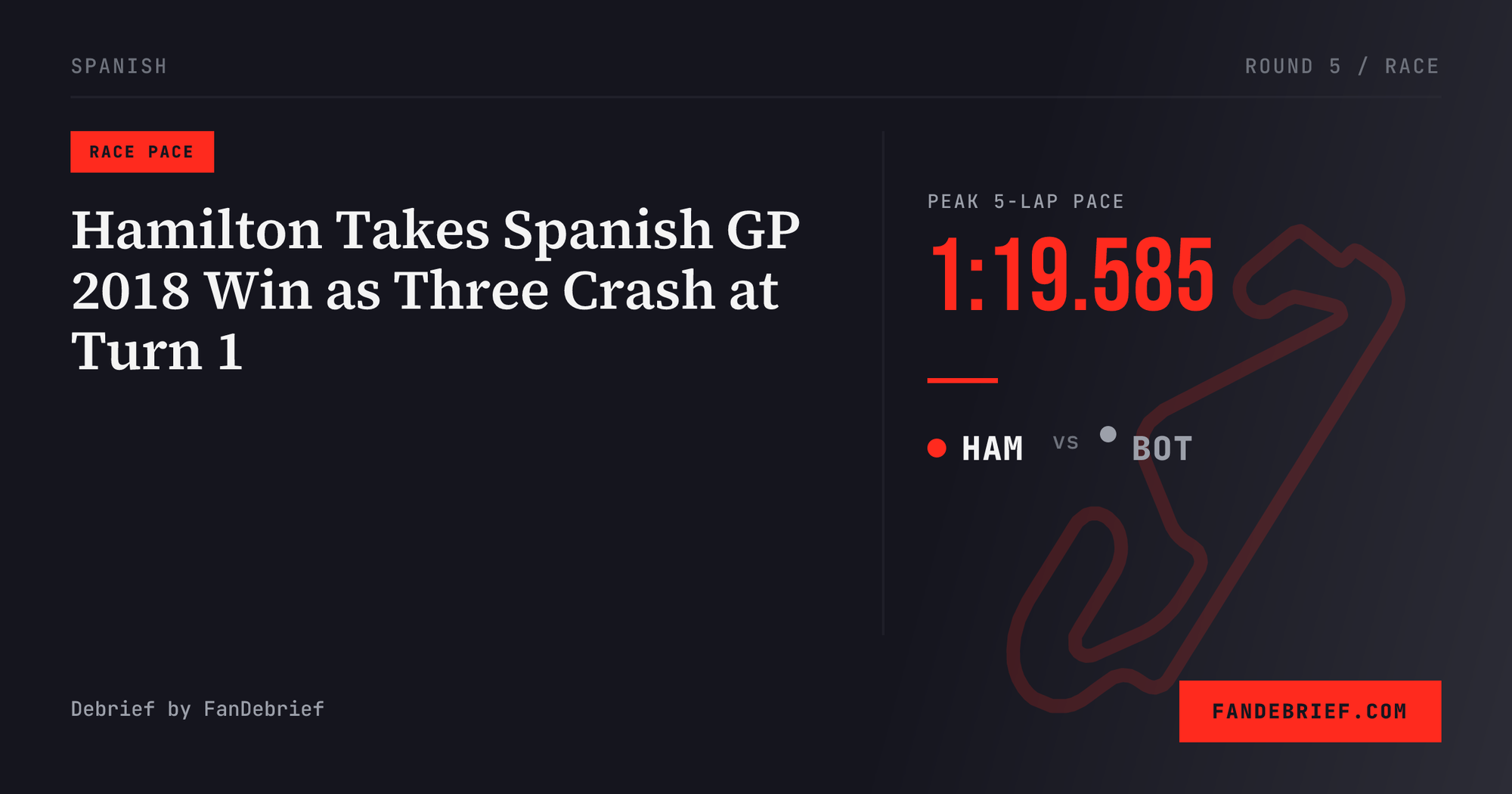
Three cars were already parked before most of the grid had cleared Turn 3. That's the image Barcelona will keep from this one: a safety car out on lap one, a chequered flag on lap 66, and Lewis Hamilton leading every meaningful lap in between.
This was a race won on pole and defended through a strategy split, not seized on merit lap by lap. Hamilton took a pole-to-flag victory that never looked seriously threatened, while Daniel Ricciardo, in the fastest car on track, spent the afternoon proving that raw pace and race results are two different conversations entirely.
Qualifying had set up exactly the sort of front row Mercedes wanted. Hamilton's pole lap put him four hundredths of a second clear of teammate Valtteri Bottas, with Vettel a little over a tenth back in third and Räikkönen fourth. The top four in Q3 were separated by well under half a second, tight enough that the grid alone told you nothing about who'd control Sunday. What it didn't tell you was that inside a lap and a half, a quarter of that grid would be finished for the day.
A first corner that ended three afternoons early
The race started clean off the line but didn't stay that way. Race control called double yellows in track sector four before the opening lap was even done, and the safety car was out moments later. Gasly, Grosjean and Hulkenberg were all involved in the same first-lap collision; all three completed exactly one lap and no more. It's the kind of opening no strategist plans for: three cars gone, a five-lap safety car period to shuffle the tyre-life calculus for everyone else, and a race that had to properly start twice.
For the frontrunners it barely registered beyond the delay. Hamilton, unchallenged at the restart, put the hammer down early and never really let up. He built his cushion in the opening stint by simply going quicker than the cars behind him lap after lap, and by the time the pit stops began to cycle through, the gap on track had swollen past thirty seconds, more a function of who'd stopped and who hadn't than any single dramatic move. Hamilton had already done the leg work early in the race when he was often half a second faster than his pursuers.
Red Bull had arrived believing a strategic variation was its best route to troubling the front-runners, banking on tyre life it had seen in Friday running. On the Friday race sims it had much the fastest car over a stint, with way less tyre degradation than either Mercedes or Ferrari, so much so that it looked able to make a one-stop strategy work. That theory held up in the pace numbers. It didn't translate into the result Red Bull needed.
The data behind the race
Timing and telemetry from every car on track.


The pit cycle that briefly rewrote the lead
The only genuine change of race lead all afternoon came through the pit sequence, not a wheel-to-wheel pass. Hamilton handed the lead to Verstappen on lap 26 when his own stop cycle put him in the pit lane, then took it back nine laps later once Verstappen made his own stop. It's a small window in the timing sheet, two lines reading "strategic" rather than "on track," but it's the only moment all race where Mercedes' control of the result was ever technically interrupted. Hamilton's own single stop, switching from soft to medium on lap 25, was the calmer, one-and-done approach that let him manage the race from the front rather than fight through it.
Verstappen made the most of the afternoon on the other side of that swap. He climbed from fifth on the grid to third at the flag, a genuinely encouraging recovery drive built on a clean, unfussy single stop of his own. His teammate had a stranger day of it: Ricciardo gained a single place to finish fifth despite setting the outright fastest lap of the race, a 1:18.441 on lap 61 that was almost seven-tenths slower than the fastest lap of the race, set by Daniel Ricciardo compared with Hamilton's best. Put simply, Ricciardo had the quickest car in isolation and still couldn't convert it into anything better than P5. That's the sharpest tension of the whole afternoon: the fastest lap of the day belonged to a driver who finished more than half a minute off the win.
Vettel's afternoon went the other way entirely. He started third and finished fourth, needing two stops where the Mercedes and Verstappen cars in front of him needed only one. Whatever tyre-life advantage Red Bull believed it had going in, Ferrari clearly didn't share it; a two-stop strategy that cost Vettel a place isn't the afternoon his side of the garage wanted, particularly with his teammate's race ending in smoke.
That teammate, Räikkönen, was the highest-profile retirement of the day that wasn't first-lap carnage. He'd started fourth, right in among the leading pack, before a turbo failure ended his race on lap 25. Ferrari's tally for the day reads one retired, one salvaged; Vettel's lost place looks a lot less costly next to a car that never saw the chequered flag at all.
The midfield told its own story
Sergio Perez produced the single biggest recovery drive of the field, climbing from fifteenth on the grid to ninth at the flag, a two-stop race that included a rare late switch back onto the soft compound with 26 laps still to run. Lance Stroll matched the theme from further back, gaining seven places to finish eleventh, and Brendon Hartley went one better again, up eight from twentieth to twelfth. None of them were fighting for the places that mattered on Sunday evening, but all three turned a scrappy grid slot into a result worth remembering.
McLaren's day split down the middle in the way this circuit often exposes a two-car team. Fernando Alonso ran a clean single-stop race to eighth. Stoffel Vandoorne never got the chance to match him: a five-second penalty for failing to stay left of the bollard at Turn 2 on the opening lap was the least of his problems, because a gearbox issue ended his race on lap 46 anyway, in what was already a two-stop afternoon that had asked more of the car than it could give. The gap between the two McLaren drivers' best laps, the better part of two seconds, tells you which side of the garage had the smoother Sunday even before you get to the DNF column.
Elsewhere, the retirement list read like a checklist of unrelated bad luck rather than a pattern: Esteban Ocon's Force India went out with an oil leak after 39 laps, and the Renault-powered McLaren aside, none of the other midfield teams lost a second car to match their first. Mercedes, Red Bull, Sauber and Williams all brought both their cars home, which given the first-lap chaos further back on the grid is no small thing.
On pure sector pace, Bottas actually owned the first sector more than anyone, topping it on 37 of the 66 laps, while Hamilton controlled the middle and final sectors on his way to the win. It's a reminder that Bottas was never far off Hamilton's raw speed all afternoon; he simply never had the clean air or the strategic opening to test it. He crossed the line 20.59 seconds behind at the flag, comfortably clear of everyone else but never close enough to make Hamilton work for it.
Hamilton's win here follows his victory at Baku last time out, back-to-back results that put him on top of a championship picture Mercedes will be pleased to sit atop heading to Monaco. But if anything from this Sunday should worry the sister garage, it's not the scoreboard, it's the pace chart: Red Bull's tyre life and Ricciardo's outright speed were both genuinely the class of the field, and a street circuit with even less overtaking room than Barcelona is no guarantee that Mercedes' strategic control repeats itself so cleanly.