Norris Holds Off Verstappen to Win Hungarian GP From Pole
Lando Norris banked his first win of the season from pole in Hungary, riding out a late Virtual Safety Car and his own teammate's retirement to hold off Max Verstappen's late charge.
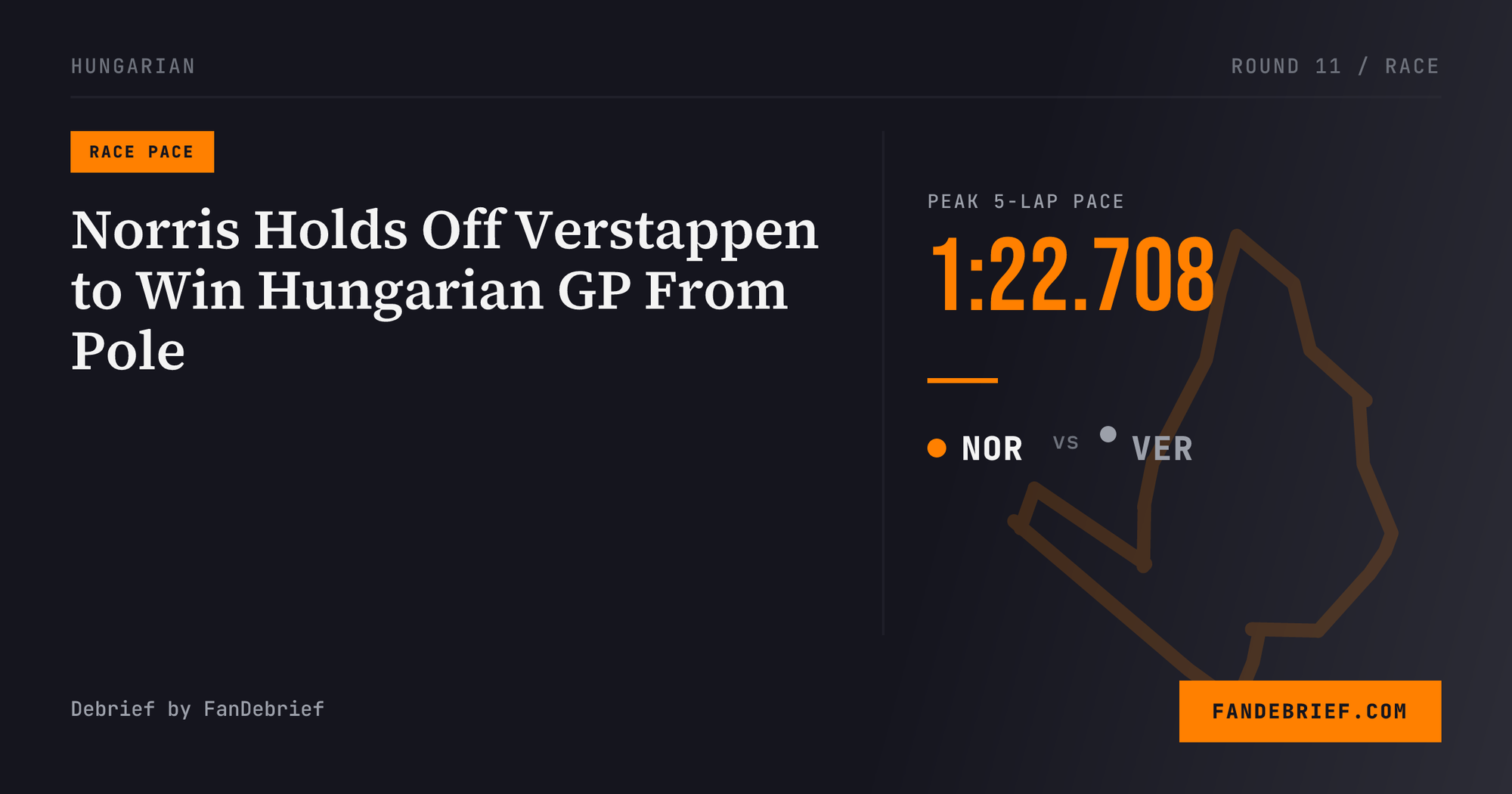
Lando Norris crossed the line in Hungary with the composure of a man who had done this before, because he had. Twelve months on from his win at this same track, Norris took McLaren's first victory of this season, on a weekend where a single quick lap in qualifying mattered more than almost anything that followed. He led when it counted and let the pit wall handle the rest.
Seven changes of the lead at a circuit rated 'very hard' for overtaking tells you plenty about how this race was actually decided. Only one of those seven changes happened with a car actually passing another on the road. The other six were pit-stop mathematics, cars trading positions on a computer screen before the drivers had even left the pit box.
Norris took pole by the barest of margins, twelve thousandths of a second ahead of Hamilton, with the top four covered by under three tenths and Piastri splitting the Ferraris in fifth. Antonelli, who arrived in Hungary leading the championship by a wide margin on the back of six wins already this season, could only manage P7 in a session where track position would prove nearly everything. Verstappen lined up sixth. In warm, dry conditions with track temperatures pushing past 50 degrees, the stage was set for a strategy race dressed up as a sprint.
McLaren ran Norris on a three-stop plan, medium tyres to start, then hard, then soft for the run to the flag, and the pace numbers back the choice: his weighted average racing lap of 1:24.4 was quickest of anyone in the field, comfortably clear of Hamilton and Leclerc in the mid-1:24.7s. But the story of the middle of this race was written by his own teammate. Piastri, starting third, actually led the race twice through the pit-stop sequence, first when Norris's own stop handed him track position around lap 16, and again from lap 23 to 33 as the field cycled through its first round of changes. For a while it looked like an all-McLaren fight at the front. Then, on lap 56, Piastri's race ended in retirement, and with it went McLaren's second contender.
The on-track gap between Norris and Verstappen through the afternoon reads like a heart monitor rather than a steady lead. Norris was out front by less than three seconds through the opening laps, then the gap ballooned past 23 seconds around lap 15 as the first stops scrambled the order. By lap 40, with the pit cycle still working through, it was Verstappen who briefly led on the timing screens by over ten seconds, before Norris and Antonelli leapfrogged back through their own stops and Norris was clear again by 17 seconds inside five laps. None of that represented a genuine change of fortune on track. It was tyre strategy playing out in real time, and Norris's crew got the sums right more often than anyone else's.
The one lead change that actually happened on the circuit came on lap 46, when Norris passed Antonelli for real, car alongside car, to retake first place for good. Everything else that afternoon, the passes and the counter-passes on the strategy boards, was theatre for the pit wall. The genuine action fit into a handful of corners on a single lap.
A Virtual Safety Car and a lead that got squeezed
Just as Norris looked to be cruising, race control threw a Virtual Safety Car on lap 56, double yellows waved in track sector six. His advantage over Verstappen, sitting at nearly 17 seconds before the neutralization, was squeezed down to just over six seconds by lap 60. It was the moment Verstappen's afternoon threatened to turn from a strong recovery drive into something closer to a shock. Norris didn't blink. He rebuilt the gap through the closing stint on fresh soft tyres, crossing the line just over 15 seconds clear at the chequered flag. Verstappen, who started sixth and gained two places to finish second, will look back on his own two-stop plan, one fewer stop than the leaders, as the difference between chasing and winning.
Antonelli's afternoon was the recovery drive of the day. From P7 on the grid he picked his way to third, running a lean two-stop strategy and putting in the fastest pit stop of the entire field, 21.2 seconds stationary on lap 53. He led two separate spells of the race through the strategic shuffle before Norris passed him for keeps at lap 46. It's the kind of drive that explains why he arrived in Hungary with a commanding championship lead in the first place, even on a weekend when the win itself went elsewhere. Russell, by contrast, slipped one place back from his grid spot to finish seventh, a quieter day for the other Mercedes.
Ferrari's afternoon raises the harder question. Leclerc was faster than Verstappen through the middle sector for large parts of the race, yet finished two places behind him, in fourth rather than second. The answer sits in the pit lane rather than the cockpit: Leclerc ran a three-stop strategy, the same shape as Norris's winning plan but without the pace to match it, while Verstappen's leaner two-stop cost him less time stationary and more than made up the deficit on strategy alone. Hamilton had the makings of a stronger result too, but a five-second penalty for speeding in the pit lane blunted his afternoon, and he came home fifth, the podium he might otherwise have contested reduced to a top-five finish.
Further back, this was a race of recoveries and quiet disasters in equal measure. Lawson gained three places from eleventh to finish eighth, one lap down but ahead of faster cars that had strategy go wrong. Stroll was the story of the midfield, climbing seven places from a P20 start to finish thirteenth. Sainz picked up a ten-second penalty for causing a collision and Bearman a five-second penalty for ignoring blue flags, both finishing towards the back of a lapped pack. Cadillac's weekend was the grimmest of all: both Perez and Bottas retired, the only team on the grid to lose both cars, Bottas out early after just 14 laps.
What Hungary tells the paddock heading to the Netherlands is that McLaren's pace is real, not a one-off born of a lucky strategy call. Norris won here last year too, and did it again this weekend by building the fastest average lap in the field and executing a three-stop plan with precision. Antonelli's championship lead survives this round intact in spirit even without a win to add to his season tally of six, because a podium from P7 on a circuit where passing is brutally hard is exactly the kind of recovery that keeps a title charge alive. The question for the Dutch Grand Prix is whether Norris's Hungary was the shape of a genuine turn in form, or a single weekend where the sums simply fell McLaren's way.
The data behind the race
Timing and telemetry from every car on track.


