Hamilton Wins 2018 Hungarian GP, Raikkonen Fastest in Third
Lewis Hamilton controlled the Hungaroring from pole to flag, but it was Kimi Räikkönen, not Hamilton or Vettel, who drove the fastest race of the afternoon and still finished third.
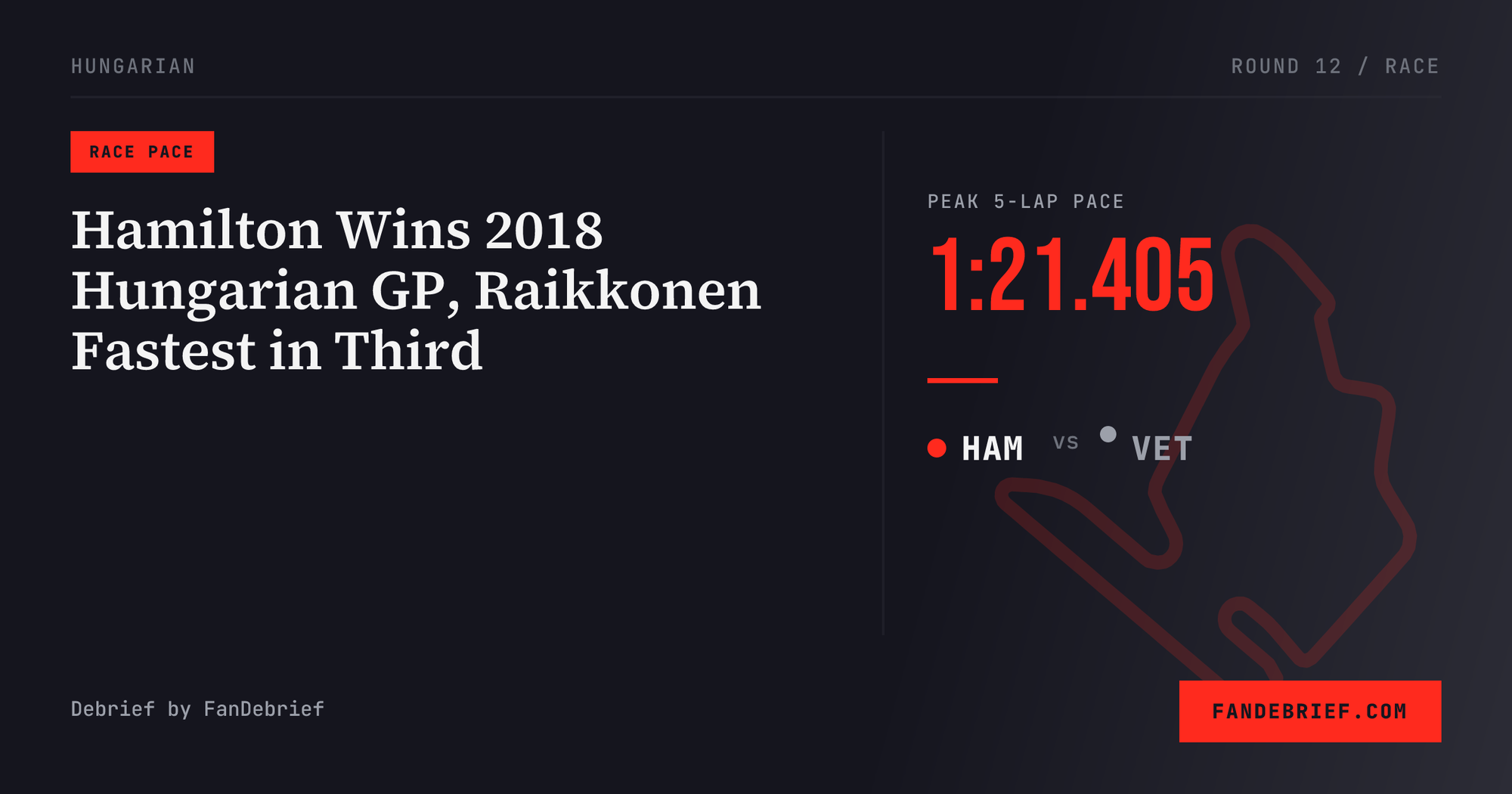
Kimi Räikkönen drove the fastest race lap for lap of anyone at the Hungaroring on Sunday. He finished third, more than eight tenths of a second slower on average than the winner and still on the wrong side of a strategy call his own team made for him.
That contradiction is the story of the 2018 Hungarian Grand Prix. Lewis Hamilton didn't have to be the fastest man on track, he just had to be the smartest, and on a circuit where passing is famously brutal, smart won. Hamilton controlled the race from pole to the chequered flag, but the margins that actually decided the podium were built in the pit lane, not on it.
Qualifying had set up a front row split by fractions. Hamilton's pole lap put him a quarter of a second clear of teammate Valtteri Bottas, with Räikkönen and Vettel three and a half tenths further back in third and fourth. On a track this tight, that grid order should have been close to destiny. It wasn't, not entirely, and the reason was tyres.
Vettel's long first stint and the two lead swaps
Räikkönen was the first of the leading four to pit, coming in on lap 14 for softs after starting on ultrasofts. Bottas followed a lap later, and Hamilton played it patient, staying out on his ultrasofts until lap 25. Vettel did something different again: he'd started the race on softs from fourth on the grid, and he simply kept going, stretching that first stint all the way to lap 39, twenty-five laps longer than Hamilton's opening run.
The payoff showed up exactly where you'd expect. On lap 25, with Hamilton still leading on-track by four and a half seconds, the picture looked settled. By lap 30, five laps after Hamilton's stop, Vettel had leapfrogged into a lead of over fourteen seconds simply by staying on track while the others cycled through the pits. That gap held near twelve seconds on lap 35. It's the reason the timing sheet shows three total lead changes in this race, and two of them were strategic, not fought for on track: Hamilton lost the effective lead to Vettel's long stint on lap 26, and got it back the moment Vettel finally pitted on lap 40, dropping to a fresh set of ultrasofts and handing the road position straight back to Mercedes.
From there the race pace numbers explain the rest of the afternoon. Räikkönen's average was the best in the field at 1:22.362, with Hamilton barely two tenths behind at 1:22.424, and Vettel and Ricciardo close enough behind that to make the argument feel almost academic: the top four were separated by under three tenths across the whole race. If lap time alone decided grands prix, this would have been a four-way argument to the flag. It wasn't, because Hamilton never had to out-drive Vettel lap after lap, he just had to make sure his one pit stop landed in the right window and his tyres held. They did: Hamilton's softs, fitted on lap 25, degraded by less than four hundredths of a second per lap for the rest of the race. That's the kind of number that doesn't grab headlines and quietly wins grands prix.
Räikkönen's problem was that Ferrari asked more of his tyres than Vettel's strategy did. Two stops instead of one meant more time in the pit lane and less margin to play with; his second stop, on lap 38, effectively used up the strategic flexibility that might have let him challenge for second. He was quicker than Vettel all weekend on pure pace. He finished a place behind him anyway, and it's hard to look at Hungary and not conclude Ferrari's second Ferrari carried the sharper race but the blunter result.
The first meaningful jolt of the afternoon actually arrived before any of that strategy played out. Charles Leclerc's race lasted a single lap before a suspension failure ended it, and five laps later Max Verstappen's Red Bull lost power and rolled to a stop, triggering a Virtual Safety Car that briefly scrambled the sequencing everyone else was planning around. Verstappen had started seventh; the retirement dropped him out of a race his teammate would later turn into the afternoon's best story.
Daniel Ricciardo's drive from twelfth to fourth is the other half of that Red Bull garage's Sunday. Ricciardo was the fastest car through the middle sector for twenty-one of the race's seventy laps, more than anyone else managed, and his overall race pace, 1:22.655, sat inside three tenths of the outright best in the field. Starting twelfth after a wet qualifying session and gaining eight places by the flag isn't a fluke; it's a driver whose car was quick enough, on this evidence, to have been fighting at the front of the grid rather than scrapping through traffic from row six. The natural question the pace numbers invite: with that kind of speed, how much did the grid penalty and the wet Saturday actually cost Red Bull's chances of properly troubling Mercedes and Ferrari here?
Bottas is the mirror image of Ricciardo's afternoon. He set the single fastest pit stop of the entire race, a 19.6-second stationary time on lap 15 that beat every other crew in the pit lane, and Mercedes still watched him slide from second on the grid to fifth at the flag. The explanation is written into his tyre strategy: once he switched to softs on lap 15, he stayed on that one set for fifty-five laps, the longest single stint run by anyone in the top ten, and the degradation numbers show why that eventually caught up with him, his pace fell away by over two hundredths of a second every lap for the back half of the stint. A brilliant pit stop bought him nothing if the rubber that came out of it couldn't finish the job.
Further down the order, the midfield produced its own small satisfactions. Pierre Gasly brought Toro Rosso home sixth from a starting slot of the same number, a tidy, unspectacular result on a weekend when tidy was enough. Kevin Magnussen matched him in spirit, gaining two places to finish seventh for Haas. Fernando Alonso's eighth for McLaren, gained from eleventh, stood in sharp relief against teammate Stoffel Vandoorne's afternoon: Vandoorne was over nine tenths slower per lap across the race and didn't see the finish, retiring with a gearbox problem after completing fifty laps, right around the moment the second Virtual Safety Car of the day was deployed. Nico Hulkenberg's second pit stop landed almost exactly in that same window, the kind of timing that looks like luck on the page and discipline on the pit wall.
Hamilton's winning margin at the flag, seventeen seconds over Vettel, tells you the race was never really in doubt once the strategic swaps had shaken out, even if the on-track gap had swung by more than thirty seconds across the afternoon's pit cycles. He arrived in Hungary seventeen points clear of Vettel in the championship battle and leaves with that cushion stretched further heading into the summer break, a shift that matters more with half the calendar still to run than any single Sunday usually would. The Hungaroring's recent form book has alternated between these two men every year since 2015, Vettel, Hamilton, Vettel, and now Hamilton again, and if that pattern means anything at all, it's that whoever gets the strategy right at this track walks away with more than just the thirty-one points on offer. Spa is next, a circuit that rewards raw horsepower over pit-wall cunning, and it will tell us fast whether Ferrari's speed advantage finally gets to matter, or whether Mercedes' knack for reading a race correctly follows them there too.
The data behind the race
Timing and telemetry from every car on track.


