Antonelli Passes Leclerc on Track to Win Belgian GP 2026
Kimi Antonelli lost the lead to a Ferrari pit cycle and had to win the Belgian Grand Prix twice, retaking Charles Leclerc on track at Les Combes with ten laps still to run.
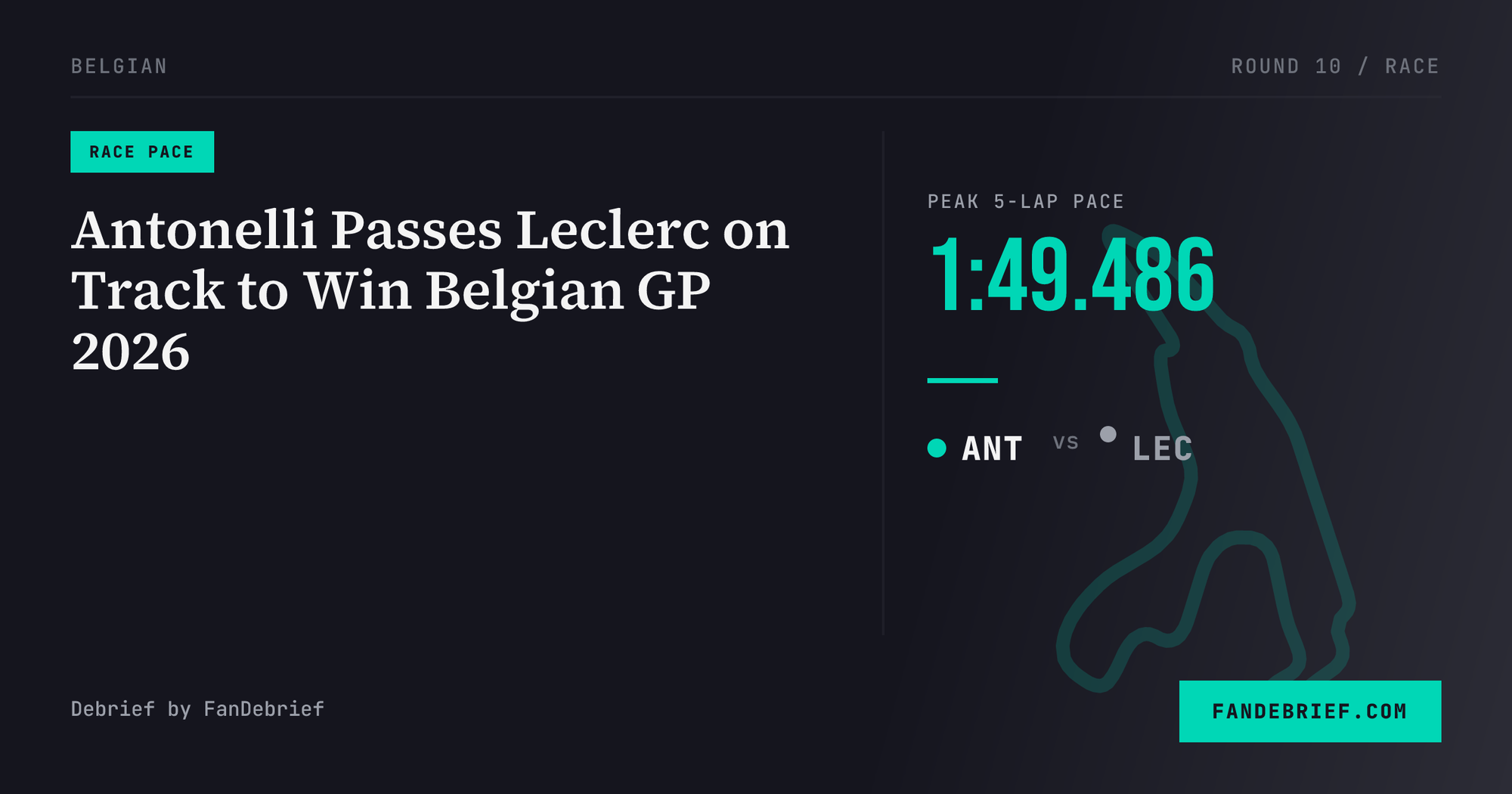
Les Combes, lap 34. Kimi Antonelli draws alongside Charles Leclerc's Ferrari, commits to the inside, and comes out the other side back in the lead of his own Grand Prix. No contact, no drama, just a pass that settled the argument Spa had spent thirty-three laps building. Ten laps later he crossed the line two seconds clear. It was his second win of the afternoon, because he'd already won it once from pole before the pit stops took it away.
That's the story of this Belgian Grand Prix: a race where the fastest car had to prove it twice. Antonelli started on pole and led comfortably through the opening stint, but a Ferrari pit stop timed around a Virtual Safety Car flipped the lead into Leclerc's hands, and it took a genuine overtake, not a strategy call, to hand it back.
Antonelli arrived at Spa carrying five wins already this season, and a Silverstone weekend where he'd taken pole but watched Leclerc convert it into victory instead. Qualifying suggested a repeat was possible: Antonelli's pole was decisive enough, three-tenths clear of Verstappen, but the top six were separated by little over half a second, with Norris third, Russell fourth, Leclerc fifth and Hamilton sixth. Piastri, starting sixth on the grid at a track where his McLaren won twelve months ago, lined up alongside a very different story for his teammate: Norris qualified down in P13, and the pair's contrasting grid slots would shape everything that followed for McLaren.
The race barely got going before it turned chaotic. A safety car was deployed on the opening lap amid a wave of yellow and double-yellow flags across multiple sectors, and George Russell's afternoon ended after a single lap, his championship hopes taking a direct hit given he'd arrived only 25 points behind Antonelli in the standings. Hamilton, meanwhile, was handed a 5-second penalty for causing a collision, a call the stewards confirmed on lap 9 and Hamilton served at his pit stop on lap 22; by the flag it had cost him ten seconds in total, though it still wasn't enough to keep him out of the points, finishing fourth having started fifth.
The pit cycle that flipped the race twice
Once the race settled, Antonelli controlled it exactly as a pole-sitter should. The on-track gap between him and Leclerc sat around two to three seconds through the first fifteen laps, comfortable, unhurried, the kind of margin that suggests a driver managing tyres rather than defending a position. Then came the pit sequence. A Virtual Safety Car on lap 18 and another on lap 20 turned the strategic chessboard over: Leclerc's stop, timed around the disruption, vaulted him into the lead by lap 19, and by lap 20 the gap on track read 13 seconds in the Ferrari's favour, the scale of a straightforward pit-cycle jump rather than anything won on pace.
For a few laps it looked settled. Norris briefly inherited the lead through the same pit cycle on lap 21, only for Leclerc to reclaim it on track two laps later. But the gap kept shrinking. By lap 25 it was down to three and a half seconds, by lap 30 under two, and by lap 35, one lap after Antonelli's pass at Les Combes, Antonelli was back in front by less than a second. He stretched that to two seconds by the chequered flag.
The tyre call underneath that recovery matters. Antonelli switched from mediums to softs on lap 18, a set that actually got quicker as the second stint wore on, gaining half a tenth a lap rather than losing it. Leclerc went to hards instead, a tyre that held up but never offered the same sting in the closing laps. Verstappen made the same hard-tyre choice as Leclerc and paid for it more heavily, sliding from second on track into third by the flag; Red Bull simply couldn't match the front two once the softer rubber went to work in Mercedes' hands.
Sector data backs up the closing-laps story. Antonelli was the fastest car through the final sector more often than anyone else in the field, quickest through Fagnes, Stavelot and the Bus Stop chicane on fifteen of the race's forty-four laps. That's precisely the sector that decides who's still accelerating hardest onto the pit straight when it matters, and it's no coincidence that Antonelli's charge back through the field happened exactly there.
The data behind the race
Timing and telemetry from every car on track.


Hadjar's afternoon, and a McLaren split down the middle
If Antonelli and Leclerc had the headline fight, Isack Hadjar had the day's most dramatic number. He started 21st and finished sixth, a fifteen-place recovery built on three pit stops rather than one, including an early lap-1 and lap-2 double-shuffle that most of the field never touched. His weighted race pace over the whole distance, a 1:50.753 average, was quicker than every car outside the top five, and it's hard to look at that recovery without wondering what a clean qualifying weekend would have delivered for Red Bull, especially with Verstappen only managing third from the front row.
McLaren's afternoon split down the middle exactly as the grid suggested it might. Piastri, starting sixth, gained one place to finish fifth, solid and unspectacular. Norris, starting all the way back in P13 after a grid drop of his own, fought back to seventh, six places up, and set the outright fastest lap of the race in the process on lap 44. Neither had anything for the podium fight, but Norris's recovery, built on a long first stint on hards before switching to mediums on lap 30, was arguably the more instructive drive: it showed a car that had the pace to matter if it hadn't needed to spend the first half of the race just getting back to where it started.
Further down, Gabriel Bortoleto brought the Audi home eighth from eighth on the grid, a quietly efficient afternoon that included the fastest average first-sector times of anyone in the field across ten of the race's laps, an odd little statistic for a car that never troubled the top six. Arvid Lindblad lost two places to finish ninth, and Franco Colapinto picked up one to round out the points in tenth. At the back, Lance Stroll and Sergio Perez both retired without a stated cause beyond the classification, and Valtteri Bottas and Fernando Alonso were both lapped before the flag, closing out a race distance for the frontrunners that felt considerably shorter than 44 laps.
Spa's own recent history offered a reminder of how rarely this place repeats itself: three different winners in the three years before this one, and now a fourth. Antonelli's win here is his sixth of the season, and it comes off the back of a round he didn't win at Silverstone, which makes this less a continuation of total dominance than a response to a rare setback. That's the shape of the story heading to Hungary: a Mercedes driver who answers pressure by winning the very next weekend, a Ferrari that can still flip a race lead onto pure strategy but is running out of tyre life to make it stick, and a Red Bull garage that now has real evidence, in Hadjar's pace through the field, that the car is quicker than its grid slots have been suggesting.