Belgian GP 2018: Vettel Beats Hamilton by 11s at Spa
Vettel's move on Hamilton was decided in the opening seconds, but it was a cleaner final tyre stint that turned a narrow launch-line pass into an eleven-second cruise to the flag.
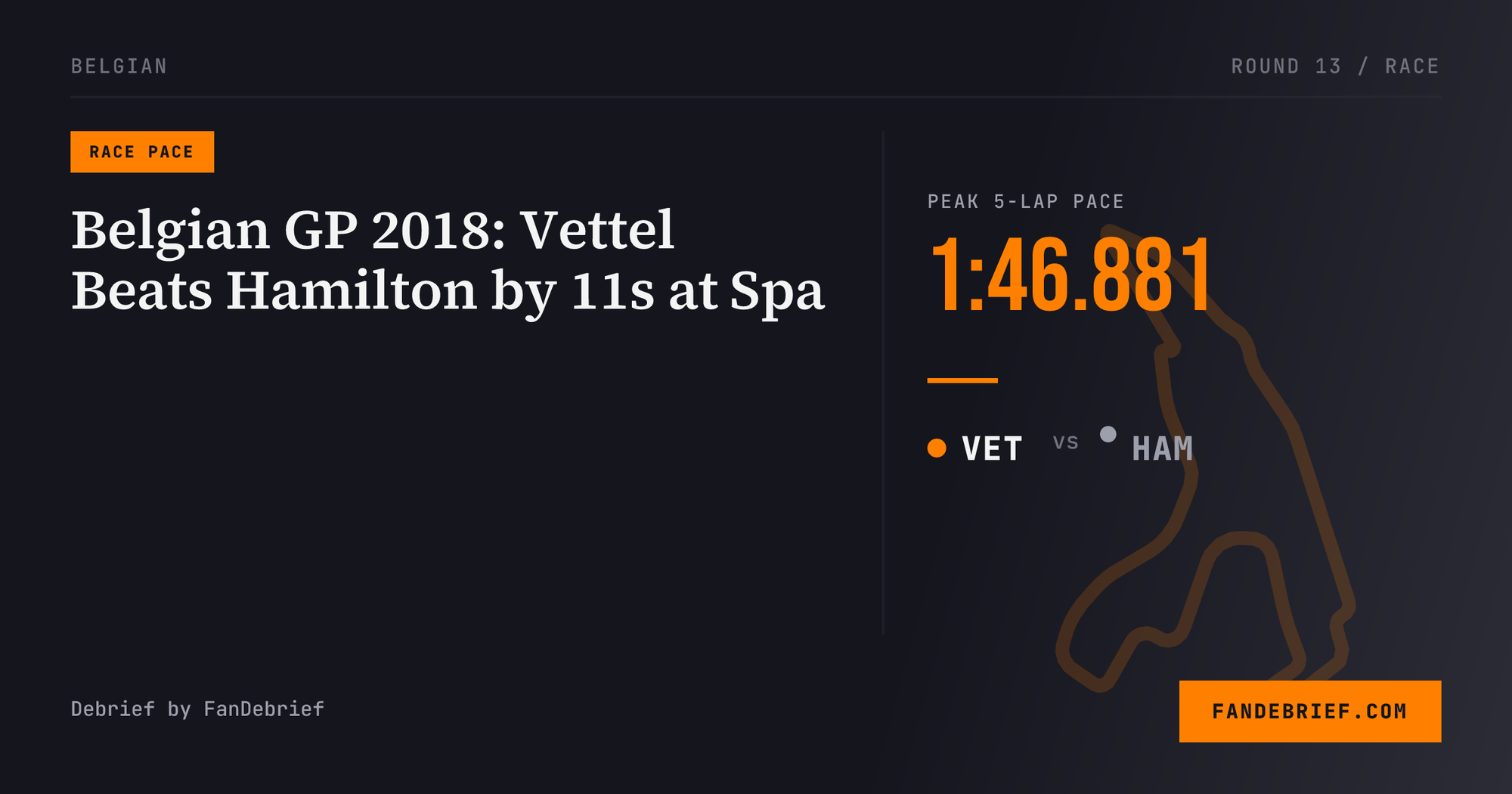
By the time the safety car peeled into the pits at the end of lap four, the Belgian Grand Prix had already decided most of its headlines. Five cars were parked, the pack behind Sebastian Vettel was picking through wreckage, and the man who mattered most, Lewis Hamilton, was already looking at a Ferrari's rear wing instead of clean air. The story of this race isn't really the chaos behind them. It's what Vettel did with the space it bought him.
This was a race won twice: once in the opening seconds off the line, and again in the final stint on used tyres. Vettel's early move on Hamilton set the platform, but it was Ferrari's tyre management in the closing laps that turned a fight into a rout.
A grid built on Saturday's wet mess, wrecked in Sunday's first minute
Hamilton had taken pole by a comfortable seven tenths over Vettel, a record fifth pole position at Spa and a record-extending 78th of his career. Behind them, Racing Point had a stunning Saturday, locking out P3 and P4 with Ocon and Perez, while both Red Bulls buried themselves in the second half of the top ten after a scrappy Q3. Valtteri Bottas, for reasons the timing sheets don't explain, lined up nowhere near the front despite a Q2 time good enough to headline the midfield; he started the race from P19, and that single fact would define his afternoon more than anything that happened on lap one.
And lap one is where this race actually turned. Vettel didn't wait. By the end of the opening lap he was already 1.8 seconds clear of Hamilton on the road, the move made and banked before the rest of the field had even sorted itself out. Further back, the sorting out went badly wrong: Hulkenberg, Alonso and Leclerc were all out inside the opening minute, both marked simply as accidents in the classification, and the safety car was out before the front-runners had completed a full lap. Räikkönen would limp on for a few more laps before his own race ended with a brake problem on lap eight, and Ricciardo nursed a damaged car for 28 laps before Red Bull pulled him in for good. Five cars gone, and the race hadn't even settled into a rhythm.
The data behind the race
Timing and telemetry from every car on track.


Vettel's launch, and the stint that made it stick
What's easy to miss under the noise of a first-lap pileup is how controlled Vettel's race actually was once the safety car pulled off. The on-track gap to Hamilton tells a story of a lead that breathed rather than exploded: 1.8 seconds after lap one, out to 3.8 by lap fifteen, squeezed back down to just 2.3 seconds by lap 25 as the two title rivals cycled through their pit windows on the same supersoft-to-soft strategy. For a good third of the race, this genuinely looked like a Hamilton recovery in progress.
Then it stopped looking like that. From lap 25 the gap didn't just grow, it accelerated: 5.0 seconds by lap 30, 7.8 by lap 40, 11.1 at the flag. The tyre data explains why. Vettel's second stint, on the soft compound from lap 23, degraded at a gentle three-hundredths of a second per lap. Hamilton's equivalent stint, started a lap earlier, degraded almost twice as fast. Over twenty-plus laps on the same compound, that gap in the wear curve is the entire margin of victory. Vettel backed it up by owning the middle and final sectors all afternoon, fastest through sector two on 24 of the 44 laps and fastest through the final sector on 21, with an average edge of over a third of a second in sector two alone. Spa's Kemmel-straight-and-Les-Combes middle sector rewards a car that can carry speed and stop it again; on Sunday, that was Vettel's Ferrari, not Hamilton's Mercedes.
There's a nice irony buried in the speed-trap data too: Hamilton and Bottas topped the outright top-speed charts all weekend, the Mercedes power unit doing exactly what it's supposed to do down Kemmel. Vettel doesn't appear in the top ten fastest speed traps at all. He won this race on tyre life and sector craft, not on raw horsepower down the straight, which is precisely the kind of result that should worry a title rival more than a straight blowout would. Vettel himself credited the launch afterwards, saying simply that timing was crucial and that he'd "managed that perfectly."
The other story: a P19 start that nearly wasn't a footnote
If Vettel's race was about control, Bottas's was about pure recovery. Starting nineteenth, he ran a three-stop strategy that no other front-running car attempted, cycling through soft, supersoft and soft again, and came home fourth having gained fifteen places. It's the single biggest position swing in the top ten and, on raw pace, nearly justified all of it: his weighted race pace of 1:49.4 a lap was the fourth-fastest in the field, behind only Vettel, Hamilton and a rampant Verstappen. It's tempting to ask whether that pace could have won the race from the front row. The honest answer, using the same numbers, is probably not; a gap of a second and a half a lap to Vettel's race pace is too much to make up even with a clean strategy, but it's more than enough to make Mercedes wonder what Sunday looks like when Bottas starts where he qualifies.
Verstappen's afternoon deserves its own line. Starting seventh, he picked his way to third by the flag, gaining four places while faster cars around him imploded, and his race pace, 1:48.7 across the stint, was comfortably the third-best in the field. That's a podium built on survival and pace in equal measure, not just fortunate timing.
Behind the podium, Racing Point's Saturday promise faded a little: Perez slipped one place to finish fifth, Ocon lost three to finish sixth, but a five-and-six in a season this tight is still a strong midfield haul from a team that qualified third and fourth. Haas quietly banked a clean double points finish, Grosjean seventh and Magnussen eighth, with neither car troubled by the retirements that hit half the grid. Gasly brought the sole Toro Rosso home in ninth, and Ericsson's tenth for Sauber was the flip side of his team's day: teammate Leclerc never got past the first corner. Ferrari's own split told a similar story in miniature. Vettel's fastest lap of the race was over seven and a half seconds quicker than Räikkönen's best, a gap that has nothing to do with talent and everything to do with one Ferrari racing cleanly and the other nursing damage from lap one.
What Spa tells us heading to Monza
Going into this weekend, Hamilton held a 24-point championship lead over Vettel, and the two had swapped exactly these positions at the previous round in Hungary, Hamilton first, Vettel second. Spa flipped that result outright, and it did so with a margin, eleven seconds at the flag, that's too large to file under bad luck or a lucky safety car. Vettel out-launched Hamilton, then out-managed him on tyres for the second half of the race; that's two separate wins stacked on top of each other, not one fluke.
The forward-looking question is whether that tyre-life advantage travels. Monza is a different kind of power circuit, less about sector-two traction and more about pure straight-line efficiency, exactly the trait that put Hamilton and Bottas atop this weekend's speed trap and left Vettel nowhere on that list. If Ferrari's chassis and tyre management showed up at Spa's Kemmel straight, the next test is whether it shows up somewhere the straight-line numbers already favour Mercedes. That's the rematch worth watching for.