Russell Wins Austrian GP by 1.6s as Verstappen Closes
George Russell had the pole and the strategy call right, but it was Max Verstappen who had the faster car all afternoon, and the final lap gap tells you exactly how close that combination came to not being enough.
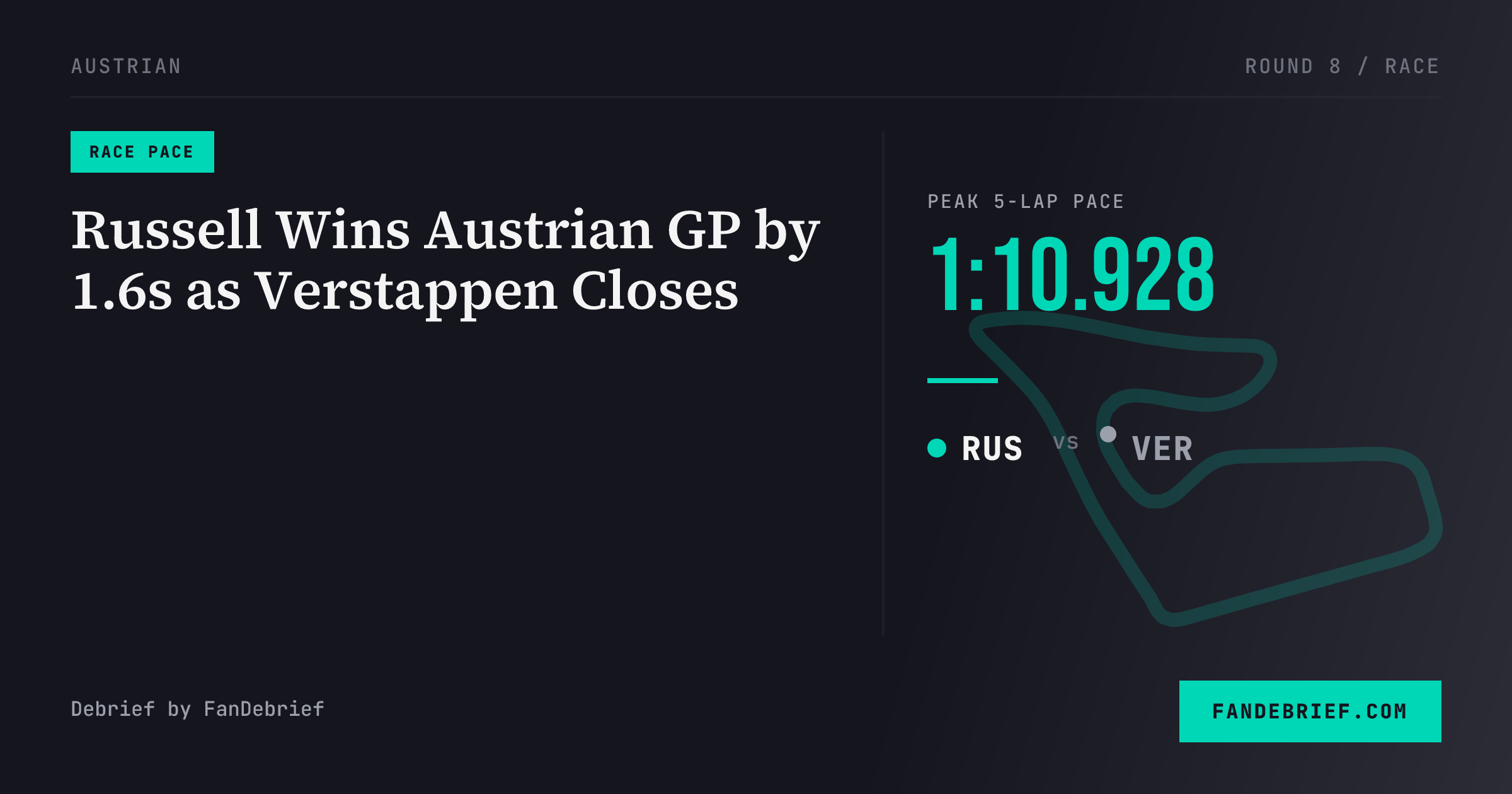
George Russell crossed the line 1.61 seconds clear of Max Verstappen at the Red Bull Ring, and by lap 71 that gap felt like the whole story of the race compressed into one number. For most of the final stint it had been shrinking, not growing. Verstappen had the pace to win this one. He just never had the position at the right moment.
That's the argument this race makes: the fastest car on Sunday afternoon didn't win it, but only because the second-fastest driver never put a wheel wrong on strategy. Russell's weighted average race lap of 1:11.745 was almost identical to Verstappen's 1:11.742, a gap so small it's really a tie. The race was decided somewhere else entirely, in the timing of two pit stops and in the way Ferrari's afternoon fell apart around them.
Saturday had set up a genuinely open grid. Russell's pole lap was just over two tenths clear of Leclerc, with Hamilton a shade further back in third and Antonelli fourth, meaning the front two rows were split by Ferrari sandwiched between the Mercedes pair. Verstappen, by contrast, only managed fifth, more than three tenths off pole, with the McLarens of Norris and Piastri filling six and seven ahead of Hadjar in eighth. On a short, punchy lap with only ten corners, that grid order looked fragile. It didn't survive the afternoon in anything like its starting shape.
Russell controlled the opening stint the way a pole-sitter should, the gap back to Verstappen bouncing between two and a half and five and a third seconds through the first fifteen laps as both worked through their medium tyres. But note what actually moved the lead around after that: every single change of race leader on this weekend, all five of them, came from the pit cycle rather than a pass on track. Lap 20 handed the lead to Antonelli when Russell made his first stop, lap 25 gave it back when Antonelli pitted in turn. Zero on-track lead changes across 71 laps at a circuit rated easy for overtaking is a striking number, and it tells you the race was fought on pit boards and lap timers, not on the run down to Turn 3.
A pit cycle that swung by eighteen seconds
The moment that decided the result sits in the second round of stops. Russell pitted from the hard tyre on lap 43 and briefly handed the lead to Verstappen, who ran a lap longer before his own second stop on lap 49. For one lap window around lap 45, the on-track gap read Verstappen ahead by 16.75 seconds, the widest swing of the race and a number that looked, for a moment, like it might decide everything. It didn't. Antonelli inherited the lead at 49 when Verstappen finally stopped, then handed it straight back to Russell at lap 52 once his own second stop was done. By lap 50 Russell was back in front by 10.66 seconds on raw timing, and from there Verstappen simply ate into it, lap after lap, down to 8.26 at lap 55, 4.12 at lap 65, and finally 1.61 at the flag. Verstappen had the legs to close a ten-second gap in twenty laps. He just ran out of laps to finish the job.
Ferrari's weekend went the other way entirely. Leclerc lined up second and finished eighth, a six-place slide that turns a promising grid slot into a forgettable Sunday. Hamilton started third and lost two spots to finish fifth. Both Ferraris ran three stops on a track where every other frontrunner, Russell, Verstappen, Antonelli, and Piastri among them, ran the standard two-stop medium-to-hard-to-hard route. Hamilton's middle stint lasted just thirteen laps on the hard before Ferrari pulled him in for softs, and Leclerc's own third stop, a switch back to soft on lap 59, was the fastest of the entire field at 21.0 seconds, which only underlines how good the pit crew was and how little the strategy needed that extra visit to the pit lane.
The irony is that Hamilton still topped the sector one charts, fastest through the uphill opening sector on 17 of the 71 laps, and his pit crew matched Russell's for speed at 21.2 seconds. None of it mattered once the tyre life ran out from underneath both cars. Antonelli was the closest thing Ferrari's misery had to a beneficiary at the sharp end, finishing third after leading twice during the pit cycle shuffle, and he owned both middle sectors of the lap more than anyone else in the field, fastest through sector two on 17 laps and sector three on 21.
The data behind the race
Timing and telemetry from every car on track.


The other stories
Piastri quietly had one of the better races in the pack, climbing three places from a P7 start to finish fourth on the same two-stop plan as the podium finishers, close enough on pace (a 1:11.994 weighted average) to suggest McLaren left something on the table by not qualifying higher. Hadjar matched that gain of three, running his medium tyre all the way to lap 40, the longest opening stint of anyone in the top ten, and turned it into sixth from an eighth-place start. Norris lost one place to finish seventh, not helped by a deleted lap time for a track-limits infraction at Turn 3 that came right at the end of the race. Both Racing Bulls cars, Lawson and Lindblad, brought it home in ninth and tenth a lap down on the winner, a result that speaks to how far back the midfield gap had stretched by Sunday afternoon in Austrian heat that averaged over 50 degrees on the track surface.
The retirements told their own story about which teams had a bad weekend and which had a catastrophic one. Cadillac's afternoon ended almost before it began, with both cars out inside the first four laps. Aston Martin lost both cars too, Stroll retiring after 45 laps and Alonso eventually classified having also picked up a ten-second penalty for speeding in the pit lane, a penalty that had no bearing on a result that was already going nowhere. Williams split its afternoon down the middle: Sainz retired after 24 laps while Albon brought his car home, lapped but running, in seventeenth.
What should worry Ferrari heading into the British Grand Prix is that this wasn't a one-off tyre quirk; it was two cars from the front two rows both needing a stop nobody else on the lead lap needed. Mercedes, meanwhile, proved again that pole position plus a clean strategy call is still enough to beat the fastest car on the day, provided the sums on the pit wall come out right at the second stop. And Verstappen leaves Spielberg with a genuine complaint: his was the best race pace on the grid, and it still wasn't enough to turn a P5 start into anything better than second. Silverstone will tell us whether that was a one-weekend problem for Ferrari or the start of a pattern, and whether Red Bull can find the four tenths in qualifying that would let Verstappen's Sunday pace actually decide a race rather than chase one down.