Verstappen Wins 2018 Austrian GP as Mercedes Double DNF
Red Bull's home race was won as much in the Mercedes garage as on the Red Bull Ring's tarmac, and the pit stop that never came proved more decisive than anything Max Verstappen did on track.
Valtteri Bottas took pole by two hundredths of a second from his own teammate. Twenty laps later, neither Mercedes was anywhere near the front, and by the chequered flag neither Mercedes was on the road at all. That is the story of the Austrian Grand Prix: a weekend Mercedes built perfectly for two days and then lost inside twenty minutes on Sunday afternoon.
This was Max Verstappen's home race in every sense that matters to Red Bull, and he took it well, holding a lead that swelled past seven seconds before Kimi Räikkönen came for it late. But the more compelling story is what happened behind him: a virtual safety car that separated the field into those who reacted and those who didn't, and a Mercedes strategy call that turned a comfortable lead into a lost weekend.
Qualifying had promised something else entirely. Bottas took pole in 1:03.130, Hamilton split him from Sebastian Vettel by two hundredths of a second, and Mercedes looked to have the Red Bull Ring, a track it had won at in each of the previous three years, wrapped up before a wheel had turned in anger. Vettel's third-place lap didn't survive to grid day; stewards handed him a three-place penalty for impeding Carlos Sainz during Q2, dropping him from third to sixth and promoting Räikkönen, Verstappen and Romain Grosjean up the order. Verstappen, who had qualified fifth, started the race from fourth. It was hot, dry trackside, 45.9C on the tarmac, the kind of afternoon at a ten-corner lap where tyre management and track-limits discipline separate the front from the also-rans.
The virtual safety car that split the race
Hamilton took the lead off Bottas early and looked in total control. Then, on lap 14, Bottas slowed and retired with a hydraulics failure, and race control threw a virtual safety car to allow the marshals to clear his car. That single moment reshaped the entire afternoon. Every frontrunner who mattered, Verstappen, Räikkönen, Vettel, Grosjean, pitted on lap 15 to convert a VSC's reduced time-loss into a free tyre change. Hamilton, out front and untouched, did not. His own tyre log shows he ran all the way to lap 25 before coming in, ten laps longer than the group he was supposed to be racing.
That gap is the whole race. The lead-change log records a single change of the lead, on lap 26, and it's marked strategic rather than on-track: Verstappen inherited first through the pit cycle, not by passing anybody. A pit stop at this circuit costs the better part of twenty seconds at normal speed; under the VSC it cost a fraction of that. Hamilton lost the race in the ten laps he spent circulating alone on a tyre everyone else had already binned.
He never really got it back. Hamilton's pace before the pit-cycle swap had been genuinely the class of the field, he set the fastest first sector on 24 of the race's 71 laps and the fastest third sector on 21 of them, more than any other driver in either measure. That's not a footnote; it's proof Mercedes had the car to win this one comfortably. But pace on a Saturday-quality tyre against a fresher rival is a losing argument, and Hamilton spent the rest of his afternoon chasing a deficit his own team had created. Asked about it afterwards, he didn't dress it up. "We were the quickest," he said, which was true, and also entirely beside the point by then.
The data behind the race
Timing and telemetry from every car on track.


The decisive stretch nobody saw coming
What followed compounded the damage rather than fixing it. Hamilton eventually pulled into the garage for good on lap 63, the timing sheet crediting the retirement to fuel pressure, the second Mercedes to fail to finish inside fifty laps of each other. Between Bottas's hydraulics and Hamilton's fuel pressure, the team that had locked out the front row went from a likely one-two to a blank scoresheet. It was Mercedes' first double DNF since the 2016 Spanish Grand Prix, a stark enough anomaly for a team that had won at this circuit three years running.
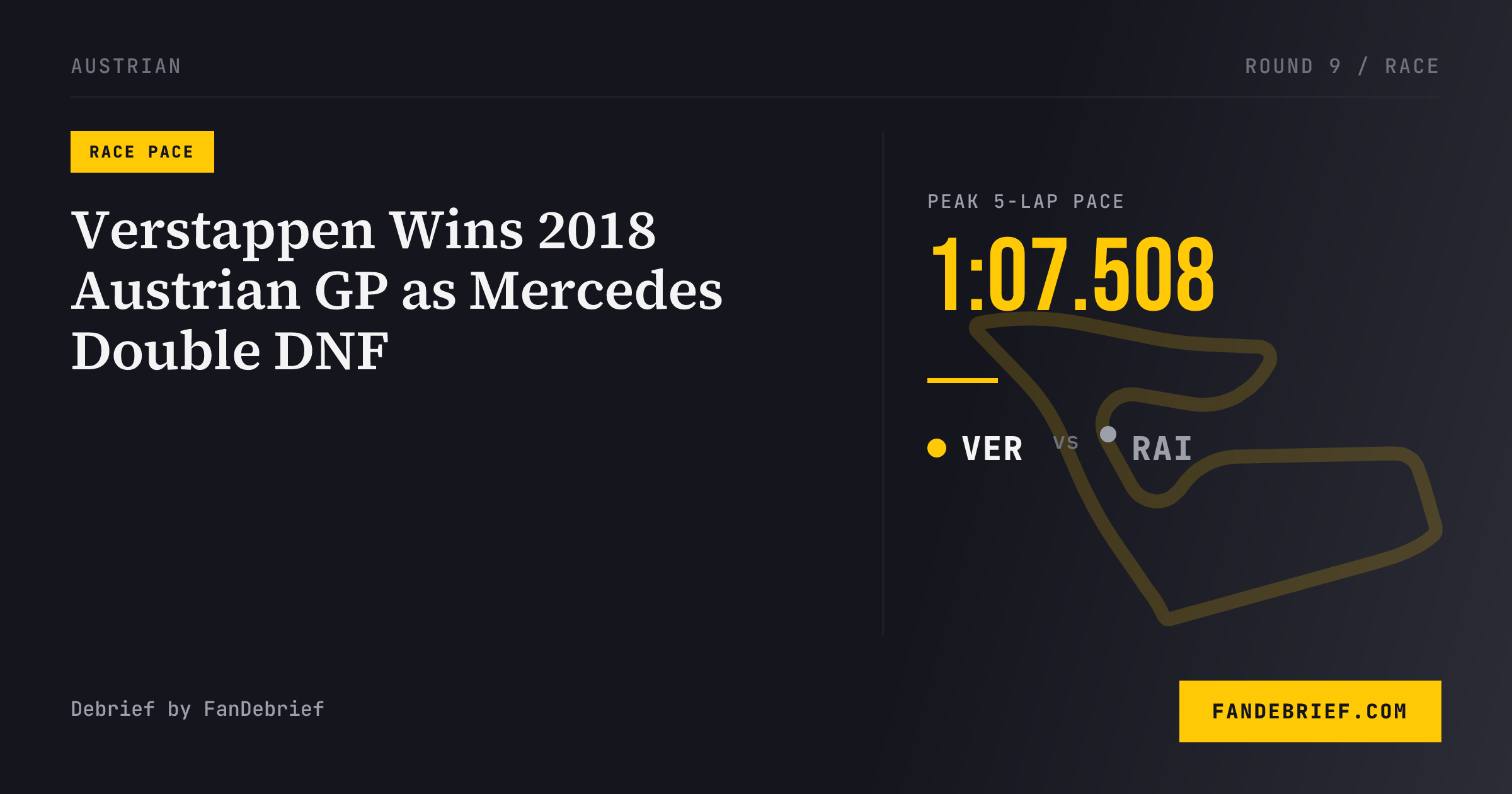
Verstappen didn't need to be spectacular once he had the lead; he needed to manage it, and he did. The gap to Räikkönen, running second throughout after the pit cycle sorted itself out, swelled from half a second on lap one to just over seven seconds by lap forty as Verstappen's supersoft-into-soft strategy paid off. From there it came back the other way. Räikkönen closed to just over four seconds by lap 60 and to a shade over a second and a half by the flag, and his fastest lap of the race, a 1:06.957 set right at the end, was over four tenths quicker than anything Verstappen managed all afternoon. Had the race run a handful of laps longer, this might have been a different result. It didn't, and Verstappen crossed the line still ahead, his first win of the 2018 season and the fourth of his career.
Vettel, who'd started sixth after his qualifying penalty, worked his way through to complete the podium, his own weighted race pace actually the fastest of anyone in the field for the afternoon. That he finished third rather than fighting for the win tells you how much ground a three-place grid drop costs even at a track with only ten corners and three DRS zones to make it back on.
Haas, Force India and a grid full of gainers
The midfield told its own story, and it was a good one for anybody not wearing silver. Grosjean brought his Haas home fourth from a fifth-place start, the best result in the team's short Formula 1 history, while teammate Kevin Magnussen recovered from a scrambled restart to finish fifth after starting eighth, his own stop delayed until lap 28 rather than the lap-15 window most of the front runners used.
Force India had arguably the most eye-catching day of anyone outside the top five. Esteban Ocon rose from eleventh to sixth, and Sergio Pérez climbed an extraordinary nine places, from sixteenth on the grid to seventh at the flag, both men converting one-stop strategies and a clean run through the carnage into points that looked unlikely at the start. Fernando Alonso, starting thirteenth, brought his McLaren home eighth. Further back, Charles Leclerc gained nine places of his own to finish ninth from eighteenth on the grid in the Sauber, and Marcus Ericsson climbed all the way from twentieth to tenth, the biggest single gain of anyone in the race, helped by a late switch onto supersofts that he ran from lap 46 to the finish.
The retirements beyond Mercedes added to a genuinely brutal afternoon of attrition. Nico Hülkenberg was out inside the first dozen laps with an engine failure that ended a promising tenth-place start almost before it began. Daniel Ricciardo, flying the flag for Red Bull on home soil from seventh on the grid, retired with an exhaust problem after 54 laps, robbing the crowd of what might have been a second Red Bull car in the points. Brendon Hartley's Toro Rosso went out with hydraulics after 55 laps, and Stoffel Vandoorne's McLaren was collected in first-lap collision damage that he nonetheless nursed to 65 laps before the day was called on his car. Six cars in total failed to see the chequered flag, on a track whose short lap and heavy kerbs usually forgive more than they punish.
What should worry Mercedes heading to Silverstone isn't the pace, which was never in question here, it's the pattern. A pole position and a front-row lockout evaporated inside twenty laps through one mechanical failure and one call that should have been automatic under a VSC. Ferrari leaves Austria with a podium finish for both cars and didn't need to be the fastest team on the day to get it; Red Bull leaves with proof that when the two Mercedes cars falter, Verstappen is ready to collect the result without needing it handed to him twice. The next round at the British Grand Prix is Hamilton's home race, and after a weekend like this, Mercedes will want it to look nothing like Spielberg.