US GP 2018: Raikkonen Wins, Verstappen Second From 18th
Kimi Räikkönen nursed a shrinking lead to end the longest win drought in Formula 1 history, but it was Lewis Hamilton who carried the fastest car all afternoon and Max Verstappen who produced the drive everyone will remember.
Kimi Räikkönen kept his sunglasses on through the entire podium ceremony, and by the time he'd finished it you understood why. This was not a win that needed celebrating with theatre. It needed to be defended, lap after lap, as the gap he'd built in the first half of the race melted away in the second.
The story of this race is a contradiction the timing screens never resolved: the driver with the fastest car all afternoon finished third, the driver who started eighteenth finished second, and the driver who led the fewest sectors won the whole thing. Räikkönen's Austin victory wasn't built on outright speed. It was built on strategy, nerve, and a rival field that kept finding ways to beat itself.
Hamilton had taken pole by six hundredths over Vettel and seven over Räikkönen, with Bottas fourth and the two Mercedes locking out the front two rows alongside Ferrari. Verstappen, meanwhile, was nowhere near that conversation, starting eighteenth after a grid penalty wiped out whatever his Saturday pace might have suggested. Nobody in Austin expected him to be relevant to the podium fight by Sunday afternoon.
A race lead that changed hands without a single overtake
Räikkönen took the point away from Hamilton at the first corner and immediately went to work building a cushion, and by lap 10 he'd stretched it to nearly 21 seconds over the chasing Verstappen. That was the peak of his advantage. From there the gap did nothing but shrink: down to 11.7 seconds by lap 15, under seven by lap 20, and inside four seconds by lap 25. By lap 50 it was 1.23 seconds. Räikkönen crossed the line 1.28 seconds clear, having spent the last third of the grand prix watching his mirrors far more than his sunglasses let on.
What's remarkable is that none of that late-race squeeze came from Verstappen actually passing anyone on track. The race lead itself changed hands four times over the afternoon, and every single one of those swaps came from pit strategy or a retirement, not a wheel-to-wheel move. Hamilton grabbed the net lead briefly around lap 11, when the field cycled through pit stops under a Virtual Safety Car triggered by Daniel Ricciardo's retirement; Räikkönen had it back a lap later. The same pattern repeated around Hamilton's second stop on lap 37, before Räikkönen reclaimed it for good on lap 38 and controlled the race to the flag. A grand prix with zero on-track lead changes and four strategic ones is not a race decided by who was bravest into Turn 1. It's a race decided by who read the timing screens correctly.
Räikkönen read them best. He ran a single stop, switching from ultrasoft to soft tyres on lap 21, and that one-stop simplicity is exactly what let him control the closing laps rather than scramble through them. Hamilton, by contrast, pitted twice, first on lap 11 and again on lap 37, trading track position for tyre life he ultimately didn't need enough to justify the extra stop.
The data behind the race
Timing and telemetry from every car on track.


The fastest car finished third
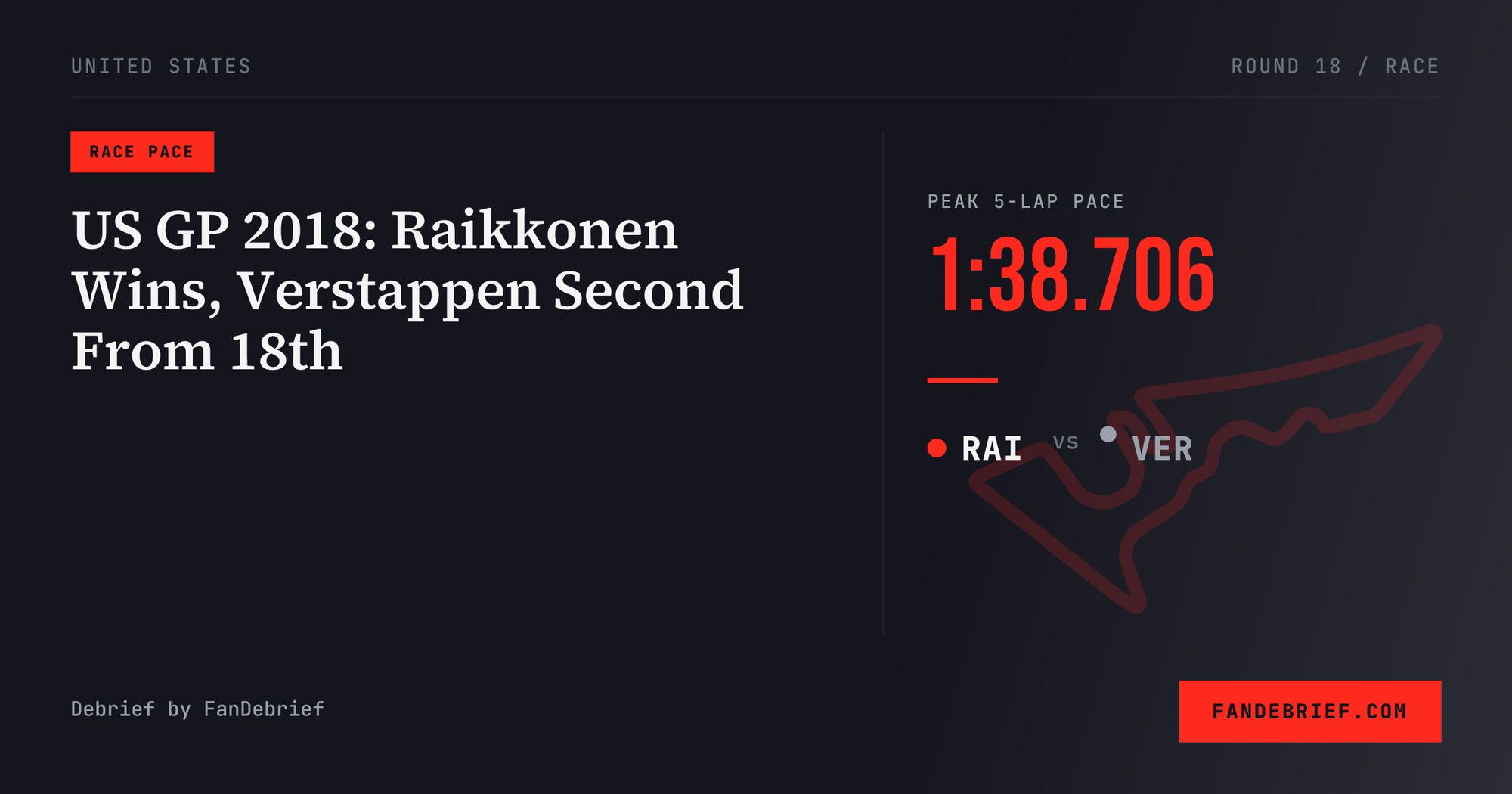
Here's the number that should needle every Mercedes strategist watching the replay: Hamilton's weighted average race lap was the quickest of anyone in the field, at 1:39.685, ahead of even Verstappen's 1:39.773 and Räikkönen's 1:39.801. Hamilton also owned the first sector for most of the race, setting the fastest S1 time on 33 of the 56 laps, and he was the fastest car through the technical stadium section too, quickest in sector three on 16 laps with an average margin approaching three tenths. At one point he was running fully six tenths of a second quicker than Räikkönen through that final sector alone. And he still finished behind him.
That's the paradox this race leaves behind. Räikkönen didn't out-drive Hamilton on a single lap of pure pace. He out-strategized him, protected a tyre that degraded barely at all in the second stint, and let Mercedes' extra pit visit do the damage a straight speed contest never could. It's the kind of result that will frustrate Hamilton more than a straightforward beating would, because the pace to win the race was sitting right there in his own car.
Verstappen's drive deserves its own paragraph, because starting eighteenth and finishing second at a permanent circuit with only moderate overtaking opportunities is not a normal Sunday. His race-average lap of 1:39.773 was quicker than the winner's, which raises the obvious question the paddock will still be asking heading into Mexico: with that pace available from a clean sheet, what does this Red Bull do from the front row rather than the back half of the grid? Nobody can answer that from one recovery drive, but the pace was unmistakably there, and the closing gap to Räikkönen proves it wasn't a fluke of traffic clearing late.
Chaos at the back, fuel trouble after the flag
The opening lap did plenty of damage that never showed up in the headline fight. Leclerc took collision damage that eventually ended his day on lap 31, having started ninth. Grosjean's race lasted two laps before collision damage retired him from eighth on the grid, and Alonso's afternoon was over after a single lap following a collision of his own. Stroll picked up a drive-through penalty on lap 6 for causing a collision, a call that fits the pattern of a first lap that claimed far more cars than the podium fight ever suggested. Ricciardo's retirement with a battery problem after just nine laps was the trigger for the Virtual Safety Car that reshuffled the whole strategic picture at the front.
Sainz picked his way forward from eleventh to what looked like seventh on the road, only to be handed a five-second penalty for leaving the track and gaining an advantage on lap 21; he kept the position regardless. Further back, Hartley climbed eleven places from twentieth to finish ninth, and Ericsson made up six places for Sauber to cross the line tenth, with Sergio Perez two spots ahead of him in eighth after gaining a pair of places of his own. Vettel salvaged fourth from fifth on the grid, one of only two cars from either Ferrari or Mercedes camp to gain positions rather than lose them, alongside Räikkönen's own single-place improvement from second on the grid to first at the flag.
Ocon and Magnussen crossed the line in what would have been eighth and ninth, only for both to be struck from the results afterward. Ocon was stripped of eighth place at Austin for breaking the fuel-flow rule, and the driver who initially inherited his position, Magnussen, was then also disqualified for a fuel irregularity. It meant a Haas that had been eyeing a strong home-soil finish and a Force India sitting on a tidy double points day both left Austin with nothing, a brutal footnote to a race that had already punished plenty of front-runners for less.
What Austin tells us heading to Mexico
Räikkönen's win ended one of the sport's more remarkable droughts. Räikkönen won for the first time since Australia in 2013, the longest span between race victories in F1 history. That storyline will dominate the write-ups, and rightly so. But the number that should worry Mercedes more is the one from the timing sheets, not the record books: Hamilton had the fastest car in Austin and still didn't win it, undone by an extra pit stop his rivals didn't need. Verstappen's climb from eighteenth to second, with a race pace that beat the winner's, is the other thread worth pulling into Mexico. If Red Bull qualifies where that pace deserves next time out, this result stops looking like a recovery drive and starts looking like a preview.