Mexican GP 2018: Ricciardo Beats Verstappen to Pole by 0.026s
Ricciardo's stadium-sector answer beat Verstappen by twenty-six thousandths of a second for Red Bull's first front-row lockout in years, even as Vettel's Ferrari proved the fastest car through sector one alone.
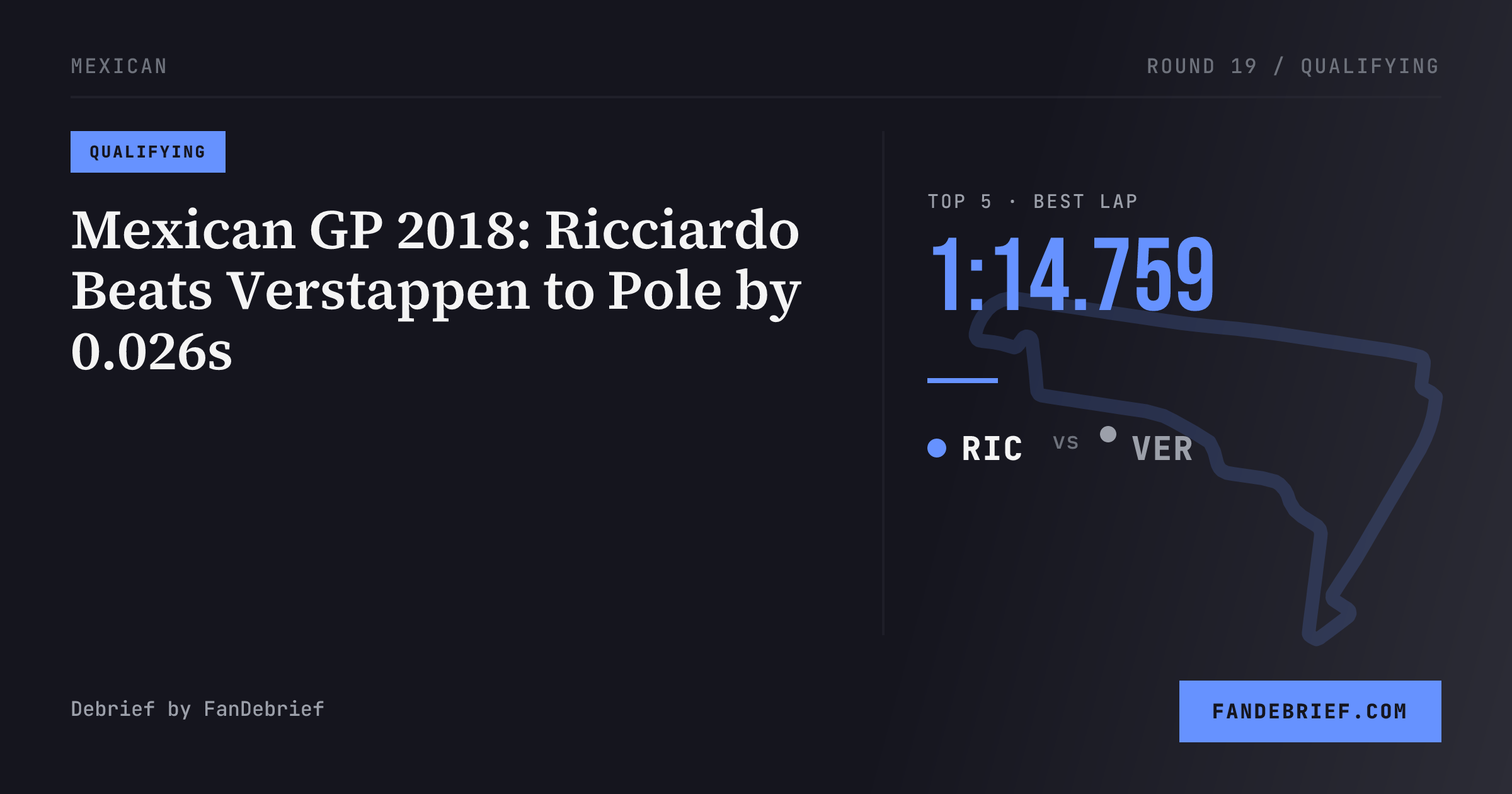
Two Red Bulls sat on the front row of a Formula 1 grid on Saturday, and for most of the hour it looked like the wrong one would start on pole. Then, with the session almost out of road, Daniel Ricciardo found four hundredths of a second in the one place his teammate couldn't touch him, and Max Verstappen's shot at a piece of pole-position history vanished by twenty-six thousandths of a second.
This was a lap won and lost in the final third of the circuit. Sebastian Vettel produced the fastest opening sector of anyone in the top four, yet qualified fourth. Ricciardo had the slowest sector one of the front-row pair, yet took pole. At 2,200 metres above sea level, where the air strips roughly a fifth of a car's downforce, sector-one speed doesn't automatically buy you the lap, and Saturday in Mexico City proved it.
Red Bull arrived expecting this. Verstappen had topped all three practice sessions and was fastest after the first runs in Q3, and by the time the final runs began he held provisional pole with the sort of margin that suggested the record for F1's youngest ever pole-sitter was his to lose. It was Ricciardo who found the answer, and in doing so claimed what report from the weekend described as his second pole of the season, denying his teammate by 0.026s.
A lap decided in the stadium, not the straight
Break the pole lap down and the story sharpens. Vettel's Ferrari was 0.444s quicker than Ricciardo's Red Bull through sector one alone, the fastest first sector of the front-runners. Ricciardo clawed almost all of that back through the middle sector and finished the job in the stadium section, the tight, technical Peraltada complex that makes up sector three, to beat Vettel by two-tenths across the lap. It's the clearest possible illustration of what altitude does to a qualifying lap here: raw straight-line pace counts for less than usual, and the car that can carry corner speed through the thin air in the twisty final third wins the shootout.
The Ricciardo-Verstappen fight ran on the same logic, in miniature. Verstappen was quicker through sector one by two-tenths, matching his reputation as the pace-setter of the weekend. But Ricciardo turned that around in the middle sector and then found another four hundredths in the stadium section to complete the turnaround, the difference between pole and second amounting to less than the length of a car by the time both crossed the line.
Verstappen wasn't in a forgiving mood afterwards, pointing to a rear-locking problem under braking that had followed his car since Friday practice and left him unable to attack the way he wanted through Q3. Whatever the cause, the timing sheet backs up his frustration: he had built what looked like a comfortable cushion after the first runs, only to lose it entirely on the lap that mattered.
Behind the Red Bulls, Hamilton was the pick of the rest in third, over a tenth off pole, with Vettel fourth another eight hundredths back. It's worth noting that Hamilton's own sector times told an odd story: across the session he set the outright fastest middle sector five times, by an average margin approaching a full second, and did the same in the stadium sector, yet none of those blistering instances lined up on the same lap when it counted. Bottas and Raikkonen filled row three, with an all-Finn look to the third row that left Ferrari and Mercedes both a comfortable distance off the Red Bull front row. None of this changes the shape of a championship fight that Hamilton arrives at this circuit controlling comfortably, a 346 to 276 points lead over Vettel built long before Saturday's session, but it does confirm that neither title contender had the outright pace to trouble Red Bull's one-lap package this weekend.
The midfield had its own theatre. Hulkenberg headed Sainz into Q3 as the best of the rest, with the Sauber pair of Leclerc and Ericsson rounding out the top ten. Further back, the margins tightened rather than widened: Ocon, Alonso, Perez and Hartley were split by barely a quarter of a second in Q2, and the McLaren garage had its own sub-plot, with Alonso through to Q2 while teammate Vandoorne was eliminated in Q1, the pair separated on the timesheet by just over a tenth. At the very back, Williams endured a familiar afternoon, eliminated in the first segment of qualifying for the eleventh time this season, alongside both Haas cars falling at the same hurdle.
Sunday hasn't happened yet, and the timing sheet from Saturday doesn't decide it. But it does set up a question worth watching from lights out: a Ferrari that found four tenths on the straight but lost the lap in the corners, lining up directly behind two Red Bulls that will need to defend exactly that ground for 71 laps. For Verstappen personally, missing out here matters beyond Saturday. He now needs to top qualifying in either Brazil or Abu Dhabi to have another shot at Vettel's youngest-pole record, with only two rounds left to do it after this one heads to Interlagos next.
The data behind qualifying
Timing and telemetry from every car on track.


