Russell Takes Barcelona GP Pole, Hamilton Splits Mercedes
George Russell beat Lewis Hamilton to Barcelona pole by six hundredths of a second, while Red Bull's Verstappen and Hadjar were left stranded outside the top four.
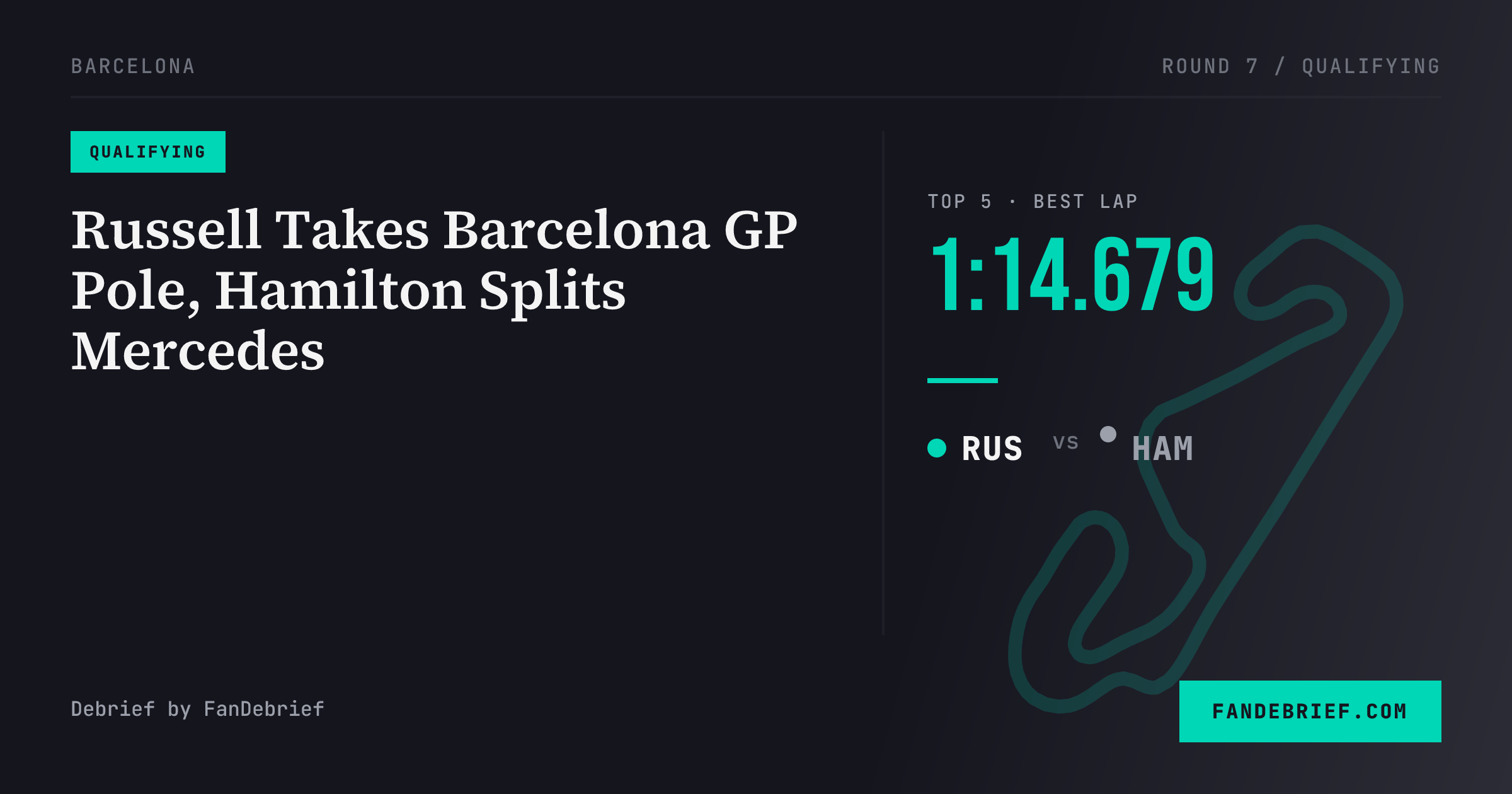
George Russell threw down his lap first. Then he had to sit in the garage and watch a monitor while Lewis Hamilton tried to take it away from him. That is the entire story of Q3 at Barcelona: a pole time set with eight minutes still on the clock, and a five-minute wait to see if it would survive.
It survived, but only just. Russell's 1:14.679 held off Hamilton's response by six hundredths of a second, less than the time it takes to blink, and turned what looked like a comfortable Mercedes lockout into a genuine fight between two of the sport's sharpest qualifiers. That fight was only half of Saturday's story. The other half belonged to Red Bull, who put both cars in Q3 and still finished the hour looking over their shoulder at McLaren.
Barcelona in September is a benchmark track for a reason: high aero load, two DRS zones that rarely produce a real move, and a middle sector that punishes any driver who arrives even slightly out of shape. Dry and warm, with track temperatures pushing past 50 degrees, it was exactly the kind of one-lap puzzle where the smallest inconsistency in a single sector gets magnified into tenths by the time the car crosses the line. Charles Leclerc found that out the hard way, exiting in Q2 while his Ferrari teammate lined up on the front row.
Russell's pole lap was won in the middle of the corner more than at the exit of it. He carried the fastest middle sector of anyone across the session on his flying laps, and it was that sector two advantage, not top speed, that gave him the cushion Hamilton eventually chased but couldn't quite close. Hamilton, chasing back through the final runs, still found enough to leapfrog Antonelli and claim the other half of Mercedes' front row for himself, denying his former team a first-and-second lockout by the width of a coat of paint.
What should worry Mercedes is how little separated the group directly behind. Antonelli's third-placed lap was quicker than Norris's fourth by just three thousandths of a second, a gap so small it's essentially a rounding error, and Verstappen in fifth was barely two-tenths further back again. Piastri, seventh, actually posted the fastest final sector of the session on his own lap, which tells you McLaren wasn't short of pace so much as short of stitching a whole lap together when it mattered. Seven cars covered by four-tenths of a second is Barcelona qualifying doing exactly what this circuit does best: turning small technical differences into a genuine shootout.
Red Bull's pace at this track has been a source of quiet anxiety for a while, and Saturday didn't settle the nerves. Verstappen's fifth and Hadjar's sixth left both cars behind two Mercedes, a Ferrari, and a McLaren before Q3 even reached its final runs, and the gap from Verstappen back to teammate Hadjar, four hundredths, was smaller than gap from Verstappen up to pole. For a team that entered this weekend fourth in the constructors' table, some way off the podium pace at the front, that is a session that reinforces rather than reverses the trend of 2026 so far.
Further back, the group that got shuffled hardest was the one chasing Q3 places rather than pole. Liam Lawson's eighth-placed lap was nearly two seconds off Russell's pole time, a jump in the gap that shows exactly where the true midfield cliff sits this weekend, with Nico Hulkenberg close behind him in an Audi that keeps punching above its weight. Leclerc's Q2 exit was the header story from Ferrari's side of the garage, a car that looked capable of front-row pace in Hamilton's hands failing to convert for the other driver. Pierre Gasly clocked the fastest speed-trap reading of the entire field, 340 km/h, yet that raw pace bought him only fourteenth on the grid, a reminder that a fast car in a straight line means nothing at a track built to punish anyone who can't also carry speed through Turn 3.
Qualifying only tells you who's quickest for one lap, not who wins on Sunday, but the long-run numbers buried inside this session are worth flagging. Russell's soft-tyre stint through the middle of the hour was not just quick, it degraded at a rate that suggests genuine race pace to go with the headline lap. Hamilton's own long-run average was the steadiest of anyone in the top six, which sets up a front row that could easily still be fighting each other on Sunday afternoon.
Barcelona's grid is set with Mercedes on the front row for the first time this season and Red Bull looking at a fight for best-of-the-rest rather than a shot at pole. Whether Russell can turn a razor-thin qualifying margin into a full race win, and whether Red Bull can find whatever they're missing before Austria, are the two questions this weekend leaves for the next round to answer.
The data behind qualifying
Timing and telemetry from every car on track.


