Baku 2019: Bottas Holds Off Hamilton by 1.5s From Pole
Valtteri Bottas led every lap from pole in Baku, yet Lewis Hamilton's average race pace was actually the quickest on the day, and the margin between them never grew comfortable enough for anyone to relax.
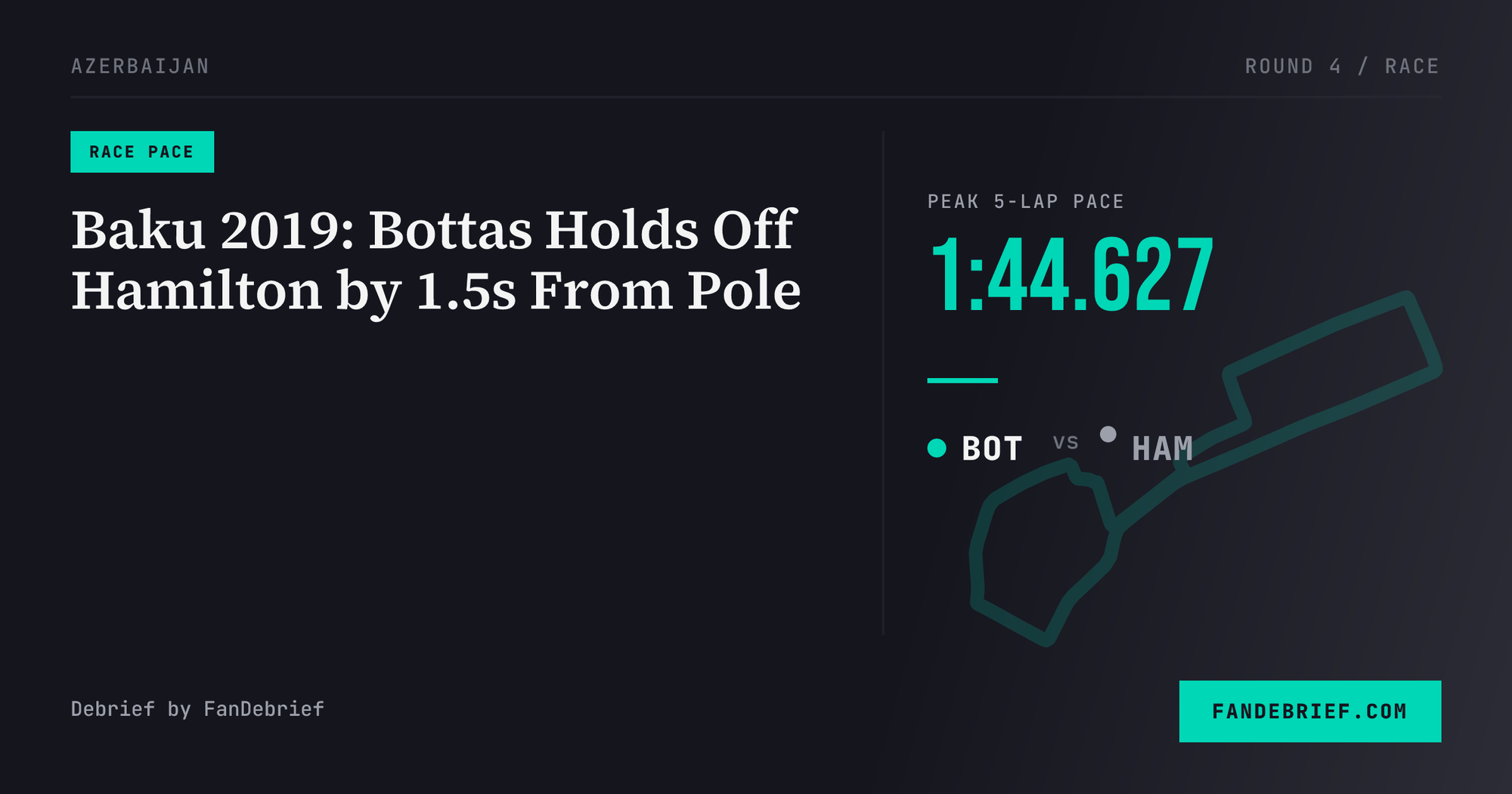
Valtteri Bottas got the run down the inside at Turn 1, held the outside line through Turn 2, and by Turn 3 the fight for the lead of the Azerbaijan Grand Prix was over before the cars had even reached the castle section. It stayed that way, technically, for another fifty laps. But nobody watching the gap between the two Mercedes cars all afternoon would call this one comfortable.
This was a race Bottas led from start to finish, yet the timing screens told a different story underneath: lap after lap, Hamilton's pace matched or bettered his teammate's, and only a start that went Bottas's way kept the result from flipping. Add in a Ferrari that led nearly a fifth of the distance without ever being fast enough to keep it, and Baku produced a podium that looked processional on the results sheet and felt anything but from the pit wall.
Bottas had arrived at the Baku City Circuit carrying pole position by the smallest of margins, four hundredths of a second ahead of Hamilton, with Vettel a further quarter-second back in third and Verstappen fourth. Leclerc's session had gone badly wrong; he could only manage ninth on the grid-setting sheet before a grid shuffle promoted him to eighth for Sunday, a Ferrari that had looked like the class of the field all weekend reduced to salvage mode. Coming into the round, Mercedes had won every race so far this season, Bottas at Melbourne and Hamilton twice since, and Hamilton held a narrow lead in the standings. Nothing in Baku suggested that run was about to end.
The opening lap was the closest this race came to genuine jeopardy at the front. Hamilton got the better launch off the line, as he had in Shanghai, but where Bottas had folded to that same move a fortnight earlier, this time he didn't. He went side by side with his teammate through the opening corners and came out the other side still leading, and from there the margin between them simply expanded and contracted for fifty laps without ever disappearing. Bottas led by nearly two seconds after the opening lap, stretched that to almost four seconds by lap 15, then watched it shrink back to just over a second by lap 30 as Hamilton found his rhythm. It never went negative. It never got comfortable either.
Nineteen laps as leader, and none of them mattered by the flag
The race's most interesting subplot belonged to neither Mercedes driver. Leclerc had started on medium tyres while the four cars ahead of him ran softs, and as those cars pitted in the window between laps 11 and 14, the timing screens threw up something odd: Bottas handed the lead to Hamilton on lap 12 through the pit cycle, and Hamilton handed it straight to Leclerc a lap later. For nineteen laps, from lap 13 to lap 32, a Ferrari that had started eighth was the official leader of a Formula 1 grand prix, riding out the life of a set of tyres nobody else on the grid was still running.
It was a mirage built entirely on sequencing rather than speed. Leclerc's fastest lap of the race, a 1:43.0 that stood as the outright benchmark of the weekend, came only after his own pit stop had dropped him back to fifth, not while he held the lead. His weighted average race pace across both stints, at 1:47.082, was in fact the slowest of the front five, behind Hamilton, Bottas, Vettel and Verstappen. The gap in raw sector one pace told the same story from a different angle: Leclerc's best opening sector was nearly a full second quicker than Verstappen's, and yet it was Verstappen who crossed the line fourth to Leclerc's fifth. Strategy, not outright speed, decided where these two cars finished relative to each other.
For Ferrari the numbers add a layer of frustration to what was already a weekend defined by Leclerc's qualifying crash. He ran an extra pit stop compared to Bottas, switching from medium to soft in the closing stages purely to chase the bonus point for fastest lap once the podium had gone. He got it. It was a small consolation for a driver who had looked like the form horse in practice and never got the qualifying lap to prove it on Sunday.
Behind the top five, this was a strategically tidy race for Vettel and Verstappen. Both ran the conventional one-stop, soft-to-medium, and both simply sat where their pace put them: Vettel third from third on the grid, Verstappen fourth from fourth, neither gaining nor losing a single position across the full distance. Verstappen was the strongest car through the castle section of the lap, fastest through sector two on twenty-one of the race's fifty-one laps, and that consistency through the technical middle sector is what kept the Red Bull ahead of the recovering Ferrari all afternoon.
The closing laps supplied the tension the middle of the race had promised but never delivered. A virtual safety car came out on lap 40 for Pierre Gasly's retirement, and by the time it ended and the race restarted, Hamilton was hunting again. The gap that had stood at two and a half seconds when the VSC was called had narrowed to under two seconds by lap 45, and Bottas crossed the line with barely a second and a half in hand, the tightest margin of the entire afternoon coming at the exact moment it mattered most. Bottas held it. That's the headline. But this was a race won by a driver who had to defend, not cruise, for fifty-one laps.
The data behind the race
Timing and telemetry from every car on track.


The retirements, and a midfield built on straight-line speed
Four cars didn't make the finish, and three of them belonged to the same unfortunate afternoon for Renault and its former driver. Ricciardo, fighting for position deep in the field, ran into the escape road in the castle section, then reversed straight into the stationary Kvyat, ending both their races on the spot; the yellow and double-yellow flags in that sector around laps 31 and 32 mark the moment. Gasly's afternoon ended in more mundane fashion with a transmission failure on lap 39 that triggered the VSC, and Grosjean retired with a brake problem on lap 38. None of those four teams lost both their cars: Red Bull, Renault and Toro Rosso each finished one and retired one, while Haas lost Grosjean but brought Magnussen home in thirteenth.
Elsewhere the midfield told its own quieter story about Baku's identity as a power circuit. Stroll set the fastest speed-trap reading of the entire field, 331 km/h, on his way to gaining four places and finishing ninth, and Perez wasn't far behind him on top speed either as Racing Point converted its straight-line strength into a double points finish, sixth and ninth. Sainz gained two places to finish seventh, Norris lost one after a two-stop gamble that never quite paid off, and Raikkonen was the biggest mover on the day, tenth after gaining ten positions to sneak into the final point. Robert Kubica's race included the sole penalty of the afternoon, a drive-through for being sent to the pits early, on lap 14, in what was otherwise a clean, low-drama grand prix for the officials.
What Baku confirmed is that Mercedes' advantage right now isn't about one driver dominating the other; it's about the team's ability to win even when its two cars are the two fastest things on track and pointing in opposite directions on strategy relative to the field. Hamilton had the pace to win this race and didn't, undone by a start he lost fair and square and a gap he could nibble but never quite close. The lesson for Spain is straightforward: if Bottas gets the jump again, Hamilton needs more than raw pace in the car to turn it around, because in Baku that wasn't enough.