Hamilton Takes 2018 French GP Pole, Mercedes Lock Out Row 1
Hamilton beat Bottas by barely a blink to take pole on Formula 1's return to Paul Ricard, but the real story was the gulf that opened up two seconds behind the top six.
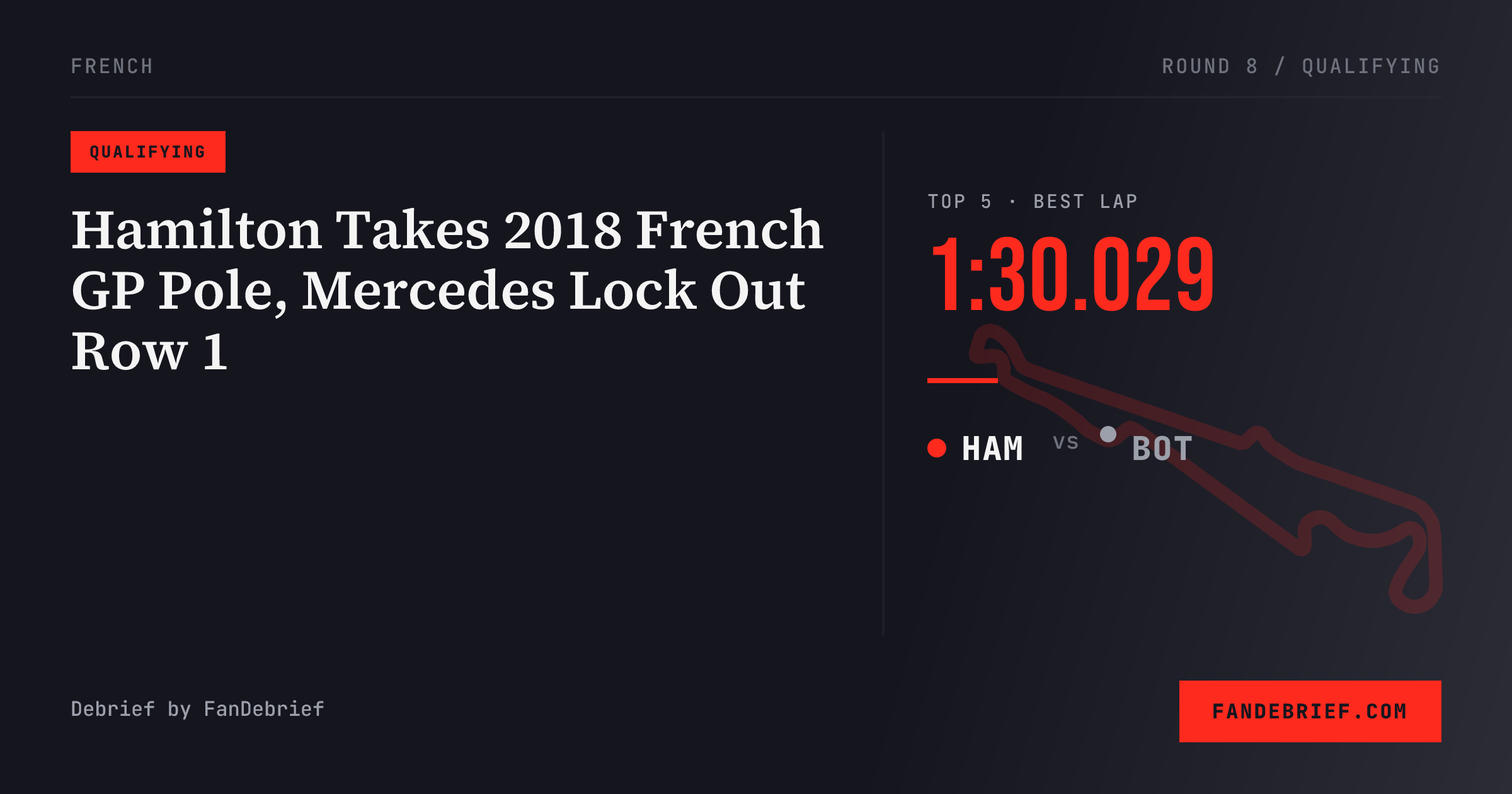
Formula 1 came back to Paul Ricard for the first time in 28 years, and it was Lewis Hamilton who put his name on top of the timesheet first. His lap of 1:30.029 was enough for pole, but only just: Valtteri Bottas, sharing the same garage and the same car, was a mere tenth of a second behind. That gap is the kind of number that means everything and nothing at once, and it's worth asking what it actually tells us about this session.
The answer isn't really about Hamilton versus Bottas at all. It's about where the rest of the field sat relative to them. Six cars, three teams, covered by barely a second. Then a cliff.
Mercedes arrived having wobbled through the previous two rounds, and the front row lockout was the clearest possible answer to any doubts. Sebastian Vettel, the championship leader coming into the weekend, could only manage third, three tenths off Hamilton's pace. The two Red Bulls of Max Verstappen and Daniel Ricciardo filled four and five, with Kimi Raikkonen's Ferrari rounding out the top six just over a second down on pole. Conditions were dry all session, with track temperatures around 31 degrees and air a touch over 23, so nobody could blame the weather for what happened next: a jump of more than a second between Raikkonen in sixth and Carlos Sainz in seventh. That's the fault line on this grid. Six cars in one world, fourteen in another.
The session wasn't without its stoppage. A red flag paused proceedings during the fight for pole, though what mattered for the story is what happened once it went green again: Bottas went top, then Hamilton reclaimed it for good. No one else in that final flurry had anything left to change the picture.
Sector splits that explain the pole without explaining everything
Hamilton's advantage wasn't built in one place. He was fastest through the first sector on seven of the session's laps, with an average margin of under two-tenths, useful but not decisive on its own. It was the final sector where he really hurt people: fastest there five times, and by an average of over a second. Bottas, by contrast, owned the middle sector, quickest there five times by an average of over a third of a second, which is exactly why his own lap was close enough to make Hamilton sweat.
Charles Leclerc's session is the clearest illustration of how that Hamilton pace advantage actually worked. Leclerc's own best lap was over a second slower than Hamilton's just in the final sector alone. But his total deficit to pole was two and a half seconds, meaning he was also losing time in the first two sectors that had nothing to do with that one weak point. Hamilton's lap wasn't a sector-three trick. It was quick everywhere, and that's a harder thing for a midfield car to answer.
The tyre strategies tell their own version of the same story. Ferrari ran both cars on ultrasofts for the entire session, unwilling or unable to gain anything from the supersoft. Mercedes and Red Bull went the other way, dipping onto supersofts through the middle segment before switching back to the purple-walled tyre for the runs that mattered. It's a small strategic wrinkle, but it's the kind of decision that shows Mercedes treating qualifying almost as a rehearsal for Sunday's tyre allocation as much as a hunt for pole.
The data behind qualifying
Timing and telemetry from every car on track.


Leclerc's Saturday and the fight for best of the rest
If there was one story outside the top six worth talking about, it belonged to Charles Leclerc. Reaching Q3 for the first time in his career, the Sauber rookie called the result nothing short of a miracle given how his weekend had started. He beat Kevin Magnussen's Haas by three tenths and, more strikingly, out-qualified his own teammate Marcus Ericsson by three quarters of a second, a gap that says as much about where Leclerc's confidence was building as it does about anything mechanical.
Sainz's Renault took the best-of-the-rest spot outright in seventh, just over two seconds off pole, ahead of Leclerc, Magnussen and the group that filled out the Q2 eliminations: Esteban Ocon, Nico Hulkenberg, Sergio Perez, Pierre Gasly and Ericsson, all bunched within roughly three quarters of a second of each other. That kind of midfield congestion usually promises a scrappy Sunday, and there's no reason to expect otherwise here.
At the other end of the speed trap, oddly, it was Perez's Force India that clocked the fastest reading of the entire session, quicker even than the cars that locked out the front three rows. It's a reminder that a strong straight-line number means nothing if the rest of the lap can't back it up; Perez qualified 13th. McLaren's Fernando Alonso and Stoffel Vandoorne never escaped Q1, and neither did either Williams, with Sergey Sirotkin and Lance Stroll rounding out the back two rows.
What Saturday leaves for Sunday is a grid with an obvious front-of-house fight between two Mercedes separated by less than the width of a blink, a Ferrari that looked comfortably but not devastatingly beaten, and a pack from seventh backwards that's going to spend the first laps sorting itself out the hard way. Hamilton has the pole; whether that tenth over Bottas survives turn one is the first question of the race weekend, and how much of Mercedes' supersoft homework from Saturday pays off will be the second.